
AI Automated Translation.

Font Size

Share

"If the Federal Reserve raises rates, the Bank of Korea must raise them even higher": Domestic bond market also hit by interest rate shock

"If the Federal Reserve raises rates, the Bank of Korea must raise them even higher": Domestic bond market also hit by interest rate shock

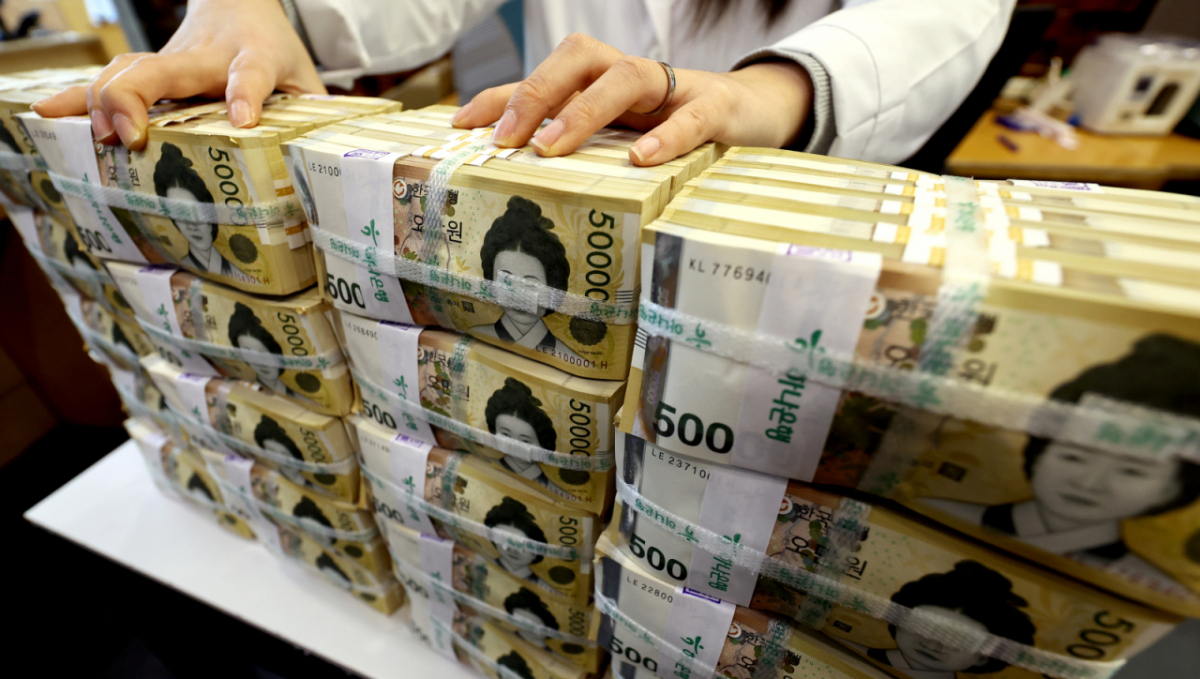
(Seoul=NEWS1) Reporter Gu Yun-seong = While the real value of the won rebounded for the first time in seven months last month, an official sorted through 50,000-won banknotes at Hana Bank's Counterfeit Response Center in Jung-gu, Seoul, on the morning of the 24th. According to analysis by the Bank of Korea and the Bank for International Settlements (BIS) on that day, South Korea's real effective exchange rate index, which reflects trade structures and price differences across countries, was recorded at 86.86 as of January this year (with the 2000 level set at 100). 2026.2.24/NEWS1 Copyright © NEWS1. All rights reserved. No unauthorized reproduction or redistribution, nor use for AI learning is permitted. /Photo=NEWS1) Reporter Gu Yun-seong

As global government bond yields rose in tandem amid uncertainty over U.S.-origin interest rates, the domestic bond market also suffered a sharp spike in yields. The 30-year Treasury bond yield surged by its largest amount in three months—10bp (1bp=0.01 percentage points)—on the first trading day of this month (the 1st), followed by further gains on the following day, the 2nd. As pressure from rising global rates spread to corporate bonds, the burden on companies' financing costs is expected to grow.

According to the Korea Financial Investment Association, the 30th-year Treasury bond closed at a final bid yield (interest rate) of 4.657% annually on that day, up 3.0bp from the previous day. The day before, it had surged by 10.0bp in a single day to 4.627%, marking its largest increase since June 1st. The 30-year bond yield had reached as high as 4.751% on the 18th of last month, setting a record high at that time. Compared to the year-end level of 3.258% last year, the 30th-year Treasury bond yield has jumped by 139.9bp in just over eight months.

The 10-year Treasury bond closed the day up 4.7bp at 4.418%, marking a rise of 103.3bp since the beginning of the year. Over the same period, the 3rd-year bond also rose by 5.2bp to 3.930%, climbing 97.7bp. Both the 3rd-year and 10-year bonds are at levels not seen in 2024 or last year. The 3-year AA- corporate bond yield rose 5.1bp on that day to 4.600%, up 112.4bp since the start of the year. The BBB- 3-year corporate bond also rose 5.0bp to 10.406%, climbing 109.4bp.
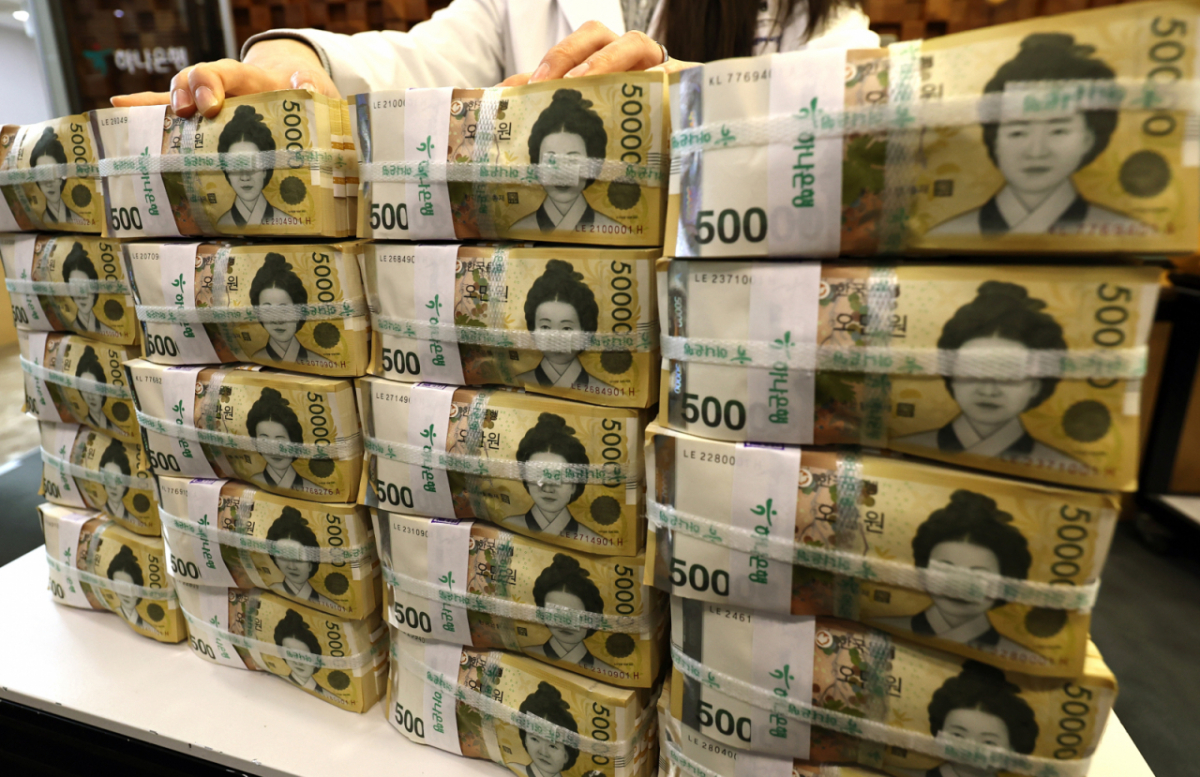
(Seoul=NEWS1) Reporter Gu Yun-seong = While the real value of the won rebounded for the first time in seven months last month, an official sorted through 50,000-won banknotes at Hana Bank's Counterfeit Response Center in Jung-gu, Seoul, on the morning of the 24th. According to analysis by the Bank of Korea and the Bank for International Settlements (BIS) on that day, South Korea's real effective exchange rate index, which reflects trade structures and price differences across countries, was recorded at 86.86 as of January this year (with the 2000 level set at 100). 2026.2.24/NEWS1 Copyright © NEWS1. All rights reserved. No unauthorized reproduction or redistribution, nor use for AI learning is permitted. /Photo=NEWS1) Reporter Gu Yun-seong

As long-term government bond yields rose together in major countries including the United States, Japan, the United Kingdom, and Germany, upward pressure was also applied to domestic long-term bonds. Domestically, supply-demand pressures regarding bids for 30-year Treasury bonds and concerns over next year's Treasury issuance volume are cited as factors pushing up yields. Whether the Federal Reserve System (Federal Reserve) will raise rates at this month's FOMC (Federal Open Market Committee) meeting is being highlighted as a key variable.

Although the Bank of Korea's consecutive base rate hikes in July and August have led to an assessment that concerns over domestic monetary policy have eased, Kevin Warsh, Chair of the Federal Reserve, made more hawkish (tightening-oriented) remarks on inflation than expected at last week's Jackson Hole Symposium, heightening fears of U.S.-origin interest rate increases. Some view that the escalation of the U.S.-Iran conflict has provided the Federal Reserve with grounds to raise benchmark rates out of concern over rising prices.
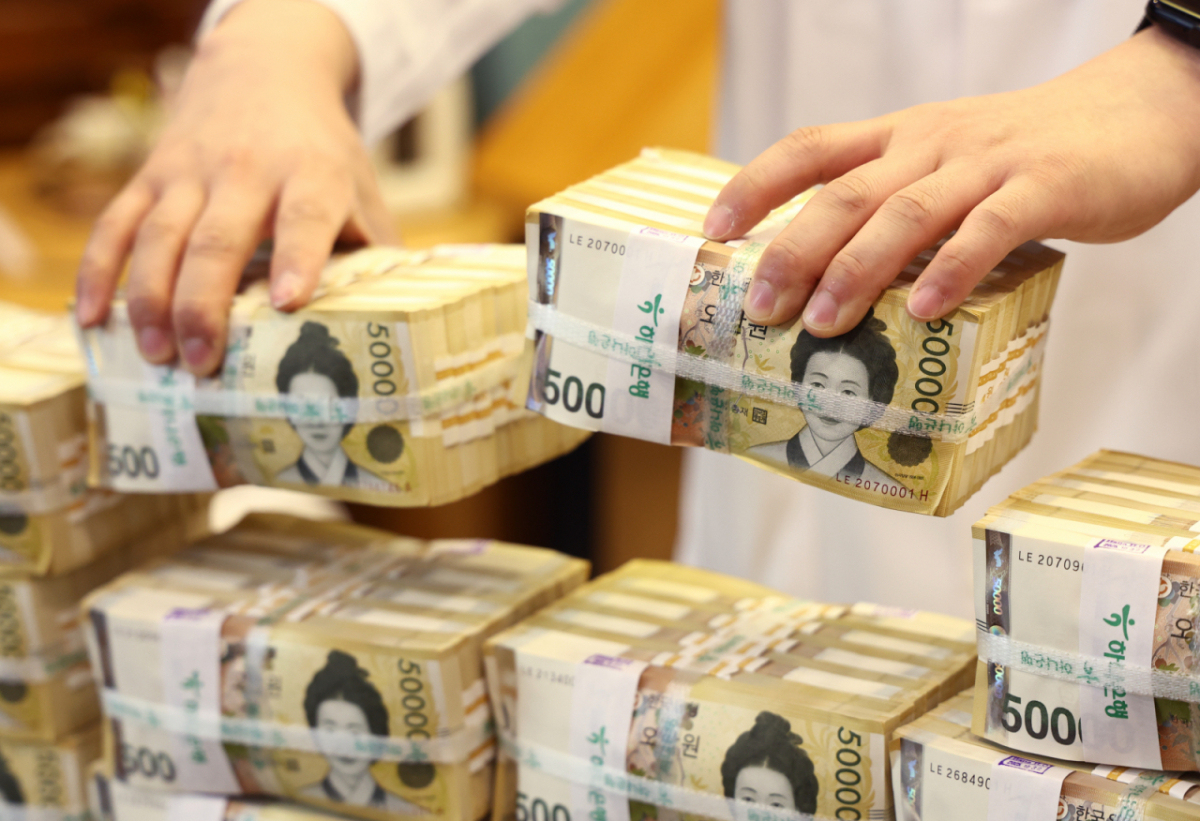
(Seoul=NEWS1) Reporter Choi Ji-hwan = An employee sorted through 50,000-won banknotes at Hana Bank's Counterfeit Center in Jung-gu, Seoul, on the 5th. According to the Bank of Korea's Economic Statistics System, as of the end of 2025, the currency issuance balance stood at 210 trillion 695.6 billion won, a 9.1% increase compared to the end of 2024. This growth rate is the highest since the COVID-19 outbreak. 2026.2.5/NEWS1 Copyright © NEWS1. All rights reserved. No unauthorized reproduction or redistribution, nor use for AI learning is permitted. /Photo=NEWS1) Reporter Choi Ji-hwan

As a result, forecasts suggest that Treasury bond yields are unlikely to fall dramatically. Ahn Ye-ha, a researcher at Kiwoom Securities, stated, "Although the Bank of Korea has secured time for further rate hikes after consecutive increases in July and August, external monetary policy uncertainty has resurfaced due to highlighted possibilities of a September rate hike by the Federal Reserve." He added, "If the Federal Reserve begins raising rates, the Bank of Korea may also expand its rate hike magnitude, so we need to examine minority opinions at the September FOMC meeting and changes in the dot plot."

Kim Ji-man, a researcher at Samsung Securities, also forecasted, "While we judge that concerns over domestic monetary policy have eased somewhat, there are no clear positive factors, and foreign government bond yields continue to pose a burden, so conditions for a significant drop in domestic Treasury bond yields are not present."

When market interest rates rise, not only the government issuing new bonds but also companies raising funds through corporate bonds will face higher interest burdens. If the global trend of rising interest rates continues, both the government and companies facing Treasury issuance expansion and corporate bond refinancing are likely to have to accept higher rates.

An executive at an investment bank (IB) stated, "AA-rated corporate bond yields have risen by as much as 100bp since the beginning of the year, reducing companies' capacity to issue corporate bonds, while institutional investors also find it difficult to actively absorb issuance volumes due to falling bond prices."

"This article was translated using AI and may differ slightly from the original."