

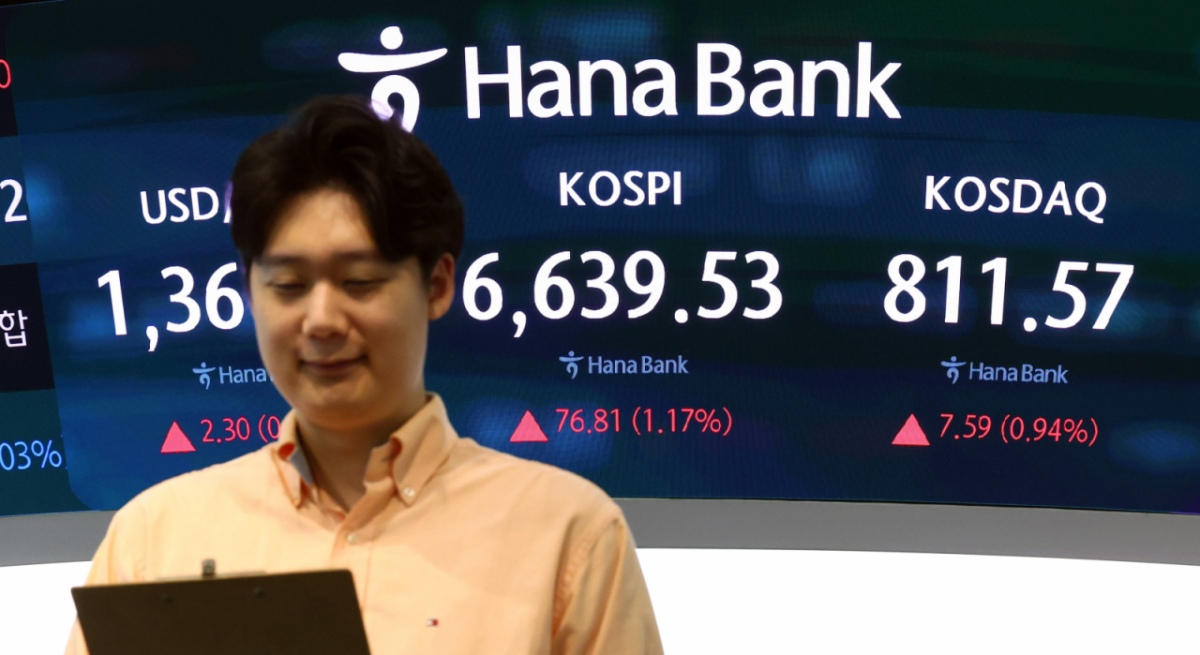
The KOSPI opened higher on the 3rd and recovered the 6,600 level. A rebound in U.S. stocks after easing overnight fears of rising market interest rates acted as a tailwind for domestic markets.
At 9:10 a.m. that day, the KOSPI index was calculated at 6,608.37, up 45.65 points (0.70%) from the previous trading day. Through Korea Exchange and Next Trading, individual investors net-purchased 173.3 billion won worth of stocks, other corporations net-purchased 50.2 billion won, while foreign investors net-sold 159 billion won and institutional investors net-sold 68.2 billion won.
Samsung Electronics traded up 3,000 won (1.20%) to 253,500 won on the Korea Exchange, and SK Hynix traded up 24,000 won (1.49%) to 1.637 million won.
Among other top market capitalization stocks, Samsung C&T and KB Financial Group showed strength in the 2nd% range, while Samsung Life Insurance and SK Square posted gains in the 1st% range. Samsung Electro-Mechanics and Hyundai Motor were mostly flat. Samsung Biologics remained in flat territory.
By sector, KOSPI retail, insurance, electrical & electronics, and entertainment & culture sectors rose strongly by around 1%. Manufacturing, financials, electricity & gas, transportation & warehousing, general services, medical precision, machinery & equipment, and real estate were mostly flat.
Conversely, telecommunications, textiles & apparel, and securities sectors declined by around 1%. Paper & wood, construction, chemicals, non-ferrous metals, transport equipment, IT services, food & beverage & tobacco, metals, and pharmaceuticals were mostly flat.
At 6 a.m., KOSPI 200 night futures closed up 1.40%.
On the 2nd (local time), the U.S. Dow Jones Industrial Average rose 0.56% from the previous day, the S&P 500 index gained 0.46%, and the NASDAQ Composite Index increased by 0.45%. The Philadelphia Semiconductor Index rose 0.45%.
The easing of rising U.S. Treasury yields was identified as the backdrop for the stock market rebound. The 10-year U.S. Treasury yield briefly surged to 4.818% during trading, reaching its highest level since November 2023, but gave back gains and closed at 4.793%.
U.S. ADP (Automatic Data Processing) private employment data that came in below market expectations and remarks by John Williams, president of the Federal Reserve Bank of New York, helped ease fears of base rate hikes. In a CNBC interview, President Williams stated, "There is evidence that inflation is easing," and added, "Rising energy prices are not spreading to other service prices."
Broadcom, which released earnings after the market close, showed both revenue and earnings per share (EPS) exceeding market expectations. However, its after-hours stock price declined.
Kiwoom Securities researcher Han Ji-young said, "We should pay close attention to Broadcom's annual consensus estimates for AI (artificial intelligence) semiconductor sales," adding, "This is expected to lead to improved earnings strength across the broader market, including leading AI and semiconductor stocks."
Regarding the domestic market, she noted, "Despite major positive announcements from core sectors, sell-on phenomena continue to repeat. It is difficult to attribute this to individual company fundamentals; rather, it appears that new buying support has temporarily weakened, excluding share buybacks by Samsung Electronics and SK Hynix amid short-term macroeconomic uncertainty."
At this time, the KOSDAQ index stood at 803.17, down 0.81 points (0.10%) from the previous day. Individual investors net-purchased 117.7 billion won worth of stocks, while foreign investors net-sold 101 billion won and institutional investors net-sold 10.1 billion won.
Among top market capitalization stocks, Iotechnic rose in the 2nd% range, while Reno Industrial and Rainbow Robotics posted gains in the 1st% range. EcoPro, HLB, AlteoGen, and Juseong Engineering fluctuated around flat territory. In contrast, Simtek declined by around 1%, while EcoPro BM and Wonik IPS were mostly flat.
By sector, KOSDAQ entertainment & culture and metals sectors rose strongly by around 1%. Retail, machinery & equipment, chemicals, general services, transportation & warehousing, medical precision, manufacturing, and pharmaceuticals were mostly flat. Conversely, printing & publishing, paper & wood, construction, textiles & apparel, telecommunications, IT services, electrical & electronics, transport equipment, food & beverage & tobacco, and other manufacturing sectors were mostly flat. Financials fluctuated around flat territory.
The won-dollar exchange rate was recorded at 1,360.5 won, up 1.3 won from the previous day at 9 a.m. in Seoul's foreign exchange market.

 in STOCK
