

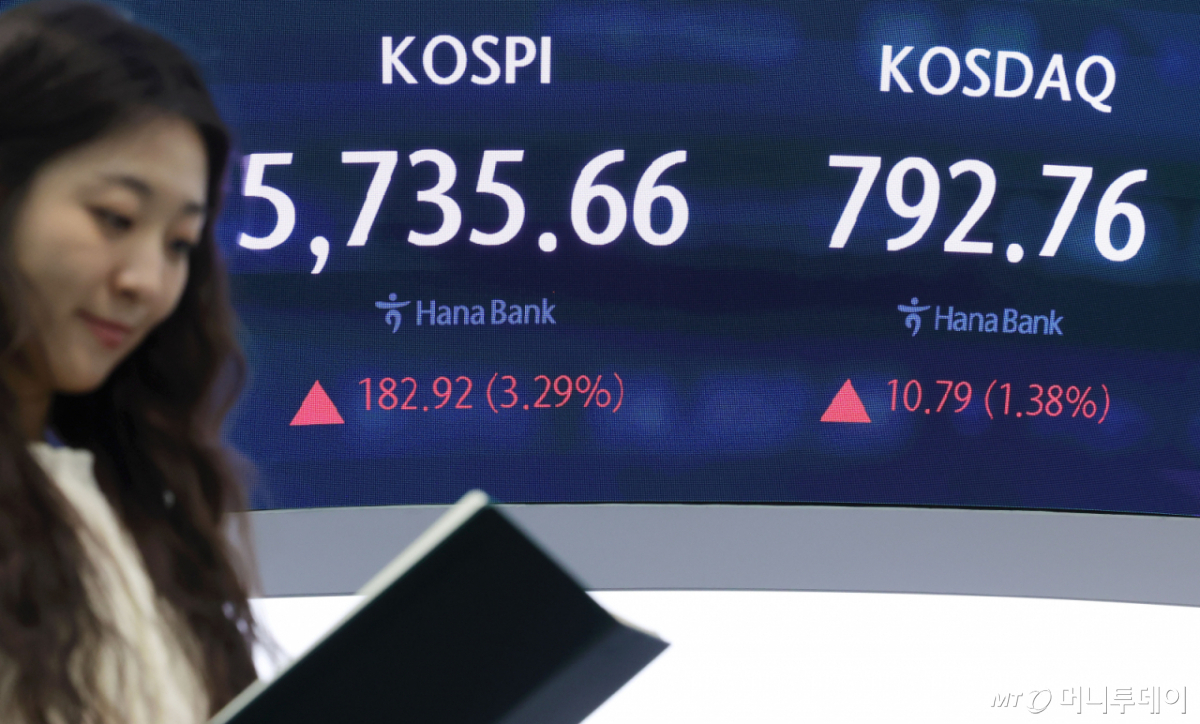
Foreign investors made net purchases exceeding 900 billion won, driving a significant rise in the KOSPI on the 21st. Foreigners, who had been net sellers for nine consecutive weeks, shifted to net buying this week. The selling pressure on major semiconductor stocks is also easing, as foreign investors have made net purchases of Samsung Electronics for four consecutive trading days.
On the 21st, foreign investors made net purchases worth 949.2 billion won in the KOSPI market (combined Korea Exchange and Nexttrade). Prior to this, foreigners had continued large-scale net selling for nine consecutive weeks. Including net sales of 1.33 trillion won last week, the total scale of net selling over the nine-week period reached 5.23 trillion won.
The selling was concentrated on the semiconductor big two, Samsung Electronics and SK Hynix. During this period, foreign investors made net sales of Samsung Electronics worth 3.76227 trillion won and SK Hynix worth 1.482 trillion won. The combined total for the two stocks was 5.24427 trillion won, exceeding the overall KOSPI net selling scale for the same period. Researcher Noh Dong-gil of Shinhan Investment Corp stated, “Foreign selling has been a form of reducing semiconductor exposure rather than exiting the Korean market as a whole,” adding, “A signal of supply-demand reversal is likely to emerge from global memory valuation.”
Recently, the selling pressure on these two stocks has also slowed. Foreign investors made net purchases of Samsung Electronics for four consecutive trading days, buying approximately 735 billion won worth during this period. The foreign ownership ratio of Samsung Electronics, which had fallen to 45.98% due to recent concentrated selling, rose to 46.08%. On the day, foreign investors made net purchases of SK Hynix worth 157.6 billion won.
Considering that the domestic stock market has shown unstable trends due to supply-demand imbalances, the slowdown in foreign selling is assessed as a potential clue for a rebound. Retail investor funds that flowed in at KOSPI levels above 7,000 could act as a supply burden each time the index rises. Share buybacks, which had absorbed foreign selling volumes, are also in their final stages.
With pension funds lacking buying capacity due to delayed rebalancing, making their support difficult to expect, it is explained that the shift in foreign trading is inevitably the key to an index rebound. Researcher Kim Du-eon of Hana Securities stated, “Foreigners have been net sellers for nine consecutive weeks, and it must be confirmed whether their recent return leads to a trend reversal.”
It is forecast that if concerns about AI (artificial intelligence) growth and profitability decrease in the big tech earnings reports starting with Meta on the 21st (local time), investor sentiment toward domestic semiconductor stocks could also recover. Researcher Han Dong-hee of SK Securities stated, “Through the big tech earnings reports in October and November, the growth potential of AI driven by the spread of agent AI and the still solid AI roadmap will be reconfirmed, and extreme concerns about the sustainability of capital investment will begin to ease.”

 in STOCK
