

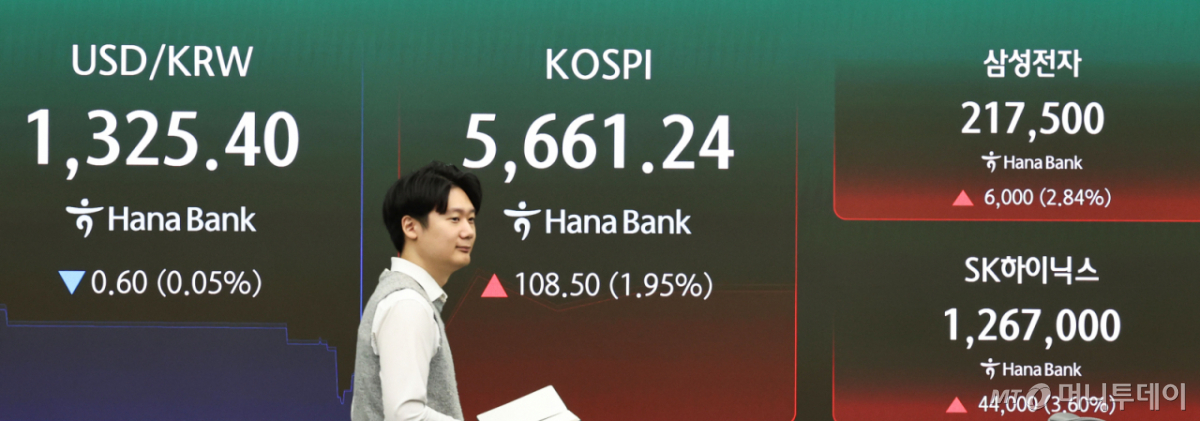
Japan's Nomura Securities set target prices of 670,000 won and 4.7 million won for Samsung Electronics and SK Hynix, respectively. Despite experiencing a sharp correction, the firm maintained the target prices it had established at the end of last June, when the KOSPI hit its all-time high.
Nomura said that concerns over a slowdown in AI growth have been excessively reflected, forecasting that semiconductor growth will continue through 2028.
According to the financial investment industry on Wednesday, in a report titled "AI Market Concerns and Memory Semiconductor Outlook" released on Monday, Nomura assessed that recent concerns over a slowdown in AI industry growth and funding issues for neocloud companies are excessive.
Nomura said, "The memory supply shortage driven by expanded investment in AI data centers will persist until at least 2028," adding, "We relatively prefer semiconductor suppliers within the AI value chain."
It further noted, "We maintain our buy recommendations and 12-month target prices of 670,000 won and 4.7 million won for Samsung Electronics and SK Hynix, respectively." These figures are 207.3% and 268.1% higher than the closing prices on the 20th.
Nomura first set its target price for Samsung Electronics at 670,000 won on June 24. At that time, Samsung Electronics' stock price was 340,500 won, recording an all-time high level. The KOSPI also stood at 8471.02, maintaining its peak level after hitting 9114.55 on June 22. SK Hynix's stock price was also 2.58 million won, approaching 3 million won.
Over the following three months, Samsung Electronics' stock price fell to 211,500 won, and SK Hynix dropped to 1.223 million won (closing price on the 20th). The KOSPI also declined to 5552.74.
Nomura forecast that memory supply will remain tight until at least 2028. It said, "The benefits of AI infrastructure investment are expected to concentrate on semiconductor companies," adding, "The combined net cash of nine major semiconductor companies increased from $27 billion in the first quarter of 2024 to $282 billion in the second quarter of 2026, and is projected to reach approximately $2 trillion by the end of 2028."
Nomura projected that the growth rate of new AI equipment capacity in 2027 will be 67%, while the growth rate of HBM (High Bandwidth Memory) bit shipments will be 50% to 60%.
It also forecast that in 2028, new AI equipment capacity will increase by 46% and HBM bit shipments by 40%. According to Nomura, global new data center capacity is expected to expand from 22.3 GW (gigawatts) this year to 31.5 GW in 2027.
Nomura emphasized that the profitability of the AI industry is better than market perception. It said, "In the second quarter, Amazon AWS's operating profit margin was approximately 39%, Microsoft's Intelligent Cloud was 41%, and Google's GCP was 36%," adding, "Cash shortages among AI developers and neocloud companies do not imply a lack of profitability across the entire AI industry." The firm also estimated that the combined revenue of OpenAI and Anthropic in the third quarter increased by approximately 507% year-on-year.
The brokerage added, "The recent slowdown in growth rates was influenced by differences in revenue accounting methods, customers' transition to their own AI tools, and seasonal demand declines due to summer vacation periods."
Nomura viewed the possibility of CoreWeave's debt issues spreading into a crisis across the entire AI market as low. The firm stated, "CoreWeave's debt stood at $35.1 billion as of the end of last June," pointing out that this is only about 1.7% of the $2.12 trillion global data center investment for 2026 estimated by Nomura. It added, "Even if individual companies face financial difficulties, GPU (Graphics Processing Unit) and data center assets can be acquired and utilized by other operators."
Nomura also assessed concerns over technological catch-up by Chinese memory manufacturers as excessive. Although observations have been raised that recent progress in the 4F² technology development by China's CXMT (ChangXin Memory Technologies) could negatively impact the competitiveness of Korean semiconductor companies, Nomura noted that the market has excessively reflected these concerns.

 in STOCK
