

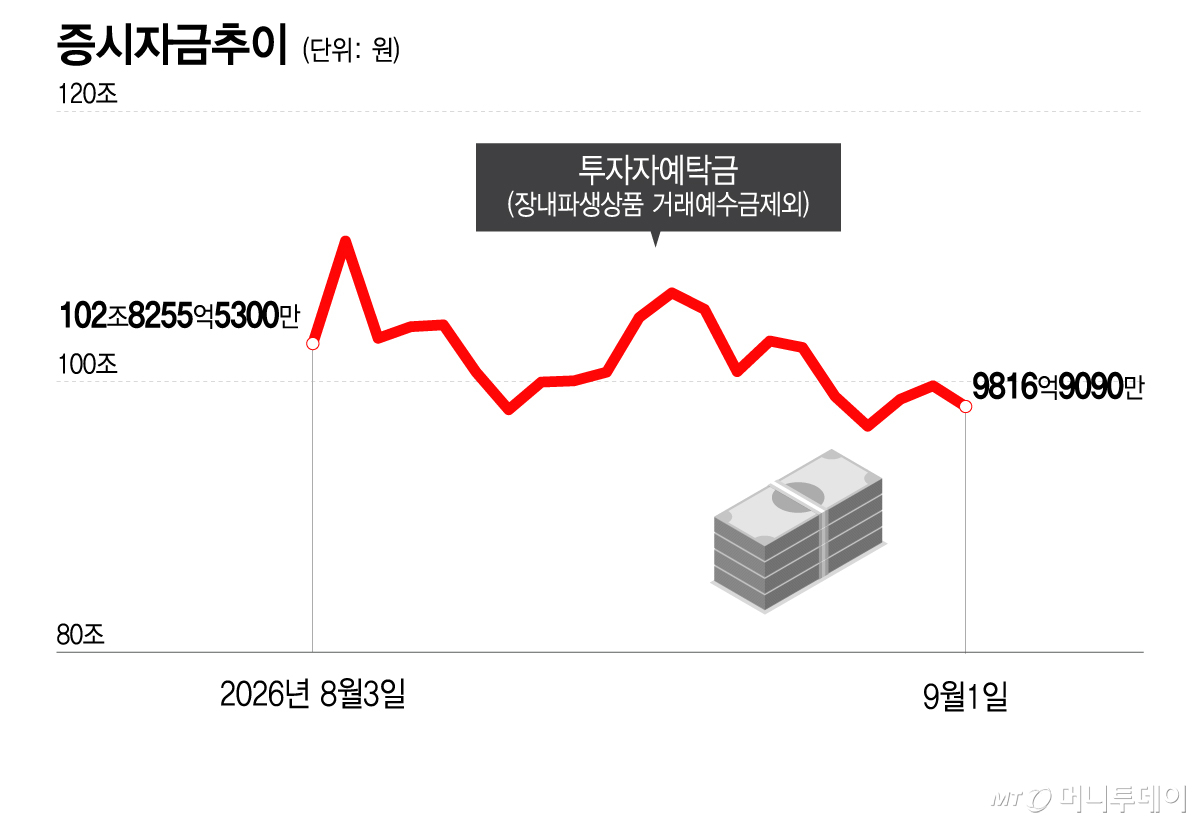
Although volatility has subsided since the frenzy over single-stock leveraged ETFs (exchange-traded funds) swept through in August, the daily average trading volume and value of Korea's domestic stock market fell to their lowest levels of the year in August. There are also signs that investment sentiment, previously concentrated on semiconductors and related products, is shifting back toward the U.S. market rather than remaining domestically.
According to data from the Korea Exchange (KRX) as of the 3rd, the daily average trading volume in August stood at 323.92 million shares, marking the lowest figure of the year. The daily average trading value during the same period was 25.846 trillion won, also the lowest of the year.
This contrasts with June, when a frenzy over single-stock leveraged ETFs drove the daily average trading volume to 490.01 million shares and trading value to 50.3471 trillion won. While some argue this decline is a natural outcome of sharply reduced turnover in single-stock leveraged ETFs and fewer trades focused on semiconductor stocks, comparisons with February and March—when the daily average trading volume at the stock exchange exceeded 1 billion shares—suggest that investor interest in the domestic market has cooled significantly compared to the beginning of the year.
Domestic investor deposits (hereinafter referred to as "deposits") also surpassed 130 trillion won in June, reaching a record high. However, since late July, they have dropped sharply into the 100th trillion won range. From the 26th through the 1st, deposits remained below 100 trillion won for five consecutive trading days. These deposits represent funds transferred by investors to brokerage accounts for stock trading or left idle after selling stocks, and are considered a key indicator of market sentiment.
Industry experts note that some investors, disappointed by volatility in the domestic market, are showing renewed interest in the U.S. market. Data from the Korea Depository & Clearing Institute (KSD) shows that while the proportion of U.S. securities held by Korean investors relative to foreign currency-denominated securities fell from 95.43% in June to 94.81% in July, it rose again to 95.63% in August—the highest level for the year.
Changes in preference for ETF-tracking sectors are also evident. Inflows of new funds into overseas stock-type ETFs have surged significantly. According to FNGuide, as of the 2nd, domestic stock-type ETFs saw net asset growth of only 145.3 billion won over the past month, whereas overseas stock-type ETFs recorded a net asset increase of 3.834 trillion won during the same period.
Interestingly, despite domestic stock-type ETFs posting a return of 5.60% over the same period compared to just 0.37% for overseas stock-type ETFs, funds flowed more heavily into overseas ETFs while only slightly increasing in domestic ones.
Although the U.S. market has experienced repeated fluctuations due to domestic and international risks, signs of shifting investor sentiment have emerged as the S&P 500 reached a record high of 7,816.70 on the 13th, and the NASDAQ began recovering after its sharp decline in late July.
Kim Sung-hwan, a researcher at Shinhan Investment Corp., stated, "The S&P 500 hit new highs even in August when numerous negative factors emerged. Considering all conditions, this rally is likely to remain robust through next year." He added, "Volatility has clearly entered a stabilization phase since mid-August."
Exchange rates also present favorable conditions for new retail investors investing in overseas stocks. As the won-dollar exchange rate fell from the mid-1,500 won range earlier this year to the mid-1,300 won range recently, the cost of purchasing dollars has decreased, potentially reducing investment costs in won for new or returning investors entering the U.S. market.
An industry official remarked, "Investors who already hold U.S. stocks may not welcome a stronger won, as it reduces the value of their holdings. However, for those looking to re-enter the market, this exchange rate environment is advantageous." The official added, "It is difficult to ignore the fact that volatility in Korea's stock market has increased investor fatigue."

 in STOCK
