

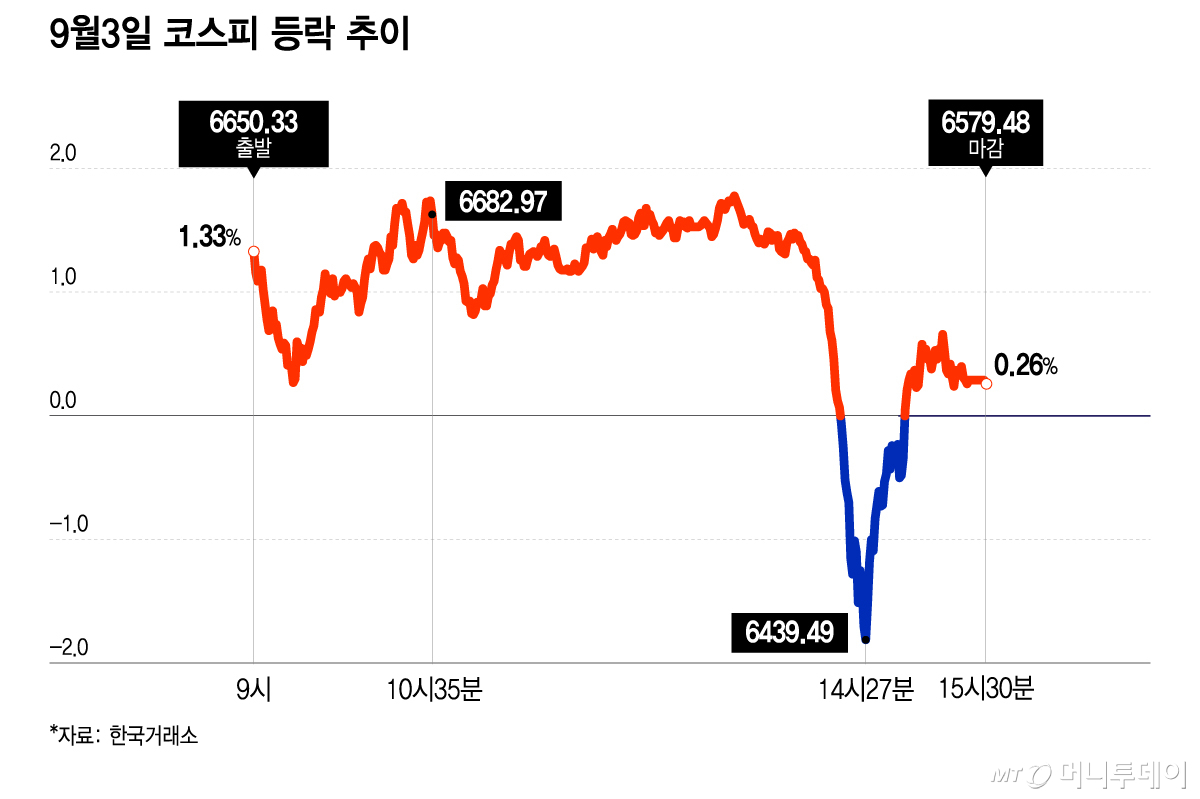
The KOSPI index surrendered its three-day gains and hovered near the 6,600 mark. Unresolved U.S.-origin interest rate concerns once again dampened market sentiment. As trading volumes dried up and the stock market wavered, experts advised caution regarding volatility management.
On this day, the KOSPI index closed at 6,579.48, up 16.76 points (0.26%) from the previous trading session. The intraday high-low spread was 243.48 points.
Combining Korea Exchange and NextTrade, retail investors sold net 1.1597 trillion won worth of shares, institutional investors sold net 241.8 billion won, and foreign investors sold net 209.4 billion won, continuing a wave of selling.
Downward pressure was offset by other corporations that bought net 1.6093 trillion won worth of shares. This account reflects share repurchase activities by Samsung Electronics and SK Hynix in the open market.
The index maintained strong momentum above 1% until 2 p.m., then suddenly plummeted, sliding to 6,439.39—a drop of 123.33 points (1.88%) from the previous close—in just 27 minutes before recovering some losses.
The sharp decline coincided with increased selling by institutional investors such as pension funds and financial investment firms, though experts offered divergent analyses on the underlying reasons for their selling.
Lee Jae-won, a researcher at Yuanta Securities, stated, "While we see a simultaneous reduction in foreign futures net purchases and profit-taking by financial investors—suggesting that weekly option expiration amplified the decline—the presence of pension fund selling means it is more appropriate to interpret this as a factor increasing intraday volatility rather than attributing the entire drop solely to expiration effects."
Lee Kyung-min, a researcher at Daishin Securities, noted, "No clear negative news has been confirmed. Volatility expanded significantly due to shifts in supply and demand, and beyond fundamentals, short-term supply dynamics and investor sentiment have gained greater influence on the index's direction."
Among major stocks, while semiconductor shares saw intraday fluctuations contained within ±2%, beneficiaries of rising interest rates widened their gains. Samsung Electronics closed down 500 won (0.20%) at 250,000 won, and SK Hynix closed down 17,000 won (1.05%) at 1,596,000 won, whereas KB Financial Group rose 8,800 won (5.20%) to close at 177,900 won.
Among the remaining top market capitalization stocks, LG Energy Solution advanced over 5%, Samsung Life Insurance rose over 3%, and Hyundai Motor gained over 1%. In contrast, Samsung Electro-Mechanics declined over 3%, Samsung Biologics fell over 1%, while Samsung C&T and SK Square closed with modest gains.
By sector, KOSPI insurance stocks surged over 4%, construction and gas/electricity rose over 3%, transportation equipment, warehousing, machinery, and metals gained over 2%, and financials, general services, and non-ferrous metals advanced over 1%. Textiles/apparel, telecommunications, medical precision, and IT services closed with declines of around 1%.
The U.S. initial jobless claims, which will offer clues on the direction of the base rate, are scheduled for release in Korean time tonight, while non-farm employment data will be announced late on the 4th. With earnings announcements from major domestic and foreign companies concluding, market attention now focuses on inflation variables ahead of the September Federal Open Market Committee (FOMC) meeting.
Im Jeong-eun and Tae Yun-seon, researchers at KB Securities, stated, "Given the continued pressure from supply-demand imbalances and interest rates, there is a need to remain cautious about the possibility of expanded stock market volatility due to geopolitical risks."
The KOSDAQ index closed down 13.77 points (1.71%) at 790.21. Retail investors bought net 340.3 billion won worth of shares, while institutional investors sold net 197.4 billion won and foreign investors sold net 132 billion won.
Among top market capitalization stocks, IOTech showed gains over 3%, whereas Altogen declined over 5%, Simtek and Wonik IPS fell over 4%, Juseong Engineering dropped over 3%, and HLB slipped over 1%.
On this day, the won/dollar exchange rate closed at 1,359.3 won, down 9.4 won from the previous session, concluding Seoul's foreign exchange market weekly trading.

 in STOCK
