

Some of the strong sanctions imposed by financial authorities on chief executive officers (CEOs) of financial companies for their responsibility in financial accidents were rendered ineffective after years of legal battles. Although the stated justification was to hold parties strictly accountable for large-scale investor losses, cases continued where the legal reasoning applied by financial authorities was not accepted by courts.
While sanctions immediately impact business activities and employment in the financial sector, correcting erroneous decisions takes years. There are calls for financial authorities, which wield strong regulatory powers, to bear corresponding responsibility alongside their "strict punishment administration."
Severe disciplinary actions against CEOs repeatedly cancelled by courts
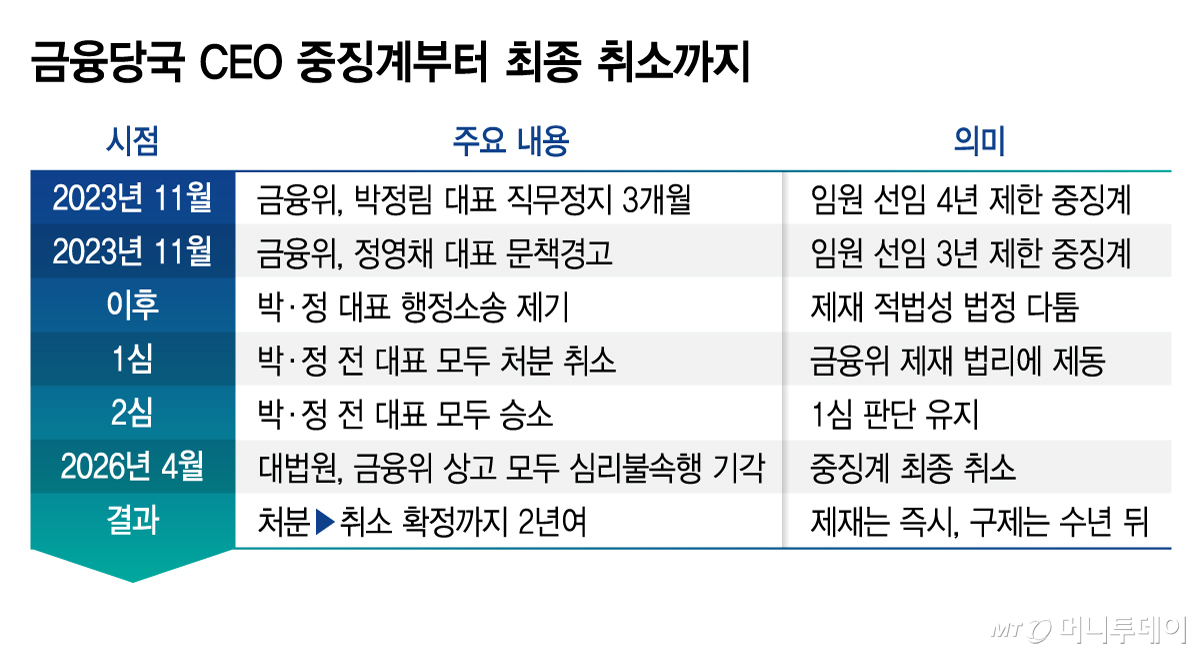
A representative case is the Lim & Optimus incident. In November 2023, the Financial Services Commission imposed a three-month suspension of duties on former KB Securities CEO Park Jung-rim regarding the Lim Fund incident and issued a reprimand warning to former NH Investment & Securities CEO Jeong Young-chae concerning the Optimus incident. These were severe disciplinary actions for violating obligations to establish internal control standards.
Financial authorities determined that in the private fund incidents causing large-scale investor losses, internal controls at sales financial companies failed to function properly and management bore responsibility. A reprimand warning or higher constitutes a severe sanction restricting future appointment of executives at financial companies.
However, the court's judgment differed. Both Park Jeon (CEO) and Jeong Jeon (CEO) won both first and second-instance administrative lawsuits against the Financial Services Commission. The FSC appealed to the Supreme Court, but in April, both cases were dismissed for lack of proceedings. Both severe disciplinary actions were cancelled at first and second instances, and when the Supreme Court rejected the FSC's appeal, they were ultimately cancelled. Park Jeon (CEO)'s case was finalized by the Supreme Court on April 9, and Jeong Jeon (CEO)'s case on April 2.
Notably, in the first instance of Park Jeon (CEO)'s case, the trial court ruled that penalizing the failure to establish more effective internal control standards was merely "retrospective punishment based on post-hoc evaluation." The ruling emphasized that the obligation to establish internal control standards should not be expansively interpreted to the detriment of those subject to sanctions.
This is not the first time courts have halted financial authorities' sanctions for internal control responsibilities. Former Woori Financial Group Chairman Son Tae-seung sued over a reprimand warning related to the DLF (foreign currency-linked derivative fund) incident and ultimately won at the Supreme Court in 2022. The Supreme Court then ruled that under the existing legal framework, obligations to "establish" internal control standards must be distinguished from obligations to "comply" with them.
Sanctions immediate, remedies years later
Even when sanctions are cancelled, uncertainty already generated does not disappear. Park Jeon (CEO)'s suspension lasted four years, and Jeong Jeon (CEO)'s reprimand warning was a severe sanction restricting executive appointments at financial companies for three years. From the moment the sanction is imposed, it directly impacts the individual's business activities and future career decisions.
Conversely, correcting a sanction requires applying for suspension of execution and filing an administrative lawsuit. In Park Jeon (CEO)'s and Jeong Jeon (CEO)'s cases, it took over two years from the November 2023 sanctions to the Supreme Court's final ruling in April this year. Even in Park Jeon (CEO)'s suspension of execution case, the court noted that even if they won on the merits after maintaining the sanction, there was a risk of "irreparable damage."
In the financial investment industry, there are calls to distinguish between holding parties strictly accountable for financial accidents and expanding legal application after an accident to find responsible persons. As pressure grows to hold management accountable for major financial accidents, concerns arise that sanctions may take precedence over legal reasoning.
There are also warnings that unpredictable sanctions can make financial companies' decision-making more conservative. A financial industry official stated, "If the government urges financial companies to actively assume risks and expand productive finance while simultaneously increasing post-hoc sanction risks, financial companies may become passive in pursuing new businesses and investments."
Holding parties strictly accountable for financial accidents and enhancing the accountability of regulatory institutional investors' sanctions are not mutually exclusive. It is pointed out that the more powerful the regulatory authority, the more it needs "accountable administration" that rigorously follows legal reasoning and scope of responsibility from the sanction stage, rather than simply imposing severe disciplinary actions first.

 in STOCK
