

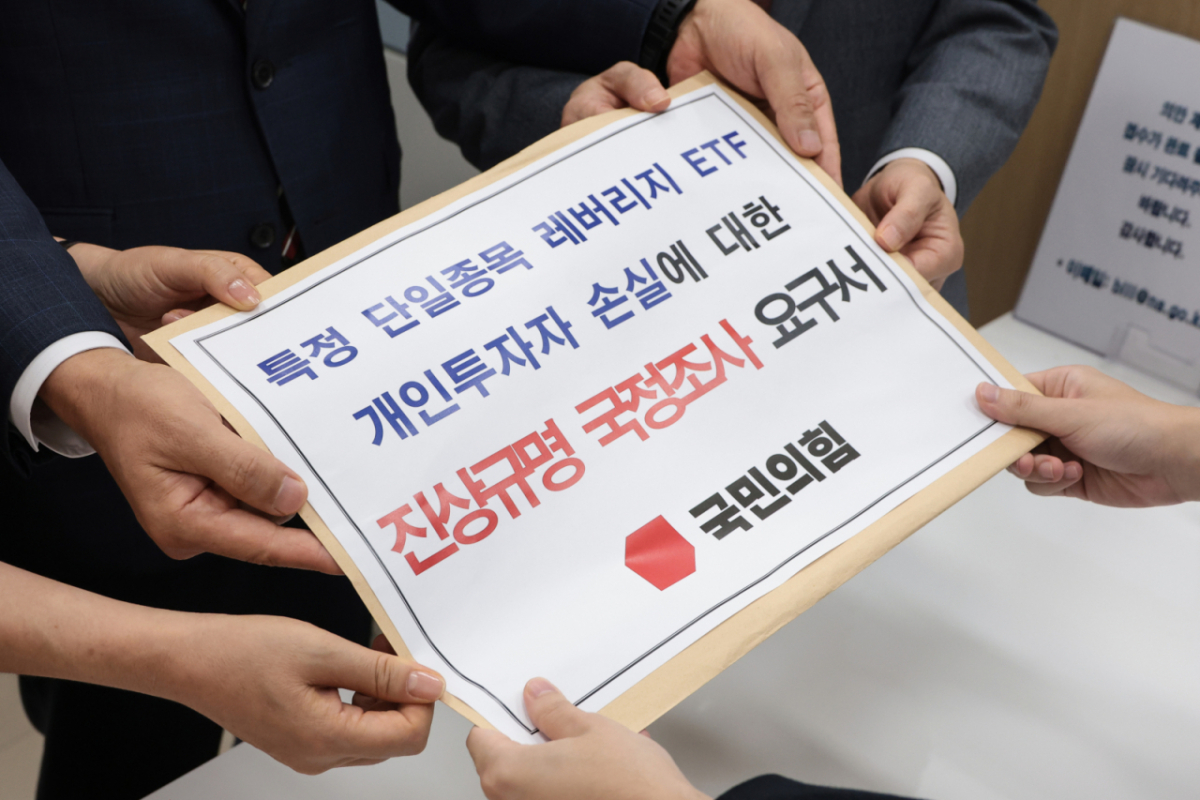
As single-stock leverage ETFs (exchange-traded funds) are expected to become a major focus of next month’s National Assembly audit, calls for government accountability are likely to intensify. The opposition has announced plans to push for a national investigation and the appointment of a special prosecutor, while also raising the possibility of summoning former Cheong Wa Dae Jeong Chaek (Head) Kim Yong-beom as a witness at the audit. With the National Assembly’s question session on government policy (economic sector) scheduled for the 11th, the debate over responsibility for single-stock leverage ETFs is expected to escalate further.
According to reports from the National Assembly and others on the 7th, the National Assembly Legislative Research Service recently identified the introduction of single-stock leverage ETFs as a key issue in this year’s National Assembly audit in its report titled "2026 National Audit Issue Analysis: Questions the Government Must Answer This Year." While the government stated that the ETFs were introduced to ensure global competitiveness, enhance investment incentives in the domestic capital market, and reduce outflows of funds, the report noted that as volatility in the domestic stock market has increased, questions have been raised about whether the policy is contributing to its intended goals and whether investor protection measures are functioning effectively.
The report added that within two months after the listing of single-stock leverage ETFs, the KOSPI’s market stabilization mechanism, the sidecar (futures market circuit breaker), was triggered 23 times, while the standard circuit breaker was activated five times. Additionally, VKOSPI, Korea’s version of the VIX (Fear Index), reached an intraday high of 97.99 on June 29.
The National Assembly Legislative Research Service explained in its report that "it is necessary to objectively verify the policy effects to determine whether existing overseas investment demand has actually shifted to the domestic market, or whether new leverage investment demand has been formed domestically while overseas investment demand remains unchanged."
Regarding investor protection measures, the report stated, "The only newly added core measure is an intensive one-hour pre-education program focused on explaining product structures and inherent risks." It further questioned, "Whether such information-centric measures were sufficient to assess investors’ actual risk perception and experience and prevent excessive investment remains doubtful."
Therefore, the National Assembly Legislative Research Service suggested that during next month’s audit starting on the 6th, questions should be raised regarding what data and scenarios the government used to pre-analyze and evaluate market impacts from the policy introduction, such as fund concentration in specific stocks, increased volatility, and changes in retail investor behavior. It also asked for the rationale behind not applying advertising restrictions, enhanced education, and stricter entry requirements from the initial implementation stage.
The political sphere is also focusing heavily on single-stock leverage ETFs. Although there are interpretations that former Chief of Staff Kim resigned with responsibility for this issue, the opposition is currently pushing for a national investigation and the appointment of a special prosecutor. They have also argued that former Chief of Staff Kim should be summoned as a witness during the audit.
During the National Assembly’s question session on government policy (economy) scheduled for the 11th, responsibility claims regarding single-stock leverage ETFs are expected to be raised again. The People Power Party has warned it will intensively interrogate controversies surrounding the promotion of single-stock leverage ETFs.
Furthermore, the National Assembly Legislative Research Service noted that with the gap between KOSPI and KOSDAQ widening to record levels, the government’s diagnosis must be examined, and whether currently promoted policies such as the KOSDAQ upgrade/downgrade system and strengthened delisting requirements for Jeonju can serve as solutions should also be assessed. Since 2024, KOSPI has risen by 297% from its lowest point to its peak, while KOSDAQ managed only a 90% rebound from its low. Compared to the beginning of the year, KOSPI rose by 68%, whereas KOSDAQ fell by 17%.
Additionally, the report pointed out other issues, including the risks associated with so-called "margin investing" (investing with debt), controversies over reduced penalties for Hong Kong H-Index ELS (equity-linked securities), and the performance of the National Growth Fund policy along with plans to guarantee operational accountability.

 in STOCK
