

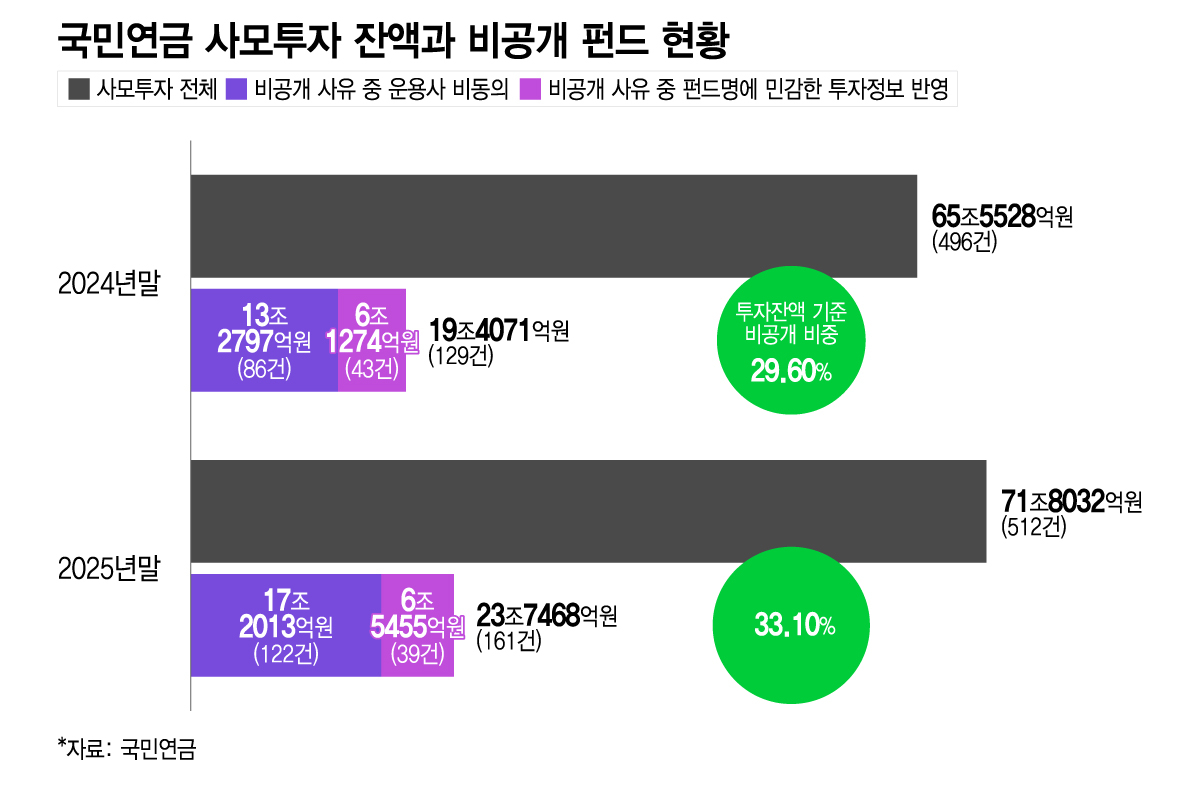
It was revealed that cases where the National Pension Service (NPS) kept fund names undisclosed due to asset managers' refusal to consent to disclosure reached 17 trillion won (based on scale) last year, a 30% increase from the previous year. Additionally, cases anonymized due to sensitive investment information totaled 6 trillion won, bringing the total amount invested in private funds with hidden names to 23 trillion won. The NPS's level of information disclosure has drawn attention as a field marked by expanded non-disclosure practices, including the non-release of meeting minutes on increasing the domestic stock allocation ratio.
According to the financial investment industry on the 7th, the National Pension Service's recent public disclosure of private investment status by fund and item as of the end of last year showed a private investment balance of 71.8032 trillion won, an increase of 9.5% from one year prior. Among these, items with undisclosed or anonymized fund names totaled 23.7468 trillion won, accounting for 33.1% by amount. The proportion of non-disclosure rose by 3.5 percentage points in one year. Of the reasons for non-disclosure, asset managers' refusal accounted for 17.2013 trillion won, a 29.5% increase. Separately, funds with undisclosed names due to sensitive investment information being reflected totaled 6.5455 trillion won, an increase of 6.8%.
Although the National Pension Service halted new investments in private equity funds targeting management rights following the Homeplus incident last year, it has continued to receive capital contribution requests and disburse funds for previously committed private equity funds.
The NPS anonymized four out of its top 10 funds by investment balance last year. The fund ranked first was anonymized as "Private Fund 1" with a balance of 987 billion won, while the third-ranked fund, "Private Fund 2," stood at 893.6 billion won. The fourth-ranked "Private Fund 3" totaled 807.3 billion won. The fifth-ranked fund was "OOO North America Fund XIII" with 741.6 billion won.
The second-ranked fund, "Carlyle Spinney Partners," had its name disclosed and held a balance of 909.8 billion won. An NPS official stated, "We considered that disclosure could violate contracts when asset managers refuse consent or when multiple asset managers jointly participate in an investment rather than the NPS acting alone."
![[Seoul=NEWSIS] Reporter Cho Su-jeong = Kim Sung-ju, Chairman of the National Pension Service Lee (President), attended the 6th National Pension Fund Investment Committee meeting for 2026, chaired by Ministry of Health and Welfare Minister Jeong Eun-kyung (on the right), held at the Seoul Government Complex in Jongno-gu, Seoul, on the afternoon of the 2nd. 2026.07.02. chocrystal@newsis.com /Photo=Cho Su-jeong](https://thumb.mt.co.kr/cdn-cgi/image/f=avif/21/2026/09/2026090716532721550_2.jpg)
While the obligation to disclose information regarding the National Pension Fund is stipulated in the National Pension Act, the specific scope and methods of disclosure are determined by the Fund Investment Committee through fund investment guidelines.
In contrast, measures to enhance transparency in retirement asset management have been implemented more rigorously in the United States. For example, under state law in California, public pension funds such as the California Public Employees' Retirement System (CalPERS) and the California State Teachers' Retirement System (CalSTRS) are required to disclose private fund names, committed amounts, paid-in capital, distributions, residual value, internal rate of return, investment multiples, and other details. Other state public pension funds in Florida and Washington also disclose these same items.
Among funds with disclosed names, the largest single Korean private equity fund was MBK Partners No. 5-2, totaling 503.6 billion won, ranking 16th overall. The second-ranked fund was Stick Special Situation No. 2 (392.1 billion won, 36th), and the third was IMM Rose Gold 4 (228.8 billion won, 103rd). Based on the disclosed scope, the NPS's investment balance in MBK-affiliated funds last year totaled 536.3 billion won, a 47.6% decrease from one year prior. Stick-affiliated funds decreased by 5.5% to 726.5 billion won, while IMM-affiliated funds fell by 8.3% to 544.4 billion won. These changes appear to reflect the recovery of existing investments and additional fund disbursements.
However, details on recovery amounts and profit/loss were not disclosed. The debate over the scope of NPS information disclosure intensified after the NPS decided in January to keep meeting minutes containing the decision to expand domestic stock allocation non-disclosed until 2030.
In May, when the NPS raised its target ratio for domestic stocks to 20.8%, it also kept the temporarily expanded scope of strategic asset allocation non-disclosed. While reasons such as financial market stability were cited, counterarguments have been raised that national retirement assets are left in a blind spot of oversight.
The NPS side stated that even among overseas pension funds, there are cases where information is not disclosed based on contractual clauses regarding private fund information disclosure. An NPS official said, "Following the Homeplus incident, we introduced new evaluation items in July last year to assess the quality of returns during fund management processes, including whether investment targets meet social standards or norms when selecting domestic entrusted asset managers, and to enhance qualitative and quantitative corporate valuation and sustainable growth strategies for investment targets."

 in STOCK

