

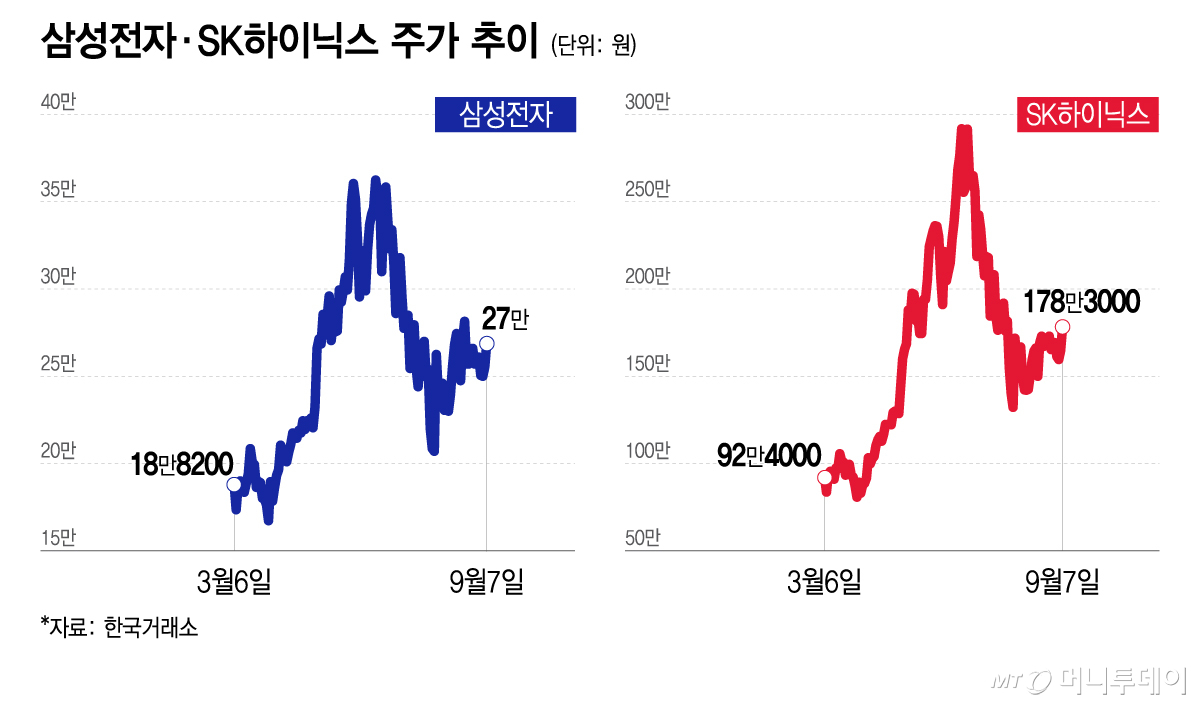
Semiconductors bolstered the domestic stock market. Concerns over AI (artificial intelligence) demand appear to have eased, while expectations for AGI (Artificial General Intelligence) seem to have stimulated investor sentiment. Although the possibility of a base rate hike has been raised in the United States, supply and demand for semiconductor stocks remain robust.
On the 7th, SK Hynix, one of the top two semiconductor players, closed regular trading at 1.783 million won, up 136,000 won (8.26%) from the previous trading day. SK Hynix showed strength for a second consecutive day. The closing price surpassed the 1.73 million won mark for the first time since the 27th of last month.
Samsung Electronics, the other top semiconductor player and the flagship stock of KOSPI, closed at 270,000 won, up 5.68% (14,500 won) from the previous trading day. Samsung Electronics also recorded strength for a second consecutive day.
The semiconductor and semiconductor equipment sectors, which include these stocks, are reported to have risen by an average of 6.63% compared to the previous trading day. Within the sector, KOSPI-listed companies such as TL Engineering (12.90%) and DB HiTek (12.12%), along with KOSDAQ small- and mid-cap stocks including Hatch Tech (16.64%), JI Tech (16.36%), Doosan Tesna (11.31%), I&C (10.81%), and TS E (10.57%) all rose by double digits.
Following this, Microcon Tech rose 9.53% from the previous trading day, while PSK Holdings (8.33%), Protech (8.00%), SFA Semiconductor (7.13%), and Cothex (6.98%) also posted gains.
As semiconductors showed a positive trend, KOSPI, which has a high weighting of these industrial stocks, rose 4.61% compared to the previous trading day. In particular, net buying by foreign investors and institutional investors was clear in KOSPI. Foreign investors and institutional investors made net purchases of KOSPI stocks worth 2.9614 trillion won and 3.4235 trillion won, respectively. Among institutional investors, financial investment firms and pension funds accumulated stocks, and buy activity by venture capital (VC) companies, including private equity funds, was also observed. It appears that swap volumes through ETFs (exchange-traded funds) or PRS (prime brokerage services) also flowed in.
The strength of semiconductor stocks reflects the situation on the New York Stock Exchange on the 4th (local time). Even amid speculation that the Federal Reserve System might raise base rates to curb inflation, semiconductor stocks such as SanDisk (11.90%), SK Hynix ADR (8.14%), and Micron (6.10%) rose in the New York market.
Regarding the domestic stock market, experts are offering positive forecasts, noting that the exchange rate has stabilized and expectations for semiconductor demand remain strong. In particular, Jensen Huang, CEO of NVIDIA, highly praised OpenAI's latest model, "GPT-6 Astra," stating that AGI has arrived and that 400,000 GPUs will be in operation, further stimulating investor sentiment.
Son In-jun, a researcher at Eugene Investment & Securities, said, "OpenAI's GPT-6 Astra, released on September 3, is judged to be the fourth turning point in AI development following 'ChatGPT → GPT-o1 → Cloud Code.' As revenue growth and investment expansion intertwine, it is expected to boost confidence in the sustainability of AI CapEx (capital expenditure) and raise long-term growth expectations for HBM, server DRAM, and eSSD demand. Therefore, we maintain a Strong Buy opinion on Samsung Electronics."
Kim Ju-yeon, a researcher at Mirae Asset Securities, said, "Despite the strong dollar over the weekend, the won-dollar exchange rate continued to fall, even dipping below 1,340 won early in trading. Net buying by foreign investors and institutional investors has continued for three consecutive days."

 in STOCK
