

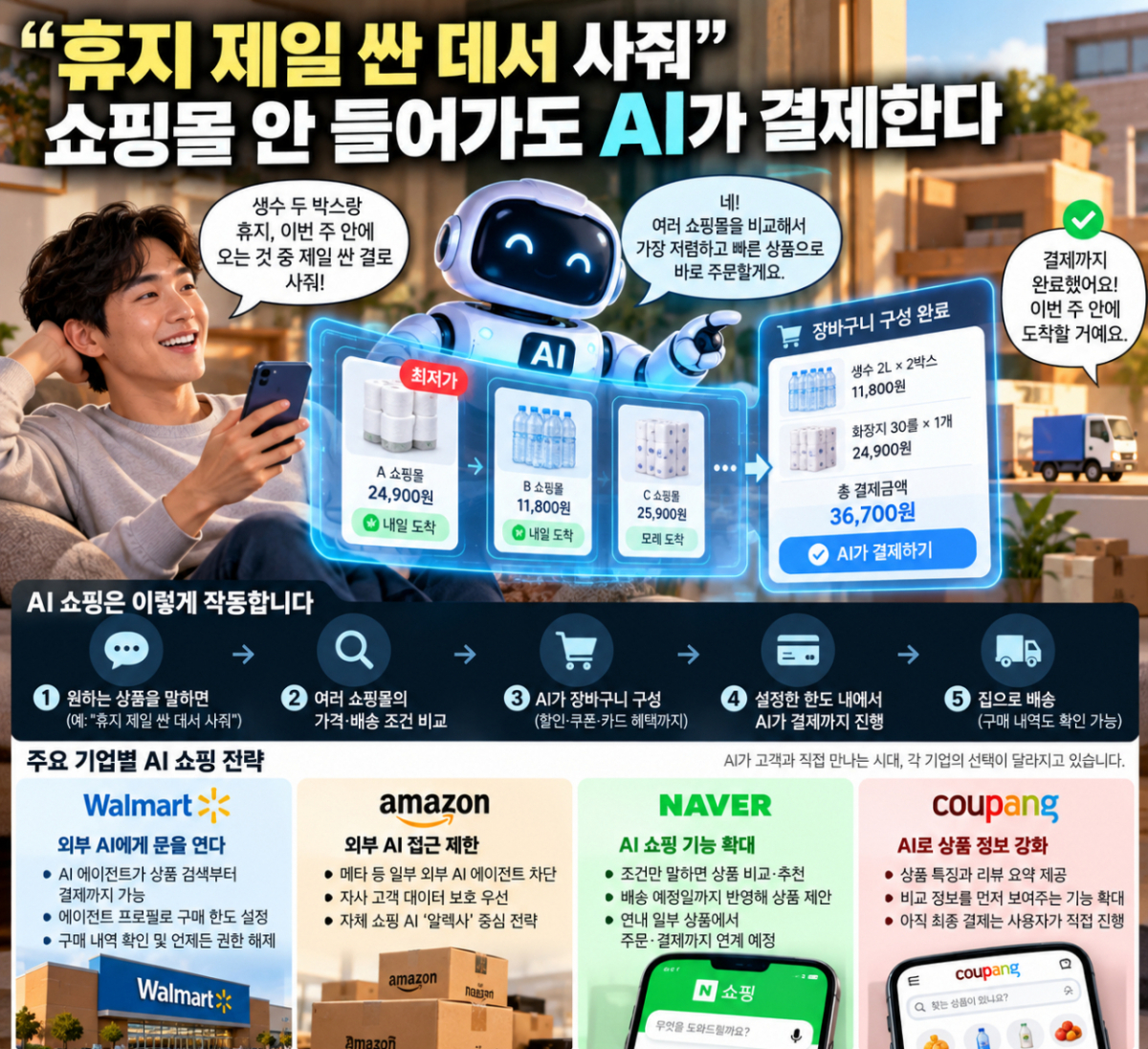
"Buy me two boxes of bottled water and toilet paper—the cheapest option that arrives within this week."
Currently, consumers open the Naver or Coupang app, compare products, add them to their cart, and make payment. In the future, a single command to an AI will suffice. 'Agent shopping' has emerged, where AI compares prices and delivery dates, selects products, and even handles payment on behalf of the user.
U.S.-based Walmart announced on the 21st (local time) the release of 'Agent Profile' and 'Agent Gateway,' enabling AI agents to shop on behalf of customers. Customers can set spending limits for the AI and separately verify purchases made. If necessary, they can revoke the AI's purchasing authority at any time.
AI does not need to click through shopping mall screens as a human would. Through a dedicated channel created by Walmart, it directly checks product prices, inventory, and delivery information to place orders.
For a long time, search was the first step in online shopping. Searching for 'toilet paper' would yield dozens of products, which consumers had to compare directly based on price, reviews, and delivery dates. This is now becoming the job of AI agents. Users simply state their desired conditions, and the AI narrows down candidates and creates a cart.
Google recently launched 'Universal Cart' in the U.S., allowing users to consolidate products from multiple shopping malls into a single cart for purchase. It notifies users when prices drop and finds discount codes. It also recommends which credit card offers the greatest benefits for payment. Amazon also provides features through its proprietary shopping AI, 'Alexa for Shopping,' including price comparison, cart composition, and automatic purchasing when prices fall below a specific threshold.
Until now, online retailers have spent enormous amounts of money to attract customers. Once users enter an app, they can be shown search ads, exposed to recommended products, and enrolled in memberships. Retailers can also track what was searched and what was purchased.
The situation changes if consumers only interact with AI instead of shopping malls. If a user says, "Buy me sneakers under 100,000 won," and the AI compares multiple shopping malls to select one for payment, the consumer no longer needs to see that mall's ads or other products. AI becomes the new 'shopping entrance.'
According to Reuters, inflow to shopping malls via AI is increasing rapidly. Some companies report that the purchase conversion rate of customers visiting through AI platforms is about twice as high as that of general visitors.
Changes are also underway domestically. Naver officially launched its shopping AI agent in July. When users state conditions such as "Find me food for a housewarming party arriving tomorrow," the AI compares and recommends products. Last month, it added a feature to narrow down products by considering actual scheduled delivery dates. Currently, final payment still requires moving to the product page and being made directly by a human. Naver is preparing to implement a method where the process from exploration to ordering and payment continues within the AI agent for some products by the end of this year. Coupang is also expanding features that use AI to summarize product characteristics and reviews, and display comparison information before consumers ask.
The way shopping works is changing. It is an era where AI detects the timing of a purchase before a person even thinks, "I'm running out of toilet paper."

 in TECH
