

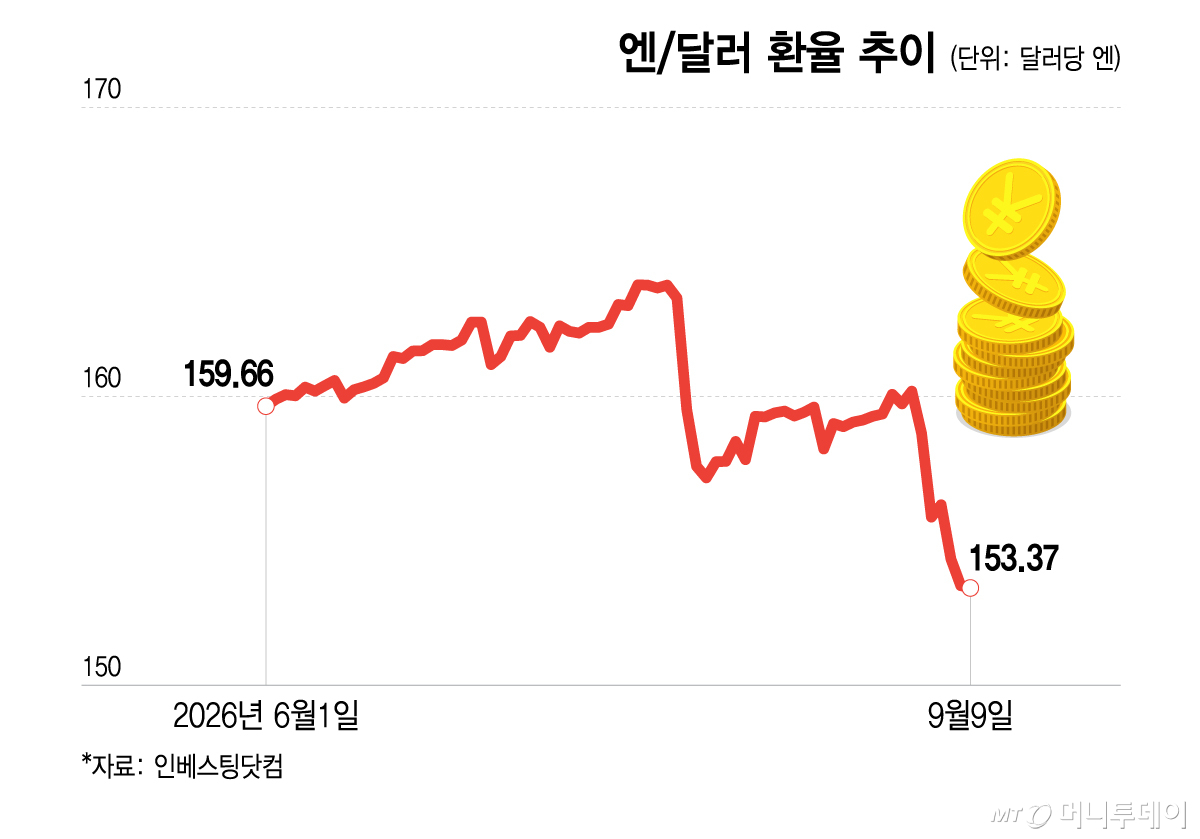
The yen-dollar exchange rate, which had shown record weakness by rising to as high as 163 yen (indicating a decline in the yen's value), has now turned bullish, drawing attention to changes in investors' asset strategies. With the yen expected to remain strong for some time and the won-yen exchange rate still at low levels, advice is emerging that it is an opportune time to invest in yen-denominated assets. While concerns about a repeat of the yen carry trade unwind from two years ago are growing across financial markets, analysts suggest the likelihood of a shock similar to that period is low.
According to Investing.com on the 9th, the yen-dollar exchange rate stood at 153.31 yen, showing a slight decline from the previous day. The yen-dollar rate had risen to around 162 yen by the end of the second quarter but has recently fallen sharply (indicating yen strength), dropping 9.2 yen (5.6%) compared to that peak. This marks the highest level of the yen's value in approximately seven months. Following a rapid shift to a strong trend in the won-dollar exchange rate over the past two months, movement in the yen-dollar rate has further focused attention on response strategies.
With a base rate hike by the Bank of Japan (BOJ) at its upcoming monetary policy meeting next week now considered certain, and expectations that it will continue raising rates, positions betting against the yen are being quickly liquidated. Citigroup recently reported in a research note that it expects the BOJ to raise the base rate to 1.25% at its monetary policy meeting on the 18th. The bank also noted that as the interest rate differential between the United States and Japan gradually narrows, unwinding of yen carry trades will expand, and the yen's bullish trend is expected to continue in the long term.
The financial investment industry also anticipates that the yen's strength will persist for some time. This expectation stems from joint intervention by the U.S. and Japanese governments to support a stronger yen and forecasts that Japan will accelerate its pace of interest rate hikes. In particular, with the won and donghua currencies having sharply declined (indicating value increases) over the past two months, the won-yen exchange rate remains at low levels, prompting advice that it is an appropriate time to invest in yen-denominated assets. Choi Kyu-ho, a researcher at Hanwha Investment & Securities, stated, "The sharp decline in the won-yen exchange rate during July and August was driven by the relative strength of the won," adding, "If the yen continues to strengthen, there is a high probability that the won-yen exchange rate will rebound from its current low."
It is also judged that sectors benefiting from yen appreciation and interest rate hikes will be well-positioned. Researcher Choi noted, "Rather than focusing on long-term bonds, investors should concentrate on stocks, paying attention to financial stocks that can benefit from interest rate normalization, domestic demand stocks that can reduce import costs, and industrial materials. A strategy of simultaneously holding short-term bonds and deposits while increasing yen holdings would be appropriate to mitigate stock price volatility risks."
As the yen's value rises rapidly, concerns about the unwinding of yen carry trades are also emerging. While some warn that such unwinding could increase financial market volatility, many point out that there is currently no significant cause for concern. This is because markets have already priced in interest rate hikes and speculative net selling positions remain relatively small.
Kim Jae-seung, a researcher at Hyundai Motor Securities, stated, "The likelihood of a sudden unwind of yen carry trades similar to August 2024 is low." He added, "Although concerns are growing as the BOJ's base rate hike trend strengthens and expectations for yen appreciation expand, the gradual narrowing of the U.S.-Japan interest rate differential means it will not trigger market volatility or sales of risk assets."

 in STOCK
