

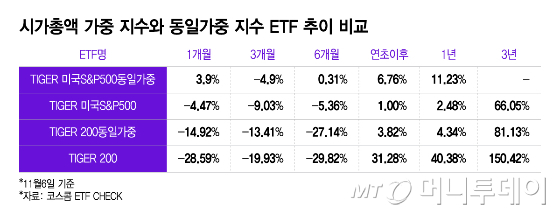
As stock prices of technology companies belonging to the AI (artificial intelligence) value chain fluctuated in South Korea's and the U.S. stock markets, it was found that the returns of equal-weighted ETFs have recently outperformed those of index-tracking ETFs (exchange-traded funds) that directly reflect market capitalization weights. This is due to the relatively larger declines in large-cap semiconductor stocks with high market capitalization weights.
According to KOSCOM ETF CHECK on the 6th, the one-month return (based on reinvestment of distributions) of the 'TIGER 200 Equal Weight' ETF was -14.92% as of that day. This is nearly twice the difference compared to the 'TIGER 200,' which recorded -28.59%. The same trend is seen in major U.S. indices, where equal-weighted returns are higher. Over the same period, 'TIGER US S&P 500 Equal Weight' and 'TIGER US S&P 500' were recorded at 3.97% and -4.47%, respectively.
Equal weighting is a strategy that includes stocks in an index with the same weight, regardless of their market capitalization. The KOSPI 200 Equal Weight index includes 200 stocks at 0.5% each, while the S&P 500 Equal Weight index includes 500 stocks at 0.2% each. It is characterized by its ability to maximize the benefits of diversification without concentration in specific stocks.
Behind the strong performance of equal-weighted ETFs lies the sharp drop in stock prices of AI technology stocks, including memory semiconductors. Concerns over profitability emerged as massive funding announcements for corporate AI infrastructure investments followed one after another, starting with Neocloud company CoreWeave's debt burden and Meta's shift to a negative free cash flow (FCF). Additionally, the possibility that AI data center construction could be delayed was added after the Democratic Party won a landslide victory in both the Senate and the House of Representatives in the U.S. midterm elections.
The semiconductor sector is cited as the industry hit hardest. In the case of big tech companies, if AI data center construction is delayed, they can postpone their funding periods, potentially creating some breathing room in cash flow. On the other hand, from the perspective of semiconductor companies receiving investment, increased shipments could lead to lower profitability. Consequently, the stock prices of Samsung Electronics and SK hynix, which account for half of the market capitalization in the KOSPI index, plunged, dragging down the index itself. As of that day, Samsung Electronics and SK hynix had fallen 30.6% and 36.2%, respectively, compared to the previous month.
Park Seung-jin, head of Hana Securities, stated, "The current market issue is that doubts have arisen about whether the AI trend is sustainable, leading to a lack of trust in future earnings estimates." He added, "While some say current valuations are cheap, there are also cases where earnings estimates are revised downward retrospectively at any given moment."
He further noted, "Not only Samsung Electronics and SK hynix, but also AI-related technology stocks such as Samsung Electro-Mechanics have seen their valuations adjusted upward, which raised KOSPI earnings estimates. However, as these begin to waver, mid- and small-cap stocks are falling relatively less, creating an effect that makes them appear to be holding up well."
Experts advise that when concerns about concentration risk and AI corrections are high, including equal-weighted ETFs in a portfolio can help address concentration issues. Han Su-jin, a researcher at Samsung Securities, said, "In market conditions dominated by leading stocks, upside is limited, but individual stock risk can be reduced, and a strategy of holding both types of products simultaneously is also effective."
However, warnings are also emerging that one should be cautious about interpreting the recent outperformance of equal-weighted ETFs over market capitalization-weighted index ETFs as a signal to sell existing weighted indices and switch to equal-weighted ones. This is because market capitalization-weighted representative indices have a structure where changes in leading companies are automatically reflected, meaning their role as long-term core assets remains unchanged.
Kim Sang-yul, head of the Global ETF Management Division at Mirae Asset Asset Management, said, "I recommend using S&P 500 Equal Weight as a satellite asset to be held alongside the core market capitalization-weighted representative index during phases where market warmth is spreading."

 in STOCK
