

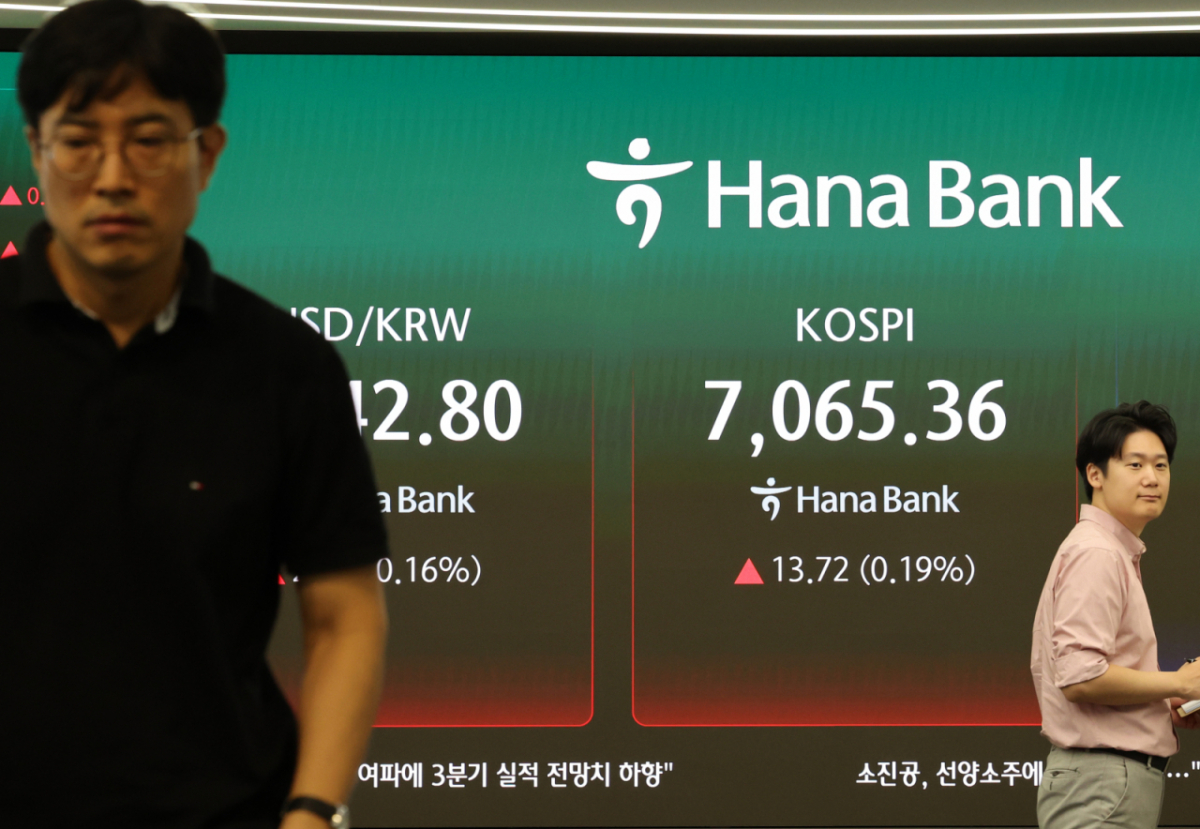
On the 10th, the KOSPI gave up the 7,000-point level intraday amid net selling by foreign investors and institutional investors. Samsung Electronics and SK Hynix rose early in the session but are trading down more than 1%. This was influenced by continued selling of stocks and futures by foreign investors on "Witching Day," when stock options and futures contracts simultaneously expire.
As of 11:09 a.m., the KOSPI stood at 6,936.27, down 115.37 points (1.64%) from the previous trading day. The KOSPI opened at 7,035.85, down 12.79 points (0.18%), rose early in the session, and then turned downward.
The U.S. New York stock market continued its weakness for three consecutive days, and foreign investors' selling coincided with the simultaneous expiration of futures and options, pushing the market into a downturn. Kim Ji-young, a researcher at Kiwoom Securities, stated, "Factors contributing to the decline include international oil price pressures, such as Brent crude surpassing $100 per barrel due to Middle East uncertainty, and the U.S. 10-year Treasury yield exceeding 4.83%. The weakness in the U.S. stock market and supply-demand volatility in domestic stocks and futures on the simultaneous expiration date of options will cause the KOSPI to give up some of yesterday's gains."
In the KOSPI market, individuals purchased 858.1 billion won worth of stocks, while foreign investors and institutional investors sold net amounts of 496 billion won and 962.7 billion won, respectively. Foreign investors had been buying net for four consecutive days from the 3rd but have continued selling since the 9th. Institutional investors, who had bought net for five consecutive days from the 3rd, also switched to net selling on this day, causing the KOSPI to fall below the 7,000-point level.
Among the top market capitalization stocks, KB Financial Group and HD Hyundai Heavy Industries were exceptions; most showed declines or weak stability. Samsung Electronics and SK Hynix rose early in the session but turned downward. Samsung Electric and Doosan Enerbility each fell more than 3%, while SK Square and Hyundai Motor also declined by more than 1%.
Among sectors, banking, insurance, robotics, and shipping stocks showed strength. KB Financial Group, Woori Financial Group, and Hanwha Life Insurance rose. Robotics stocks gained as major companies such as Hyundai Motor and Samsung Electronics announced the development of humanoid robots one after another. In KOSDAQ, Robotics and Rainbow Robotics showed strong performance.
Kim Seok-hwan, a researcher at Mirae Asset Securities, analyzed, "The banking and insurance sectors rose due to expectations of increased interest income for banks from rising rates and higher bond yield returns for insurers." He added, "Shipping stocks gained as some shipping companies benefited from expectations of freight rate increases due to the possibility of prolonged military conflict in the Middle East."
At the same time, KOSDAQ was down 10.09 points (1.22%) at 820.28. Opening at 825.06, down 5.31 points (0.64%), KOSDAQ has seen continued net buying by individuals.
Individuals purchased 246.7 billion won worth of stocks, while foreign investors and institutional investors sold net amounts of 208.6 billion won and 42.5 billion won, respectively.
Among the top market capitalization stocks in KOSDAQ, AlteoGen, EcoPro, EcoPro BM, and HLB fell more than 3%, showing weakness.
Kang Jin-hyeok, a researcher at Shinhan Investment Corp., diagnosed, "With high oil prices and high interest rates continuing, supply-demand events overlapped, causing the KOSPI to fall below 7,000 again." He added, "In KOSDAQ, while large-cap stocks in biotechnology and secondary batteries showed overall weakness, some materials, components, and equipment (MCE) and robotics stocks held their ground."

 in STOCK
