

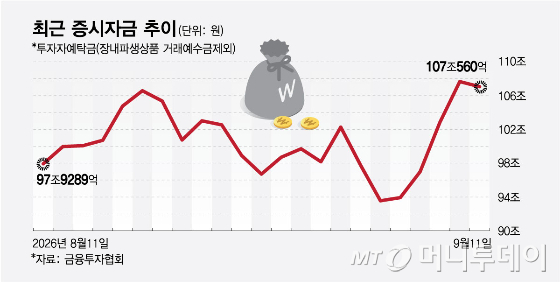
Standby funds surrounding the domestic stock market have recently begun to increase again. Amid this, individual investors have turned to selling since September and are adopting a wait-and-see approach. With emerging volatility factors such as concerns over U.S. interest rate changes and arguments for slowing down AI (artificial intelligence) development, analysts suggest that investors are reducing their exposure to risk assets while waiting for the next buying opportunity.
According to the financial investment industry on the 15th, as of the 11th, investor deposited funds (hereinafter referred to as "deposited funds") reached 107 trillion 56 billion won, re-entering the 100th trillion won range. Although deposited funds surged to a record high in the late 130 trillion won range at one point during the first half of the year, they have frequently fallen below 90 trillion won since August. The figure dropped to the 93rd trillion won range on the 4th of this month but exceeded the 100th trillion won mark again on the 9th, now approaching the 110th trillion won level.
Deposited funds refer to standby capital that investors have transferred to securities firm accounts for stock trading or left after selling stocks. Just one year ago, deposited funds were at the level of around 60 trillion won.
Credit transactions and loans, indicators of what is commonly known as "margin investing" (investing with debt), also stand in the range of 32 trillion to 33 trillion won. Although they briefly fell to the 28th trillion won range last month, it did not take long for them to return to record highs.
Despite the increase in standby funds converted into cash for investment, individual investors have been withdrawing capital from the domestic market this month. As of today, individual investors sold off more than 8 trillion won in net across all markets including KOSPI and KOSDAQ. This marks the first time since April that individual investors have shown a selling trend, after about five months. For the entire year so far, individuals have purchased domestic stocks with a net inflow of approximately 90 trillion won.
The securities industry observes that recent market influences such as global interest rate changes and arguments for slowing down the semiconductor sector are increasing volatility, leading investors to reduce their exposure to risk assets while waiting for the next buying opportunity.
A securities firm official stated, "There is sufficient capital around the stock market, but growing domestic and foreign uncertainties have strengthened demand to hold cash rather than buy stocks immediately." The official added, "Once the market direction becomes clear or after a sufficient price correction, standby funds are expected to flow back into the stock market."
The trend of risk asset avoidance among domestic investors can be indirectly confirmed by examining the recent net asset value changes in ETFs (exchange-traded funds). As of the 15th, the top two ETFs with the highest weekly net asset increases were parking-type ETFs: KODEX Money Market Active and KODEX CD Rate Active (Synthetic), which saw increases of 530 billion won and 301.3 billion won, respectively.
Additionally, during the same period, TIGER CD 1-Year Rate Active (Synthetic) recorded a net asset increase of 229.1 billion won, ranking fourth, while RISE Money Market Active saw a net asset increase of 193.4 billion won, placing fifth. Furthermore, KODEX KOFR Rate Active (Synthetic) ranked 17th with a net asset increase of 57.2 billion won. These results indicate that individual investors are increasingly flocking to products known as parking-type ETFs.
Parking-type ETFs are designed to allow short-term funds to be managed like bank deposits. Investors use them to temporarily hold money when they have not yet decided where to invest. They primarily invest in bonds or short-term financial products, aiming for relatively stable returns. A notable feature is that interest accrues even if the funds are deposited for just one day.
Capital market experts advise that given expected short-term volatility, maintaining a long-term investment principle is more important than reacting to stock price declines. Lee Jun-young, a researcher at Eugene Investment & Securities, stated, "We believe that investors are adopting a wait-and-see stance ahead of the U.S. Federal Open Market Committee (FOMC) meeting while also increasing sensitivity and volatility regarding AI infrastructure demand." He added, "The decline in stock prices due to weakened investor sentiment appears excessive relative to fundamentals, so it is necessary to take advantage of short-term volatility by approaching with long-term, phased buying strategies."

 in STOCK
