

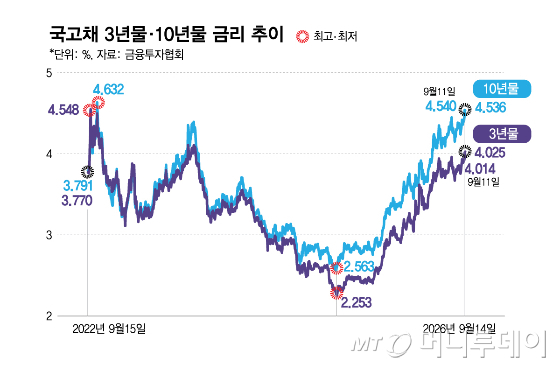
Driven by the relentless surge in international oil prices and U.S. employment and inflation data that exceeded expectations, yields on short- to medium-term government bonds reached their highest levels in three to four years. With the Federal Reserve System (Fed) set to hold its September Federal Open Market Committee (FOMC) meeting on the 15th–16th (local time), markets are strongly reflecting the possibility of a rate hike by the Fed. Many experts predict that the Bank of Korea will also implement additional rate hikes within this year and advised investors to approach Korean government bonds cautiously.
According to the Bond Information Center of the Korea Financial Investment Association on the 15th, the final bid yield for three-year government bonds rose by 66 basis points (1bp=0.01%) from the previous trading day to 4.091%. This marks the first time since November 2023 that yields entered the 4th% range, approximately three years later. On the same day, 10-year bond yields also surpassed 4.5%, reaching 4.6% on this date—the highest level in about four years since October 2022. As government bond yields hit multi-year highs consecutively, all segments except for one-year and two-year short-term bonds exceeded the 4th% range.
A major factor behind the sharp rise in government bond yields is high oil prices. On the 14th (local time), the November Brent crude oil settlement price rose by 1.02% from the previous session to $105.68 per barrel, while the October West Texas Intermediate (WTI) crude oil settlement price increased by 1.34% to $101.39 per barrel. International oil prices, which broke through $90 per barrel in July, have now climbed to the $100 level this month, fueling inflation concerns.
U.S. employment and inflation data also fueled rising interest rates. August non-farm payrolls exceeded market expectations by nearly three times, while the unemployment rate remained at 4.1%. The August core consumer price index (CPI) rose by 0.29% from the previous month, surpassing the expected 0.2% range and raising concerns about persistent inflation and a resurgence in inflation expectations. An Ye-ha, a researcher at Kiwoom Securities, stated, "Given that recession risks or sharp employment declines are limited, the Federal Reserve now faces higher costs from delaying action on inflation than from the growth costs associated with rate hikes."
Experts predict a high probability that the Federal Reserve will raise its base rate at the upcoming FOMC meeting amid such macroeconomic pressures. Fed Chair Kevin Warsh previously stated at the Jackson Hole Economic Symposium that if inflationary pressures do not ease, there is a significant chance of taking measures to curb them. Director Christopher Waller also mentioned that he would consider raising interest rates if prices surge sharply after reviewing the three-year annualized change in CPI during the September rate decision.
Park Jun-woo, a researcher at Hana Securities, said, "With financial markets strongly reflecting expectations of an interest rate hike, if the Federal Reserve holds rates steady, there is a heightened risk of eroding confidence in price stability." He added, "An increase in rates is expected at this meeting, including from Chair Warsh, while only three to four members are likely to express dissenting views favoring a hold."
Earlier, the Bank of Korea implemented two consecutive rate hikes. Now, forecasts suggest a high probability of additional rate hikes within this year. The Bank of Korea had already raised its base rate from 2.75% to 3.00% at its August Monetary Policy Board meeting in anticipation of inflation concerns. Jo Young-gu, a researcher at Shinyeong Securities, noted, "Significant changes have occurred in key risks for domestic interest rate forecasts, including the possibility of the Federal Reserve shifting its stance on rate hikes and fluctuations in oil prices and exchange rates." He analyzed that the Bank of Korea is likely to reach its final interest rate faster than before and maintain high rates. He further added, "After an additional hike in November, the final interest rate could reach 3.50% by February next year at the latest, or no later than April."
Experts anticipate that pressure from rising interest rates on the bond market will intensify and recommend reducing holdings of government bonds or adopting a conservative investment strategy. Researcher Park stated, "Once the U.S. interest rate hike cycle begins, the Bank of Korea will have additional room to raise rates, and market uncertainty regarding the final benchmark interest rate is also expected to increase."

 in STOCK
