

As the likelihood of U.S. interest rate hikes increases, tension in the domestic stock market is also rising. Amid this, the securities industry has recently raised target prices for refining stocks across the board, drawing attention. Analysts note that this is not simply due to rising international oil prices, but rather because refining margins and infrastructure scarcity are enhancing the industry's competitiveness.
Target prices for SK Innovation, S-Oil, and others have risen recently… Profitability 'stands out'
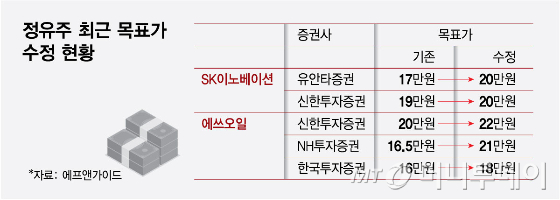
According to the financial investment industry on the 16th, Yuanta Securities raised its target price for SK Innovation from 170,000 won to 200,000 won on the 15th. Although restructuring remains with SK I-Tech, the explanation is that operating profit, which was only 448.7 billion won last year, could jump to 1 trillion won, leading to this target price adjustment.
Hwang Gyu-won, a researcher at Yuanta Securities, stated, "Global supply and demand disruptions have persisted for about 14% due to delays in crude oil supply caused by the delayed Iran war, delays in restarting petrochemical facilities after damage in the Middle East, and energy facility damage from the Russia-Ukraine war, which is positive news." He added, "The performance effects of refining and lubricants will likely outweigh the reduction in corporate valuation resulting from restructuring."
Not only Yuanta Securities but also Shinhan Investment Corp raised its target price for SK Innovation from 190,000 won to 200,000 won at the end of last month. While acknowledging that the merger could expand short-term stock price volatility, the firm cited the expansion of refining and lubricants cash flow as the reason for raising the target price.
Shinhan Investment Corp also raised S-Oil's (S-Oil) target price from 200,000 won to 220,000 won on this day. This is because operating profit is expected to exceed 5 trillion won this year compared to 288.2 billion won last year. The securities firm believes that refining facilities, which are in short supply, are irreplaceable regardless of oil prices.
Additionally, NH Investment & Securities raised S-Oil's target price from 165,000 won to 210,000 won this month. Korea Investment & Securities raised its target price from 160,000 won to 180,000 won, while Yuanta Securities raised it from 175,000 won to 205,000 won at the end of August.
In addition, Heungkuk Securities recently raised target prices for GS and HD Hyundai, which hold refining subsidiaries, from 140,000 won to 170,000 won and from 300,000 won to 330,000 won, respectively. Commonly, the firms assessed that the healthy operating profits of the refining subsidiaries would drive target price increases.
Rising oil prices make refining stocks favorable? A one-dimensional outlook… "Refining margins and infrastructure scarcity expand foundational strength"
These domestic evaluations of refining stocks come amid a backdrop where downward pressure on the domestic stock market has softened due to international oil supply instability and rising possibilities of base rate hikes by the Federal Reserve System (Fed), drawing significant attention.
Market analysis suggests that the one-dimensional view—that rising international oil prices will increase inventory valuation gains for crude oil held by refining companies, thereby boosting refining stocks—is an oversimplified assessment that overlooks the simultaneous burden of rising raw material prices.
The recent industry focus on profit growth in refining stocks stems from expanding refining margins and scarcity of refining infrastructure. The securities industry explains that while supply instability for crude oil and petroleum products continues, primarily centered in the Middle East, domestic refining capacity has not increased sufficiently. For domestic refining companies that import crude oil, convert it into petroleum products, and sell them, high refining margins are playing a key role.
The high-interest-rate environment is also seen as a factor maintaining the competitiveness of existing players by further raising entry barriers unique to the refining industry. Since refineries are capital-intensive industries requiring large funds and long construction periods, rising interest rates make the costs for new expansion burdensome, delaying new capacity additions. Consequently, the value of existing infrastructure held by domestic refining companies that have already secured large-scale facilities is bound to rise.
An official in the financial investment industry stated, "The recent upward revision of target prices for refining stocks reflects not just the simple formula that higher oil prices mean higher profits for refiners, but rather a combination of high refining margins, limited global capacity expansion, and the value of already secured refining infrastructure." He added, "This is a result reflecting expectations that the profit resilience of existing refining companies will last longer than anticipated."

 in STOCK
