

As foreign investors are now allowed to directly invest in ETFs (exchange-traded funds) through integrated accounts, brokerages are accelerating their preparations. Although trading volume via these integrated accounts does not yet constitute a major share, industry analysts view them as a new competitive edge for expanding the retail customer base.
According to the financial investment industry on the 17th, recent regulatory changes by Korean authorities have amended the Financial Investment Business Regulations to permit foreign investors to invest in domestic ETFs and ETNs (exchange-traded notes) through integrated accounts. This measure expands the scope of tradable assets under integrated accounts from domestic stocks alone to include ETFs and ETNs. However, leveraged and inverse ETFs remain excluded.
Integrated accounts are a system that allows overseas investors to trade Korean stocks via local securities firms without needing to open direct accounts with domestic brokerages.
Industry observers expect full-scale trading to commence on January 1 of next year, when revised tax laws regarding withholding taxes take effect.
The 2026 tax reform plan stipulates that starting January 1 of next year, a special withholding tax exemption will apply to transactions involving foreign integrated accounts. Under this framework, domestic brokerages will withhold taxes on income such as dividends paid to foreign financial investment firms (including overseas securities companies) that have opened integrated accounts through them. Subsequently, the overseas securities firm will collect the corresponding taxes from foreign investors. This approach is considered convenient for foreign investors.
Brokerages are also accelerating their preparations. Integrated accounts offer a means to secure overseas clients and thus represent a potential new competitive factor.
While these accounts are unlikely to account for an absolute share of total brokerage revenues or drive rapid growth, maintaining integrated accounts could generate additional retail revenue. Some analyses suggest that expanding investment options beyond individual domestic stocks to include ETFs could further broaden access to the Korean market for investors.
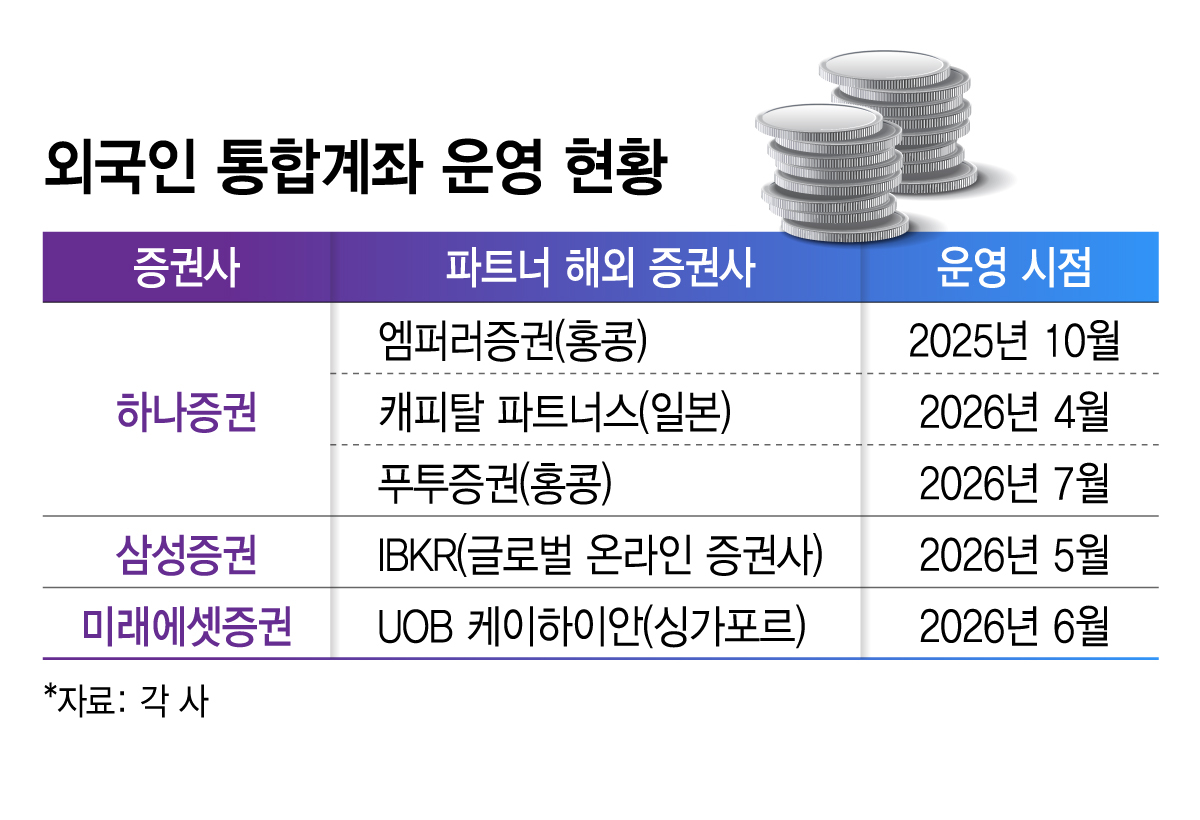
Hana Securities, which launched the foreign integrated account service first in the industry last October, reported net foreign purchases exceeding 1 trillion won. Samsung Securities, which introduced its service in May, is said to have average daily trading volumes through its integrated accounts amounting to several hundred billion won.
Mirae Asset Securities signed a contract with Singapore-based major brokerage UOB Kay Hian in June to provide foreign integrated account services and has already launched the offering. Shinhan Investment, NH Investment & Securities, KB Securities, and Meritz Securities are also reviewing or preparing similar services.
Kim Sung-hoon, a researcher at Hyundai Motor Securities, stated, "Foreign integrated accounts should be viewed not primarily for their short-term earnings contribution but rather for enhancing retail competitiveness through expanded touchpoints with overseas retail customers." He added, "If ETF trading is permitted, the range of available products will broaden, accelerating growth in trading volumes."
A securities industry official remarked, "Foreign investors who have opened accounts at domestic brokerages and subsequently established integrated accounts abroad wish to transfer their stocks into these integrated accounts, but this remains impossible for now. As a service designed specifically for foreign investors, any inconveniences should be addressed and improved in the future."

 in STOCK
