

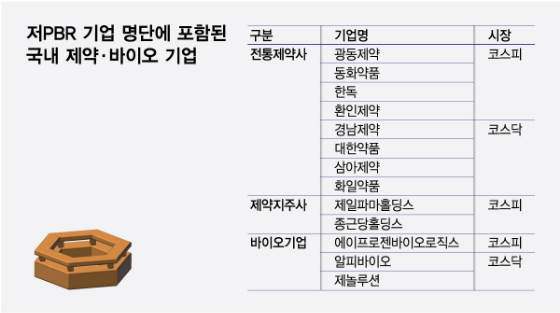
Of the 13th pharmaceutical and biotechnology companies included in the Korea Exchange's list of low price-to-book ratio (PBR) firms, 10 were found to be affiliates of traditional pharmaceutical companies. While a stable revenue base has long been cited as a strength, the sector has received low market valuations for an extended period, making concrete improvement efforts to re-evaluate corporate valuation a pressing task.
According to industry sources on Monday, among the 151st low-PBR companies disclosed by the exchange starting that day, 13 were pharmaceutical and biotechnology-related firms (excluding medical devices, etc.). Of these, 10 are traditional pharmaceutical companies, pharmaceutical holding companies, or active pharmaceutical ingredient manufacturers.
On the Korea Exchange, four traditional pharmaceutical companies—Kwangdong Pharmaceutical, Dongwha Pharm, Handok, and Hwanin Pharmaceutical—along with two holding companies, Jeil Pharma Holdings and Chong Kun Dang Holdings, were included. On the KOSDAQ market, four firms made the list: Gyeongnam Pharmaceutical, Daehan Pharmaceutical, Samah Pharmaceutical, and Huil Pharmaceutical, a specialist in active pharmaceutical ingredients.
The disclosure of this list is a measure aimed at encouraging voluntary corporate valuation improvement by companies that have been undervalued for a long time. The exchange selected companies whose PBR fell within the bottom 25% of KOSPI or the bottom 10% of KOSDAQ in their respective sectors for six consecutive semi-annual periods, or for six out of seven semi-annual periods. This was to identify companies with long-term undervaluation rather than temporary stock price declines.
PBR is an indicator calculated by dividing a company's market capitalization by its net assets; a ratio below 1 indicates that the market valuation is lower than the book value of net assets. However, a low PBR may reflect not only potential undervaluation but also the market's low expectations regarding profitability or growth prospects. The exchange plans to display selected companies on brokerage trading screens and encourage voluntary corporate valuation improvement through tailored consulting and other measures.
Traditional pharmaceutical companies differ from biotech firms focused on new drug development, whose corporate valuations can fluctuate significantly based on clinical trial results or technology transfers. Traditional pharma companies generate continuous revenue based on the sale of existing drugs. While they have been recognized for their stable business foundation and performance, it is relatively difficult for them to be acknowledged as having high growth potential.
However, business stability does not necessarily translate into a high corporate valuation. In a business structure centered on existing drugs, even if revenue and profits are generated steadily, there may be a lack of new drivers to raise the market's growth expectations. In particular, when stagnation in the growth of existing products, slowing profitability, and uncertainty over new drug development outcomes overlap, the likelihood of a low market valuation persisting for a long period relative to held assets increases.
A market official diagnosed that "the selection of low-PBR companies presents both an opportunity and a challenge for traditional pharmaceutical companies," noting that "while there is room for corporate valuation re-evaluation based on stable revenue and held assets, a low PBR does not guarantee the possibility of stock price appreciation." The official added, "To change market perceptions, improvements in the profitability of existing businesses, securing new growth drivers, and enhancing capital efficiency must be supported."
Given that individual companies can be interpreted as either 'undervalued amid stable growth' or 'lacking growth drivers' depending on perspective, it is assessed that each company's response has become crucial. As countermeasures for the traditional pharmaceutical industry, suggestions include enhancing the competitiveness of existing drug businesses while demonstrating growth potential through new drug development and overseas market expansion, as well as implementing shareholder return policies such as dividend increases and share buyback cancellations.
Jeil Pharma Holdings has been the clearest in stating its position. Last month, the company presented a plan to improve capital efficiency by enhancing the profitability of key subsidiaries, utilizing investment real estate, leveraging treasury shares, and adjusting dividends. Through these measures, it aims to raise its PBR from the current level of 0.37 times to 0.5 times by 2028.
Chong Kun Dang Holdings, the holding company of the Chong Kun Dang Group, stated that it will accelerate internal reviews in light of this evaluation. While the selection of a holding company for the low-PBR group does not directly correlate with the group's new drug development capabilities or pharmaceutical business competitiveness, the company plans to propose substantive indicator improvement measures beyond shareholder return policies, considering its symbolic position.
A Chong Kun Dang official explained, "While it is not yet at a stage where specific details can be disclosed, we are internally reviewing various aspects to find substantive PBR improvement measures."
Dongwha Pharm, which has grown by making over-the-counter (OTC) drugs such as Hwallyeongsu, Pancol, and Fusidin its core revenue sources, aims to accelerate the realization of results from its business diversification efforts.
A Dongwha Pharm official said, "For several years, the company has expanded its existing OTC-centric business structure into global markets while broadening its business areas into healthcare, food, medical devices, and overseas distribution." The official added, "Going forward, we plan to focus on creating substantive results and improving profitability in each business area, while further strengthening investor relations activities to expand communication with the market and shareholders."

 in THEBIO
