

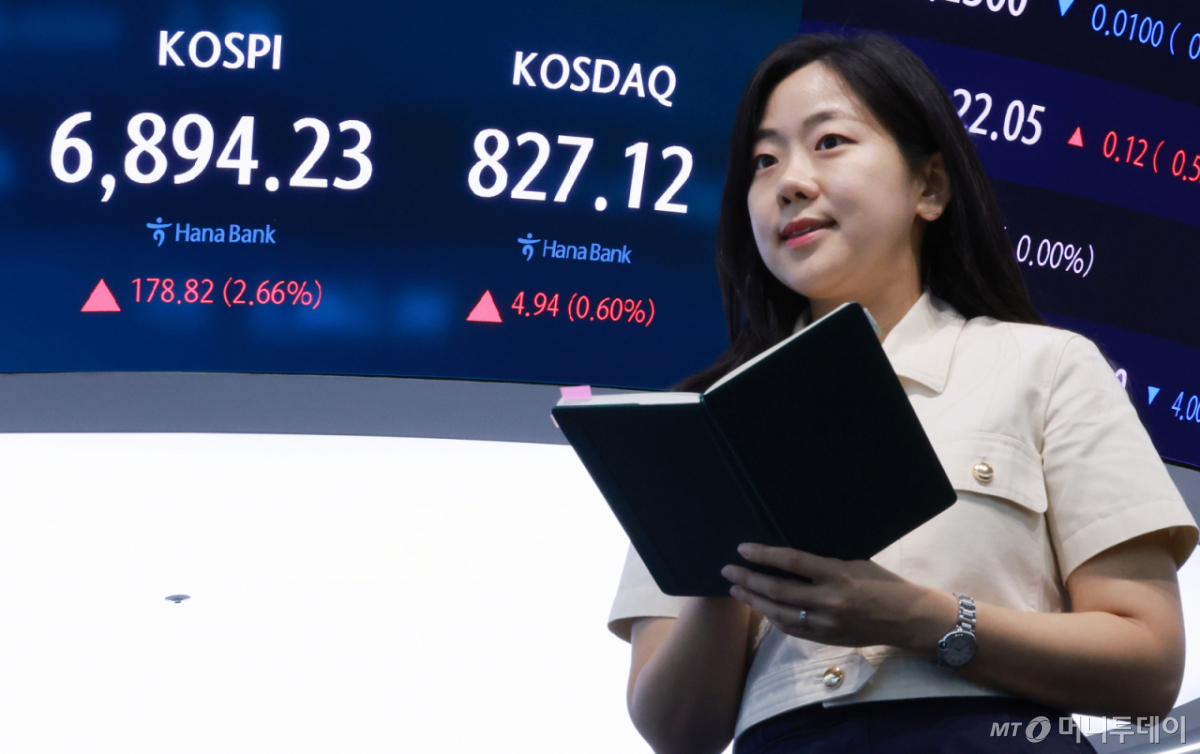
KOSPI closed higher despite interest rate hikes by the United States and Japan. This was because AI (artificial intelligence) momentum revived amid easing monetary policy uncertainty, which led to declines in long-term interest rates and international oil prices. With next week's Chuseok holiday approaching, attention is focused on whether the AI momentum will continue.
KOSPI rose following the September Federal Open Market Committee (FOMC) meeting, supported by reduced uncertainty and falling global oil prices. Jensen Huang, CEO of NVIDIA, also boosted investor sentiment in semiconductor stocks and KOSPI with remarks about increased semiconductor sales volume.
On the 18th, KOSPI closed at 6,894.23, up 178.82 points (2.66%) from the previous day.
Although the Federal Reserve (Fed) raised its base rate at the September FOMC meeting, domestic and foreign stock markets instead moved toward stability. This was due to reduced uncertainty in Fed policy and Saudi Arabia's proposal for a ceasefire in Oman, which caused international oil prices to fall.
Additionally, CEO Huang met with reporters ahead of his attendance at an AI summit held in Scotland on the 17th (local time) hosted by King Charles III of the United Kingdom. He stated, "NVIDIA expects chip sales next year to reach twice this year's volume," improving semiconductor investment sentiment.
Major U.S. stock indices also rose across the board overnight. On the 17th (local time), the S&P 500 index closed at 7,637.73, up 85.19 points (1.14%) from the previous session; the NASDAQ Composite Index ended at 26,418.30, up 439.87 points (1.69%); and the Dow Jones Industrial Average closed at 51,778.18, up 316.28 points (0.61%).
Furthermore, during the session on that day, the Bank of Japan (BOJ) decided to raise its base rate by 25 basis points to 1.25%.
Lee Kyung-min, head of FICC Research at Daishin Securities, said, "The domestic stock market showed strength as macroeconomic uncertainty that had capped index gains eased." He added, "Foreign investors, who had been net sellers for seven consecutive trading days, switched to net buying. Institutional investors and financial investors expanded their net purchases, contributing to the upward trend in indices." He further explained, "Declines in international oil prices and U.S. Treasury yields alleviated macroeconomic pressures, while momentum in AI and semiconductor value chains became prominent."
In the KOSPI market, foreign investors and institutional investors made net purchases of 438.9 billion won and 1.5055 trillion won, respectively. Retail investors sold off stocks worth 3.5929 trillion won.
Among KOSPI sectors, electrical & electronics rose 4.46%, and manufacturing gained 3.42%. Non-metallics increased by 1.16%, while medical precision/instruments, construction, and IT (information technology) closed with slight gains. In contrast, electricity & gas and distribution fell more than 1%, while insurance, general services, and food & tobacco closed with slight declines.
The top five companies by market capitalization in the KOSPI all rose simultaneously. Benefiting from improved semiconductor investment sentiment, Samsung Electronics and SK Hynix jumped 3.37% and 6.42%, respectively. SK Square closed strongly up 7.04%, and Samsung Electric rose 4.36%.
Financial stocks closed weakly. Hana Financial Group fell 3.2%, while KB Financial Group and Shinhan Financial Group each dropped more than 2%.
KOSDAQ recorded a gain of 4.94 points (0.6%) from the previous day, closing at 827.12.
In the KOSDAQ market, retail investors and institutional investors made net purchases of 12.2 billion won and 21.8 billion won, respectively. Foreign investors sold off stocks worth 42.9 billion won.
Among KOSDAQ sectors, construction and electrical & electronics rose by over 2%. Transportation equipment/parts, machinery/equipment, and communications increased by more than 1%. In contrast, pharmaceuticals fell 2.05%, while entertainment/culture, paper/wood, financial services, and general services closed with slight declines.
Among KOSDAQ companies with the highest market capitalization, Peptron surged 5.48%. Other semiconductor materials, components and equipment stocks also showed upward trends. Rino Industrial rose 4.82%, while Wonik IPS and Eugene Tech gained 2.97% and 1.17%, respectively. Biotech stocks showed weakness. HLB fell 7.34%, while ABLE Bio, Samtong Pharmaceutical, and Ligand Bio dropped 3.61%, 2.39%, and 1.2%, respectively.
On that day, the won/dollar exchange rate closed the weekly trading session at 1,382.2 won, up 13.6 won from the previous day's closing price.
Im Jeong-eun, a researcher at KB Securities, stated, "With major countries' monetary policy schedules concluding, related uncertainties have partially eased." She added, "Domestic stock markets will be closed for the Chuseok holiday on the 24th and 25th."

 in STOCK
