

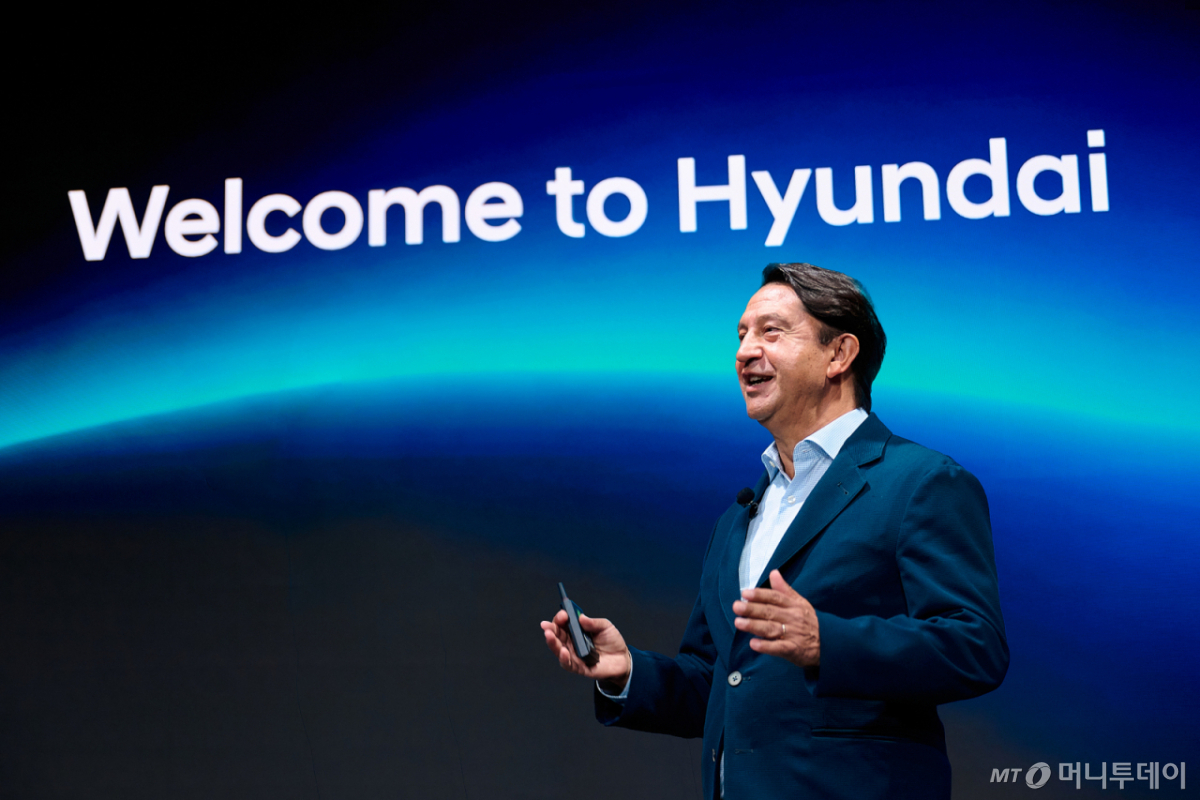
The reason Hyundai Motor's performance has failed to rebound so far this year is that the business environment has deteriorated significantly, according to an analysis by President and CEO Jose Munoz. For now, Hyundai Motor anticipates that external uncertainties will persist for some time and is striving intensely to find a breakthrough.
The industry advises that securing "fundamental competitiveness" in future mobility fields, such as improving electric vehicle performance and design and commercializing autonomous driving technology, is essential to guaranteeing sustained growth.
In fact, this year has been an exceptionally harsh period for global automakers. The war between the United States and Iran, which erupted at the end of February this year, directly hit exports to the Middle East region, while logistics costs and raw material prices rose across the board, making it difficult to secure profitability. The 15% tariff imposed by the United States, Hyundai Motor's largest export market, on Korean-made automobiles is also a significant burden.
Amid this backdrop, major Chinese electric vehicle brands have aggressively entered the European Union (EU) and Latin American markets to offset sluggish domestic demand, intensifying local sales competition. Although Hyundai Motor responded based on its quality and service advantages, it was inevitable that local operations would suffer from the offensive of Chinese electric vehicle brands leveraging "ultra-low prices." On top of this, a full-scale labor union strike—the first in 10 years—and supply disruptions caused by a fire at an engine valve supplier compounded to make normal production difficult.
With sudden adverse factors piling up, Hyundai Motor's performance continued to slump. In the first quarter of this year, despite recording its highest-ever revenue for the same period (4,593.89 billion won) driven by strong sales of HYBE lead vehicles, operating profit plunged 30.8% to 251.47 billion won due to factors such as U.S. tariffs and rising raw material prices.
In the second quarter, although it achieved its highest-ever quarterly revenue (492.153 billion won), operating profit decreased by 20.8% to 285.09 billion won. Conversely, in the third quarter, operating profit rebounded by 5.5% to 267.72 billion won, but revenue fell by 3.4% to 451.102 billion won. The increase in operating profit was partly due to higher sales of high-margin HYBE lead vehicles, but it also appears to have been influenced by the base effect from U.S. tariffs being at 25% during the same period last year.
Since most global automakers could not avoid rising logistics costs and raw material prices, there is little disagreement that deteriorating profitability was difficult to evade. Consequently, some voices argue that Hyundai Motor's "sluggish sales performance," which serves as an indicator of product competitiveness, is more disappointing than the reduced operating profit.
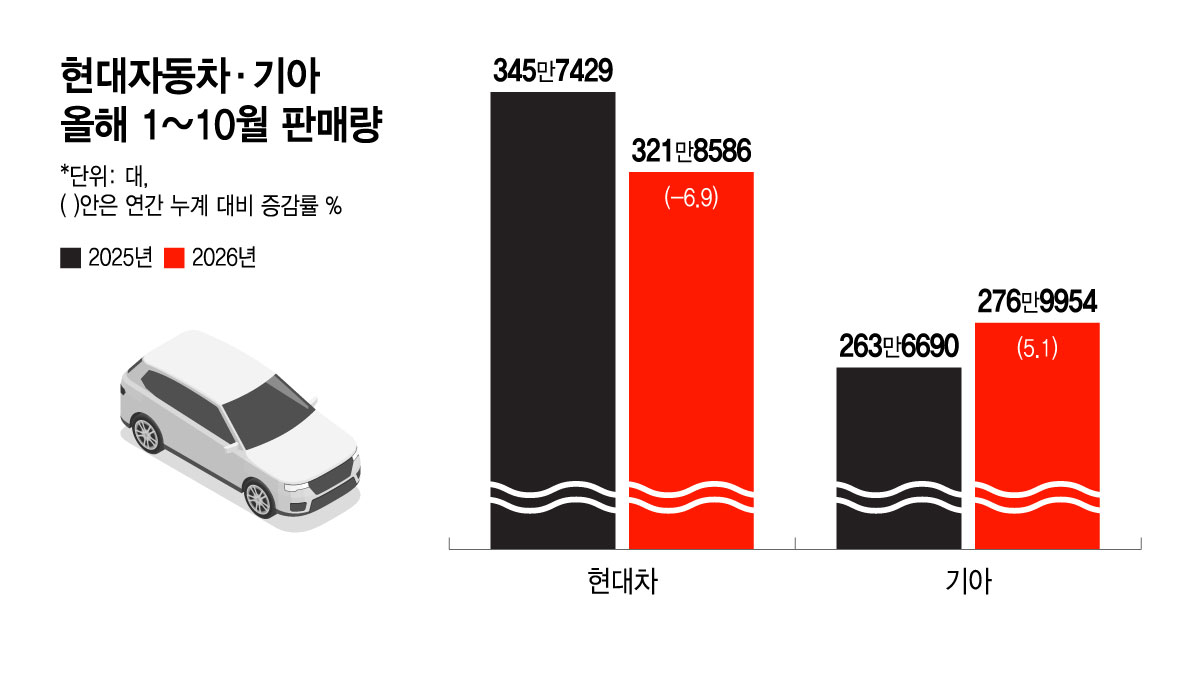
Hyundai Motor's cumulative global sales through October this year totaled 3,218,586 units, a decrease of 6.9% compared to the same period last year. This contrasts with Kia, which sold 2,769,954 units in the same period, an increase of 5.1%. Notably, tensions also arose within the company when Hyundai Motor's sales fell behind Kia domestically in April last month.
At that time, Kia sold 55,108 units, surpassing Hyundai Motor (54,051 units) for the first time in 28 years since its integration into the Hyundai Motor Group in 1998. Regarding this, Hyundai Motor cited supply disruptions from partner companies and other factors, but Kia also led in domestic sales in July-August and October last month. This suggests that the situation cannot be viewed as a temporary impact.
Hyundai Motor is making all-out efforts to restore its pride. Aggressive new model launches are representative of this effort.
Munoz also emphasized in an email to employees, "We are on the verge of the largest-scale new car launch in Hyundai Motor's history," adding, "By 2030, we will unveil more than 100 new models and product-improved models worldwide and secure an additional production capacity of 1.27 million units."
He further expressed confidence by stating, "The new Avante and Tucson, as well as the Genesis GV90 and GV80 HYBE lead, are just the beginning." Additionally, Hyundai Motor plans to minimize cost burdens through continuous improvement in cost competitiveness and reduced incentives associated with new car launches, focusing on enhancing profitability.
There is a consensus in the market that Hyundai Motor must boost its product competitiveness centered on future mobility. First, opinions suggest that a "paradigm shift" in perception is necessary to abandon the stereotype that Hyundai Motor holds an advantage in quality and design if it aims to lead Chinese brands in the electric vehicle market, which has emerged as the mainstream globally after the "chasm" (temporary demand stagnation).
An industry official stated, "The notion that the greatest strength of Chinese electric vehicles is their 'low price' is a misconception," adding, "It is generally evaluated that their quality is already on par with major global automakers."
Commercializing autonomous driving is also an urgent task. U.S.-based Tesla and major Chinese brands have moved to secure a first-mover advantage in the global autonomous driving market based on high software (SW) technological capabilities and vast driving data.
Hyundai Motor is pursuing rapid commercialization of autonomous driving technology through cooperation with NVIDIA, while simultaneously executing a "two-track" strategy to internalize proprietary technology. Park Min-woo, Head of the Advanced Vehicle Platform (AVP) Division at Hyundai Motor and Kia and CEO of 42dot, recently stated in an internal interview, "Aiming for top-tier autonomous driving technology, we will secure safety and reliability through our own technology."

 in INDUSTRY

