

It has been revealed that securities firms have funds tied up in one out of every four distressed real estate project financing (PF) sites where sales repeatedly failed. While the government plans to normalize these troubled PF projects by even exempting capital adequacy rules to accelerate housing supply, critics point out that normalization will be difficult since most projects are located outside Seoul.
According to public disclosures from the Korea Financial Investment Association on the 21st regarding distressed real estate auction PF sites, as of late August, a total of 251 projects remain without buyers and await sale. These projects fall into three categories: △pre-construction sites where land was secured but construction has not begun, △sites under construction but progressing slowly, and △completed sites that have failed to sell despite multiple auctions.
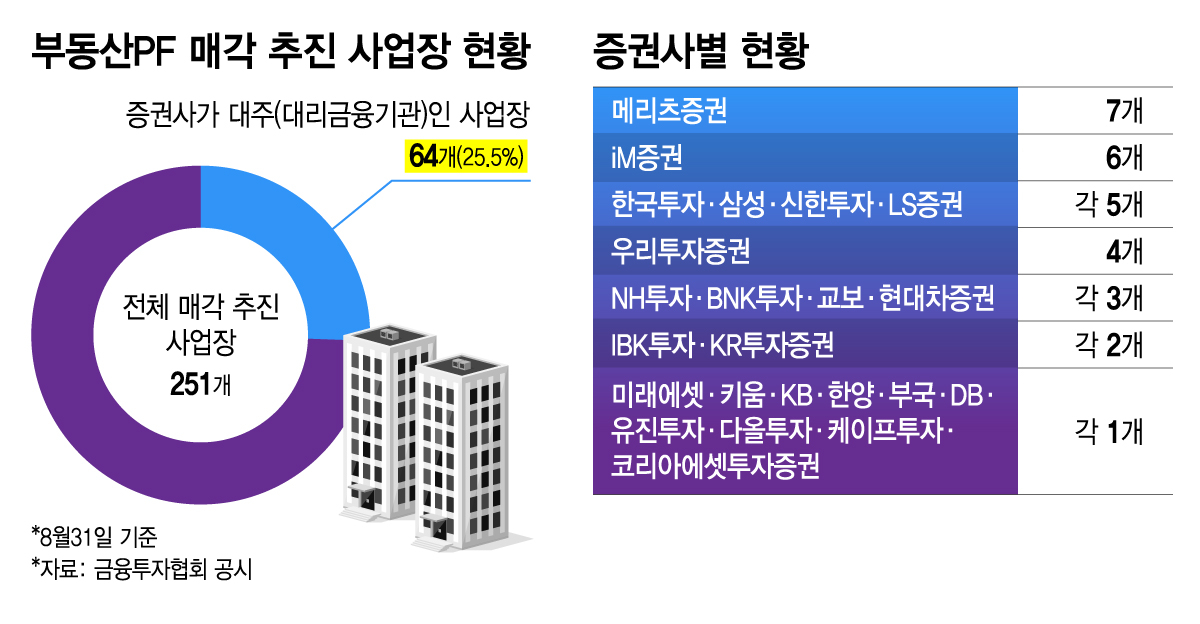
Among these, PF sites where securities firms serve as lead institutional investors (lenders) number 64, accounting for 25.5%. By industry sector, securities firms rank second only to mutual financial institutions such as regional agricultural cooperatives and Saemaeul Credit Unions. Breaking it down by firm, Meritz Securities holds the most with seven sites. iM Securities follows with six sites. Korea Investment, Samsung, Shinhan Investment, and LS Securities each provided funds for five sites but have yet to recover them.
The issue lies in the deteriorating financial soundness of securities firms' real estate project financing while the government rushes to normalize these projects. As of late March, the exposure amount (risk exposure) of PF projects under watch or considered distressed in the securities industry totaled 3.7 trillion won, an increase of 200 billion won from the previous quarter. Non-performing loans below standard accounted for 14.57% of total lending, also rising by 1.27 percentage points compared to the prior quarter.
The deterioration in securities firms' real estate project financing stems from insufficient project viability and lack of market demand. In fact, only five of the 64th sites were located in Seoul. Most were office apartments, mixed-use complexes, or logistics centers in Gyeonggi-do and Incheon, or apartments, mixed-use complexes, and office apartments outside the capital region. The widening demand gap between Seoul and non-Seoul areas has left these projects unsold despite multiple auctions.
Consequently, while the financial investment industry acknowledges the government's intent to increase housing supply, reactions remain cautious about its effectiveness. Some argue that current policies alone are insufficient to revive these projects, as those not yet restructured have significantly declined in viability, creating a large "price gap" between buyers and sellers.
A financial industry official stated, "The most problematic cases are sites where EOD (end-of-day loss) has occurred, and most are located outside Seoul. Restructuring requires cooperation between developers and contractors, but it remains uncertain whether government intervention can accelerate this process."
While the government has decided to exempt PF capital adequacy regulations for residential projects for two years, concerns arise that such measures may not significantly improve either financial soundness or speed of resolution. With current delinquency rates failing to fully reflect actual risks, further regulatory relaxation could hinder qualitative improvements in real estate project financing. According to Korea Credit Rating's stress test on real estate project financing, if actual risks were accounted for, non-performing PF would rise from 6 trillion won to 12.7 trillion won, requiring securities firms to additionally set aside 1.1 trillion won in provisions.

 in STOCK
