

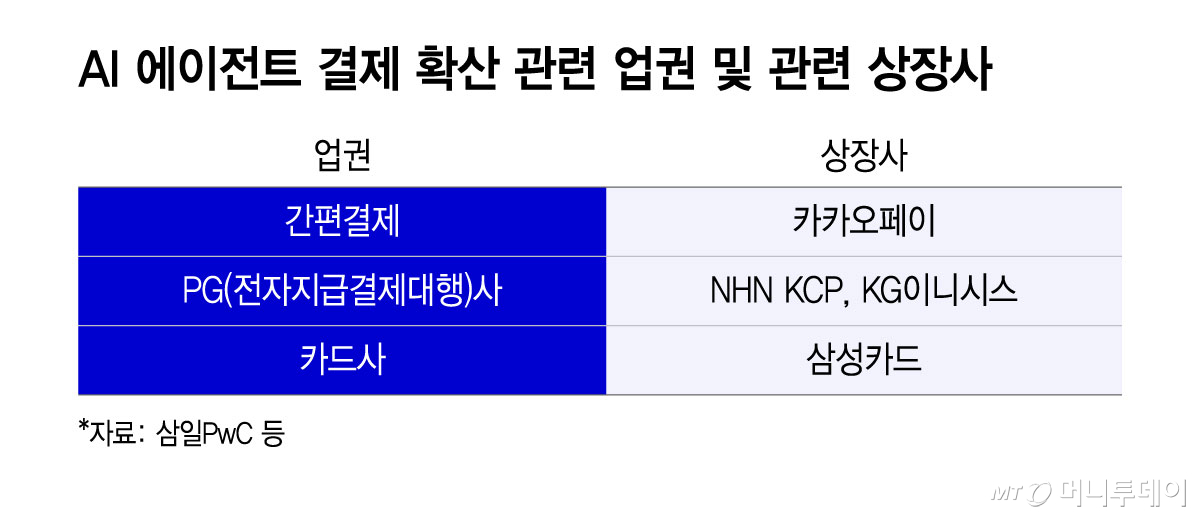
As the AI agent economy, in which artificial intelligence (AI) agents explore, compare, and complete payments for products and services on behalf of humans, officially takes off, mobile payment companies, card issuers, and payment gateway (PG) companies have been identified as industries likely to be affected by this shift. Among listed payment service providers in the domestic stock market are Kakao Pay in the mobile payment sector, Samsung Card in the card sector, NHN KCP and KG iNISYS in the PG sector, among others.
According to a report released on the 24th by Samil PwC, mobile payment companies, card issuers, and PG companies are expected to be significantly impacted by the AI agent economy in the electronic payment sector. Card issuers may see their existing competitive landscape, which has been centered on brand loyalty and primary-use cards, shift if AI begins comparing and recommending consumers’ payment methods. This means they must redesign transaction-specific benefit programs and data strategies to align with an environment where AI selects payment tools. In contrast, capital companies, savings banks, insurance firms, and securities companies are assessed as facing limited impact.
Mobile payment companies have taken the lead in responding to the AI agent economy. Last August, Kakao Pay unveiled a Payment MCP (Model Context Protocol) and Agent Toolkit that enable AI to independently complete payments. In the card sector, Visa, a global payment network operator, has been conducting the “Visa Agent Ready Program” since April this year to verify the applicability of AI agent payments in collaboration with six domestic financial institutions. Participating companies include KB Kookmin Card, Samsung Card, Shinhan Card, Kakao Bank, Hana Card, and Hyundai Card.
Samil PwC identified key challenges for financial and payment service providers as establishing authentication and authorization management systems to allow AI agents to conduct payments and financial transactions on behalf of users, and reforming financial infrastructure into an open format.
Additionally, the report emphasized the need to improve data systems to enable AI to compare and select products and payment methods, while also strengthening risk management capabilities to detect abnormal transactions in real time.
Cho Kyu-sang, a PwC Consulting Partner, stated, “The spread of AI agents is going beyond simply accelerating payments; it is transforming how customers discover and choose products, as well as the touchpoints where financial institutions interact with their clients.” He added, “Given that an environment where AI—not humans—will perform a significant portion of transactions is expected in the future, financial institutions must prepare corresponding data, authentication, and operational systems.”

 in STOCK
