

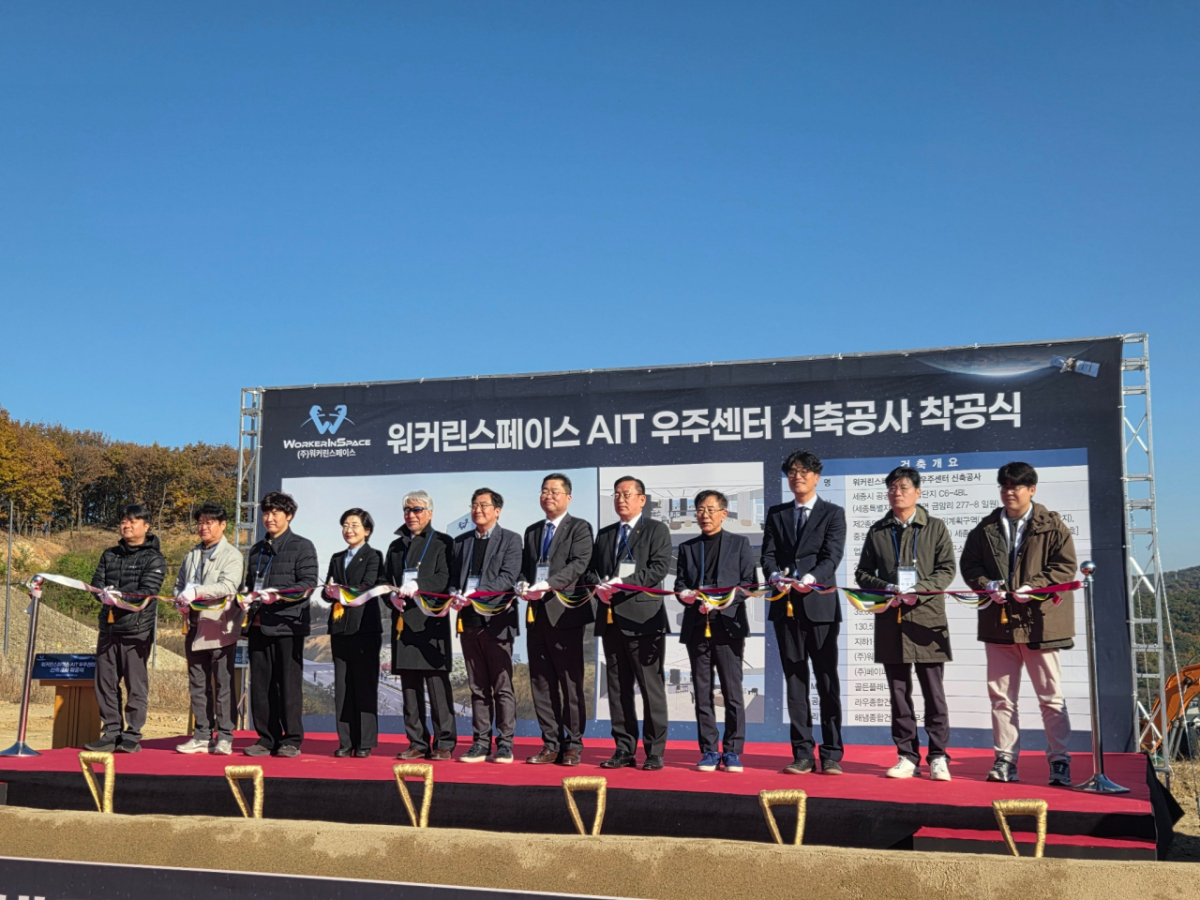
Space services startup WalkerInSpace is investing 13 billion won to build its own satellite assembly, integration and testing (AIT) facility in Sejong City. The company plans to use the center as a development hub for robotic satellites capable of refueling and repairing other satellites in orbit.
WalkerInSpace held a groundbreaking ceremony for the AIT Space Center on Nov. 10 at the Public Facilities Complex in Janggun-myeon, Sejong City. The center will occupy a site of approximately 2,160 square meters (about 23,250 square feet) and consist of one basement level and four above-ground floors. It will have a building footprint of about 857 square meters and a total floor area of approximately 3,398 square meters. Completion is targeted for August next year.
The facility will include a cleanroom for assembling and testing medium and large satellites, a space robotics laboratory, a space environment testing laboratory and a microgravity simulation system. The cleanroom on the first floor will be used for the assembly and testing of medium and large satellites.
The space robotics laboratory will develop robots for the maintenance and repair of space structures. The space environment testing laboratory will use thermal vacuum chambers and vibration testing equipment to verify satellites' ability to withstand space conditions. The microgravity simulation system will support tests of advanced space technologies, including rendezvous, docking and capture operations between satellites.
WalkerInSpace decided to build its own facility to secure the infrastructure needed to develop, manufacture and test medium and large robotic satellites for on-orbit servicing. Outsourcing the production and testing of such satellites is difficult, while transporting equipment and renting specialized facilities can incur substantial costs.
"We are not a company that makes small components or software. We develop medium-sized robotic satellites about the size of a car," said Kim Hae-dong, CEO of WalkerInSpace. "Our goal is to serve as a gas station and repair shop in space, refueling or fixing satellites that break down in orbit."
Founded in 2024, WalkerInSpace is a space services startup headquartered in Jinju, South Gyeongsang Province. It is developing on-orbit servicing (OOS) technology using multifunctional robotic satellites to refuel, repair, replace components and upgrade other satellites in orbit. The company aims to extend satellite lifespans and increase the value of space assets.
WalkerInSpace plans to accelerate development of its first robotic satellite, VEROS-1, using the new center as its base. VEROS-1 is designed to approach and dock with satellites running low on fuel to help maintain their orbits.
The company aims to conduct space environment tests in 2028 and launch the satellite in 2029. It plans to expand its services in the future to include precision repairs and the assembly of space structures.
"VEROS-1 is being developed to remain in orbit for more than seven years after launch and provide life-extension services to government and commercial satellites in Korea and overseas," Kim said.
Park Seong-su, vice mayor for economic affairs of Sejong City, said, "Using a single robotic satellite to perform various tasks, including refueling and repairs, is a highly creative challenge. We hope the construction of this space center will help turn satellite assembly and research and development into tangible business results."
In a video message, Rep. Kang Jun-hyun of the Democratic Party of Korea, who represents Sejong B, said the National Assembly would work to help WalkerInSpace grow into a global leader in the space industry.
Independent Rep.
Kim Jong-min, who represents Sejong A, also said in a video message that he hoped the company's move into Sejong would become a turning point for the development of the region's space industry.
Attendees at the groundbreaking ceremony included WalkerInSpace CEO Kim Hae-dong; Park Seong-su, Sejong's vice mayor for economic affairs; Yoo In-ho, vice chairman of the Sejong City Council; Sejong City Council member Lee Sun-yeol; Yoon Bong-jin, an executive at Sejong Urban Transportation Corporation; Oh Deuk-chang, head of the Sejong Center for Creative Economy and Innovation; and Kwak Min-seok, head of corporate support at Sejong Technopark.

 in FUTURE
