

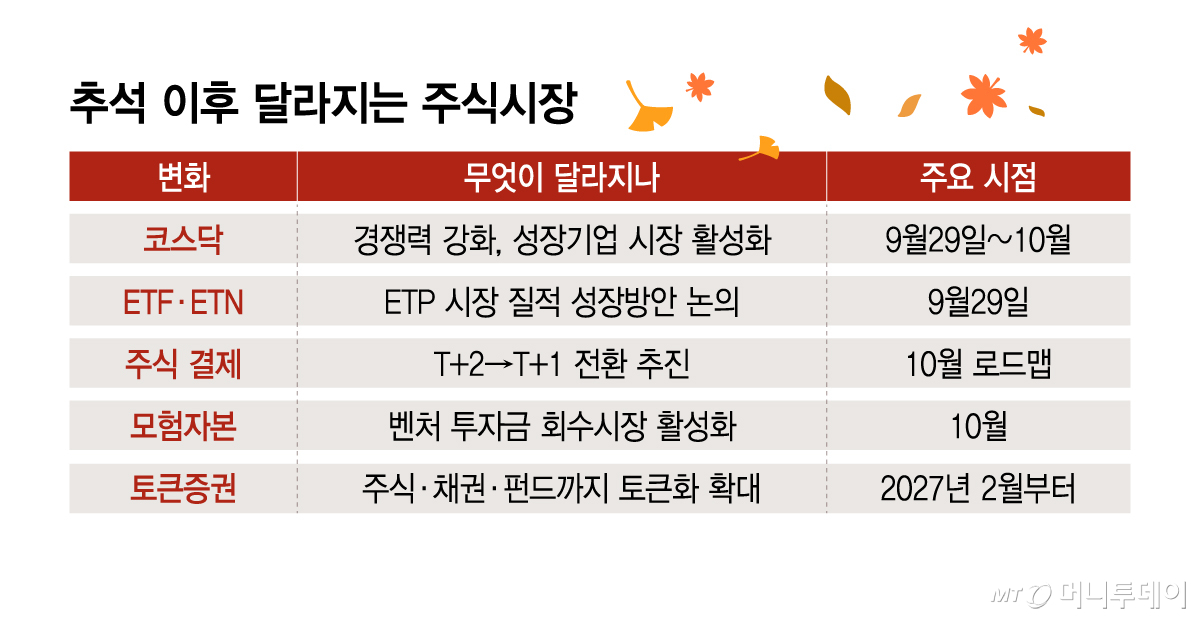
A series of changes that investors need to watch out for after the Chuseok holiday are waiting. From measures to enhance the competitiveness of KOSDAQ and exchange-traded products (ETP) to tasks to change the settlement method where money and stocks are exchanged after buying and selling stocks, preparations are underway. Efforts to create a new market that issues and trades stocks, bonds, and funds in token form are also gaining speed.
According to the Financial Services Commission on the 25th, 'Korea Premium Weeks 2026' will be held for three weeks from the 28th, immediately after the Chuseok holiday, until the 16th of next month. The Financial Services Commission and Korea Exchange are co-hosting the event, with participation from 42 institutional investors related to the stock market and the financial investment industry, as well as 55 listed companies. Approximately 25 events will be held over 13 business days.
It is not just a gathering of events. Follow-up tasks for the capital market reforms that the government has been promoting this year will also gradually take shape during this period. There are five major changes that retail investors should pay attention to after Chuseok.
① KOSDAQ, 'Growth Company Market' undergoes structural improvement
First is the KOSDAQ market. On the 29th, a global conference will discuss policies to strengthen KOSDAQ's competitiveness, followed by a KOSDAQ competitiveness enhancement seminar and investor relations (IR) sessions for KOSDAQ and KOEX listed companies from the 6th to the 8th of next month.
This marks the full-scale discussion of follow-up policies under the government's direction to develop KOSDAQ as a funding market for innovative and growth companies. Unlike the Korea Exchange, which has risen mainly driven by large-cap stocks, the key point to watch is how to enhance the competitiveness of the KOSDAQ market.
② ETFs and ETNs move beyond size expansion to 'qualitative growth'
ETFs (exchange-traded funds) and ETNs (exchange-traded notes), which are familiar to retail investors, are also targets for reform. The Financial Services Commission and the Korea Exchange will discuss 'plans for qualitative growth of the ETP market' on the 29th. ETP is a term that encompasses both ETFs and ETNs.
As the ETF market has grown rapidly and products have become more diverse, the intention is to shift policy focus from simply increasing the number of products and asset size to improving the quality of the market. Specific details on institutional improvements are expected to be released after Chuseok.
③ Stock settlement T+2 → T+1, October roadmap
The time required to buy and sell stocks and actually exchange money and stocks is also expected to shorten. Currently, the domestic stock market uses a 'T+2' system where settlement occurs two days after the trading day. A plan to shorten this to 'T+1', with settlement occurring one day later, is being pursued.
The Working Group on Settlement Period Reduction, which includes the Korea Exchange, KRX (Korea Securities Depository), and the Korea Financial Investment Association, is preparing a concrete roadmap targeting next month. At the Korea Premium Week on the 29th, plans to modernize capital market infrastructure, including settlement period reduction, will be discussed as key agenda items.
If the settlement period is reduced by one day, investors can utilize funds from stock sales more quickly and reduce risks occurring during the settlement process. However, challenges remain, such as changing work systems at securities firms and institutional investors, and issues regarding foreign investors' currency exchange and time zone differences.
④ Money invested in ventures also widens 'exit' options
The venture capital ecosystem is another major topic after Chuseok. During Growth Company Week from the 6th to the 8th of next month, a seminar will be held to discuss measures to activate the venture exit market.
As the government encourages funds to flow into venture and innovative companies through various means such as commercial paper and Business Development Companies (BDC), it has become important to grow markets where invested capital can be recovered. This is because investors must recover their invested funds before they can invest in new companies again. This is why the revitalization of KOSDAQ and KOEX, along with the development of a venture exit market, are being discussed together.
⑤ Beyond art, stocks also become 'tokens'
The most forward-looking change is tokenized securities. On the 4th, the Financial Services Commission announced its policy direction for tokenized securities, deciding to expand tokenization from a focus on fractional investment in art and real estate to include existing securities such as stocks, bonds, and funds.
The first phase will begin next February alongside the enforcement of relevant laws. Private MMFs (money market funds) and private bonds exclusively for institutional investors will be tokenized, and unlisted stocks will also be tokenized using a trust method. In the long term, plans are being pursued to test tokenized trading of listed securities centered on the Korea Exchange.
Tokenized securities are 'securities' regulated by the Capital Markets Act, unlike virtual assets. What changes is the method of issuance and trading. The Financial Services Commission envisions building a digital capital market that connects everything from security issuance to trading, clearing and settlement, and exercise of rights.
An STO (tokenized securities) summit will also be held at the Korea Premium Week immediately after Chuseok. Changes such as ETFs, stock settlements, venture capital, and tokenized securities on KOSDAQ may appear different, but their direction is similar: to broaden investment targets and make trading and settlement more convenient, thereby enhancing the competitiveness of the Korean capital market.

 in STOCK
