

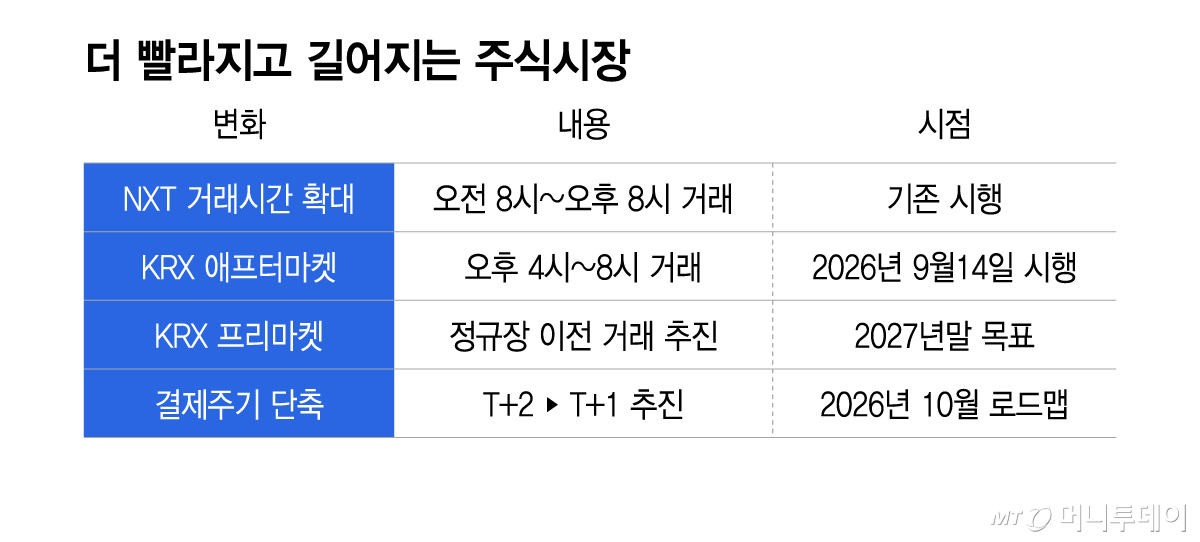
The trading day in the stock market is getting longer, and trade settlements are being accelerated. Following the extension of domestic stock trading hours to 8 p.m. starting this month, plans to reduce the settlement period—the time between buying/selling stocks and actually exchanging money and shares—from two days to one day are taking concrete shape. Additionally, measures to open a pre-market to allow stock trading in the morning are also being promoted.
Sold stocks and waited two days…Now settled within one day
According to the Financial Services Commission and others on the 25th, the Settlement Shortening Working Group, which includes Korea Exchange, Korea Securities Depository, and the Korea Financial Investment Association, plans to finalize a roadmap by next month to shorten domestic stock market settlement from T+2 to T+1.
The principles of T+1 and T+2 are simple. 'T' stands for the trade date—the day stocks were traded. T+2 means that actual exchange of stocks and money occurs two trading days after the day of purchase or sale.
For example, if you sell stocks on Monday, the sale is immediately reflected in your account, but actual settlement concludes on Wednesday. While it is possible to immediately use the proceeds from selling stocks to buy other stocks, withdrawing the cash requires waiting until the settlement is complete.
This Chuseok holiday serves as a case in point. An investor who sold domestic stocks on the 23rd, the day before the holiday began, was scheduled to receive payment on the 25th based on T+2 rules, but due to the Chuseok holiday, the actual payment date was delayed to the 29th.
With a shift to T+1, this process shortens by one day. Stocks traded on Monday will be settled by Tuesday. Investors can use sale proceeds sooner, and as the time between trading and actual settlement decreases, risks that may arise during the settlement process are also reduced.
The United States moved ahead of Korea. The U.S. securities market shortened the standard settlement period for stocks and other assets from T+2 to T+1 in May 2024. In line with global trends toward shortening settlement periods in major capital markets, discussions on transitioning to T+1 have continued domestically as well.
However, reducing the timeline by one day is not as simple as erasing a single number from a calendar. After stock trades, multiple procedures follow, including verification of trade details through securities firms, exchanges, and the Korea Securities Depository before money and stocks are exchanged. Systems and work methods must also be changed to process all these tasks one day faster.
In particular, foreign investors face issues related to time zone differences and currency conversion. Institutional investors and securities firms must also complete back-office operations such as trade confirmation and fund preparation within a shorter timeframe. If preparations are insufficient, the risk of 'settlement failure,' where settlements do not occur on time, could increase.
Financial authorities plan to include specific transition schedules and methods in the roadmap after reviewing preconditions, including these issues. At the 'Korea Premium Week' scheduled for the 29th, immediately following the Chuseok holiday, restructuring of capital market infrastructure, such as extending trading hours and shortening settlement periods, will be a major discussion topic.
Extended stock market until 8 p.m.…Morning trading also being promoted
The time available for stock trading is expanding. Korea Exchange introduced the aftermarket starting on the 14th. In addition to the existing regular market hours from 9 a.m. to 3:30 p.m., stocks can now be bought and sold from 4 p.m. to 8 p.m.
For investor employees, this means they can trade domestic stocks even after work hours. The time available to respond to news or economic indicators occurring overseas after the closure of the regular domestic market has also increased.
The exchange is also promoting the establishment of a pre-market, allowing stocks to be bought and sold before the regular market opens, with the goal of implementation by the end of 2027. With both aftermarket and pre-market added, the time available for trading domestic stocks will become even longer than it is now.
The goals of shortening settlement periods and extending trading hours are the same: to create a market where investors can trade more conveniently at their desired times and complete transactions more quickly after they occur. Financial authorities envision long-term integration of separately progressing infrastructure reforms, such as T+1 settlement, extended trading hours, and tokenized securities, to develop into a 'real-time, continuous-trading, integrated digital market.'

 in STOCK
