

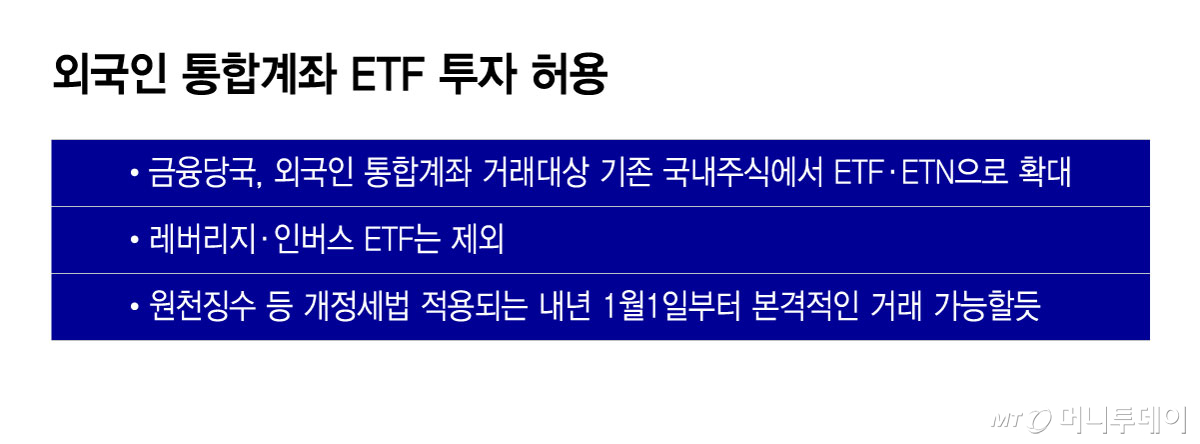
Starting next year, foreigners will be able to directly invest not only in domestic stocks but also in ETFs (exchange-traded funds). There is growing expectation that the 'reverse direct purchase' market—where overseas investors buy domestic stocks directly—will expand further. Analysts suggest this move will improve accessibility for foreign investors and allow securities firms to broaden their retail customer base, creating new competitive advantages.
According to the financial investment industry on the 25th, financial authorities recently amended the Financial Investment Business Regulations to expand the trading scope of foreign integrated accounts from domestic stocks to include ETFs and ETNs (exchange-traded notes). Foreign integrated accounts are a system that allows overseas investors to trade Korean stocks through local securities firms without opening accounts directly with domestic securities companies. However, leveraged and inverse ETFs remain excluded from the trading scope.
This measure aims to enhance foreign investors' access to the domestic stock market. Financial Services Commission Chairman Lee Eoung-won stated at a press briefing in May: "Overseas retail investors are sending love calls expressing their desire to buy Korean stocks." He added, "To promote globalization of the capital market by attracting global funds and high-quality assets, we intend to expand the trading scope of foreign integrated accounts to include ETFs."
The industry expects formal trading to begin on January 1 next year, when revised tax laws including withholding tax provisions take effect. As part of its 2026 tax reform plan, the government has decided to apply a special withholding tax exemption starting January 1 next year, aligned with the expanded scope of foreign integrated account trading. Under this system, when domestic securities firms pay income such as dividends to foreign financial investment businesses (including overseas securities companies) that have opened foreign integrated accounts, taxes are withheld at source. Domestic securities firms deduct the tax first, and overseas securities firms later bill the foreign investors. This simplifies tax handling for foreign investors.
With foreign investors now permitted to invest in ETFs, diversification of supply and demand in the domestic stock market is also expected. A financial industry official stated: "ETF products have seen strong demand from overseas securities firms." He explained, "Through ETF investments, investors can purchase small amounts of domestic stocks, and customers unfamiliar with Korean stocks can hold a diversified portfolio of multiple stocks." He further added, "While transaction volumes may not surge immediately, this move is significant in terms of diversifying supply and demand in the domestic stock market."
According to the Financial Services Commission, from February 6 to May 15, total transaction amounts for foreign integrated accounts reached 5.8 trillion won, with net purchases amounting to 2.2 trillion won. Hana Securities, which launched the foreign integrated account service first in October last year, reported foreign net purchases exceeding 1 trillion won. Samsung Securities, which introduced its service in May, is said to have average daily transaction volumes for foreign integrated accounts in the tens of billions of won range.
Allowing ETF investments could further increase trading volumes. Securities firms also anticipate additional profits through expansion into overseas retail markets. Kim Sung-hoon, a researcher at Hyundai Motor Securities, stated: "Foreign integrated accounts should be viewed not primarily as contributors to short-term performance but rather in terms of enhancing retail competitiveness by expanding touchpoints with overseas retail customers." He added, "If ETF trading is also permitted, the range of available products will widen, accelerating growth in transaction volumes."

 in STOCK
