

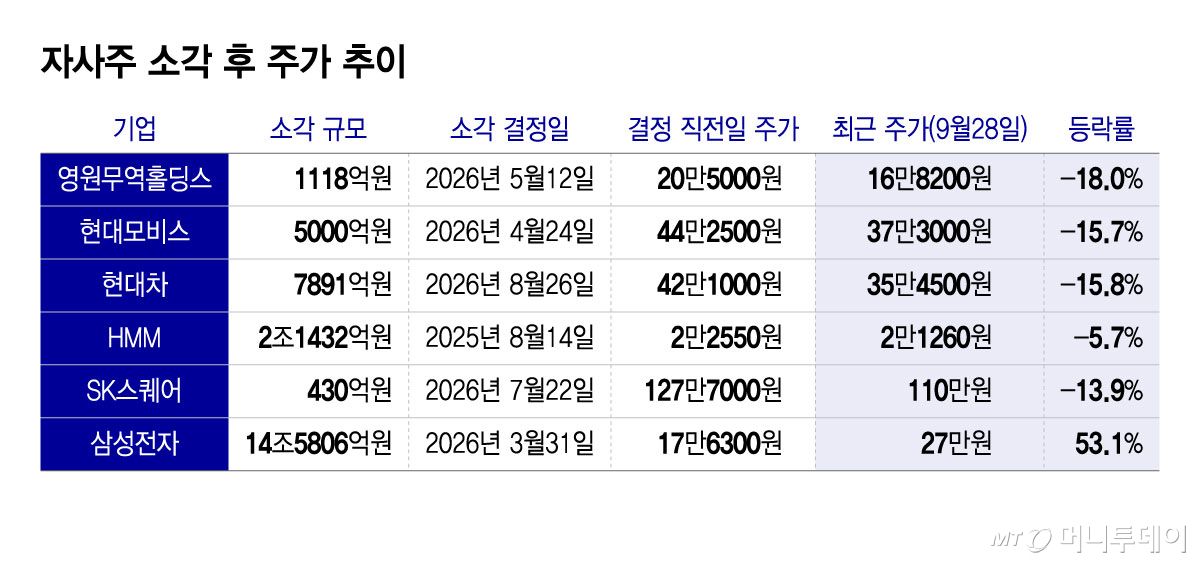
Although the era of mandatory treasury share destruction has begun, experts warn that burning treasury shares alone does not raise corporate valuation. Even with trillions of won worth of treasury shares destroyed, stock prices fell in some cases, and post-destruction price trends varied by company. While destroying treasury shares reduces the number of outstanding shares and enhances shareholder value, it cannot boost a company's profit-generating capacity or growth potential. Consequently, voices are calling for moving beyond the simplistic equation of 'destruction=value-up program'.
According to the financial investment industry on the 28th, under the revised Commercial Act implemented in March, companies must generally destroy treasury shares within one year from the acquisition date. For treasury shares acquired before the implementation, the principle is to destroy them within one year and six months from the effective date. To hold or dispose of treasury shares for employee compensation or business purposes, shareholder meeting approval is required.
Since the system's implementation, there have been cases where large-scale treasury share destruction did not lead to stock price increases. Hyundai Motor decided last month on the 26th to destroy a total of 2.505606 million shares, including 1.291274 million ordinary shares and 1.214332 million preferred shares. This amounted to 789.1 billion won based on the previous day's closing price. However, stock prices moved backward instead. Hyundai Motor's stock closed at 353,500 won on September 28, marking a 15.8% decline compared to the day before the destruction decision was announced.
Even before the system's implementation, there were numerous cases where large-scale treasury share destruction did not lead to sustained stock price increases. HMM decided in August last year to publicly acquire and subsequently destroy all 81.801526 million of its treasury shares. This represented 7.98% of issued shares, with a public acquisition price totaling 2.1432 trillion won.
HMM's stock closed at 21,250 won on the 28th, down 5.8% from 22,550 won on August 13 last year, just before the destruction decision was made. While various factors such as shipping market conditions and earnings forecasts influenced the price decline, it cannot be attributed solely to the destruction. However, it became evident that large-scale destruction itself does not guarantee sustained stock price increases.
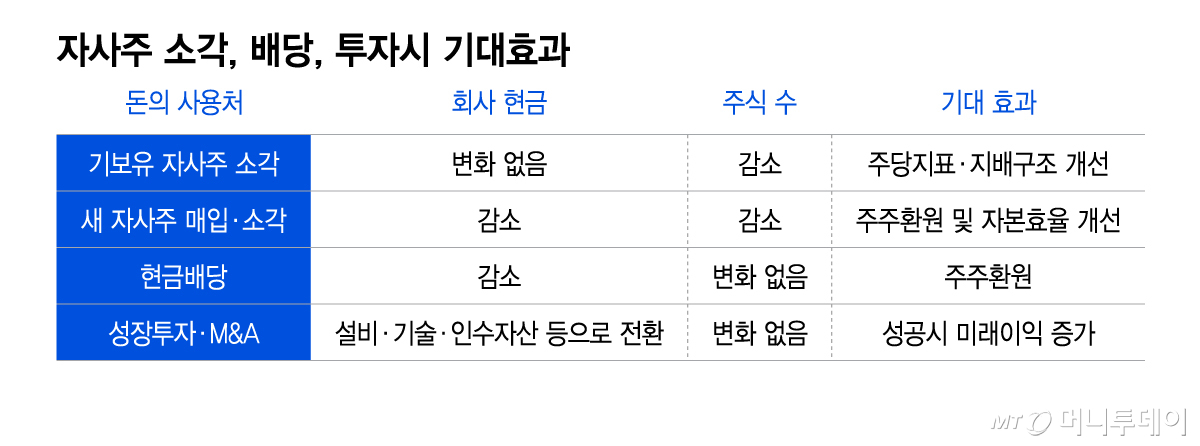
Recent studies also distinguish between destruction itself and rising corporate valuation. Professor Chung Dong-jun of Chungnam National University analyzed in a recently published paper that treasury share destruction itself is 'value-neutral'. He pointed out that destroying treasury shares does not generate new cash or profits for the company.
The significance of mandatory destruction lies in improving corporate governance. Professor Chung analyzed that while holding large amounts of treasury shares could allow major shareholders to transfer them to friendly parties and strengthen their control, mandatory destruction blocks such possibilities, leading the market to evaluate it positively.
However, experts emphasize that corporate valuation is ultimately determined by profits, cash flow, growth investments, and capital efficiency. A financial investment industry official stated, "If mandatory treasury share destruction is a system that improves corporate governance and lays the foundation for a value-up program, then raising actual corporate valuation on top of that is the company's responsibility." He added, "Ultimately, what matters is not how much was burned, but how well it was managed."

 in STOCK

