

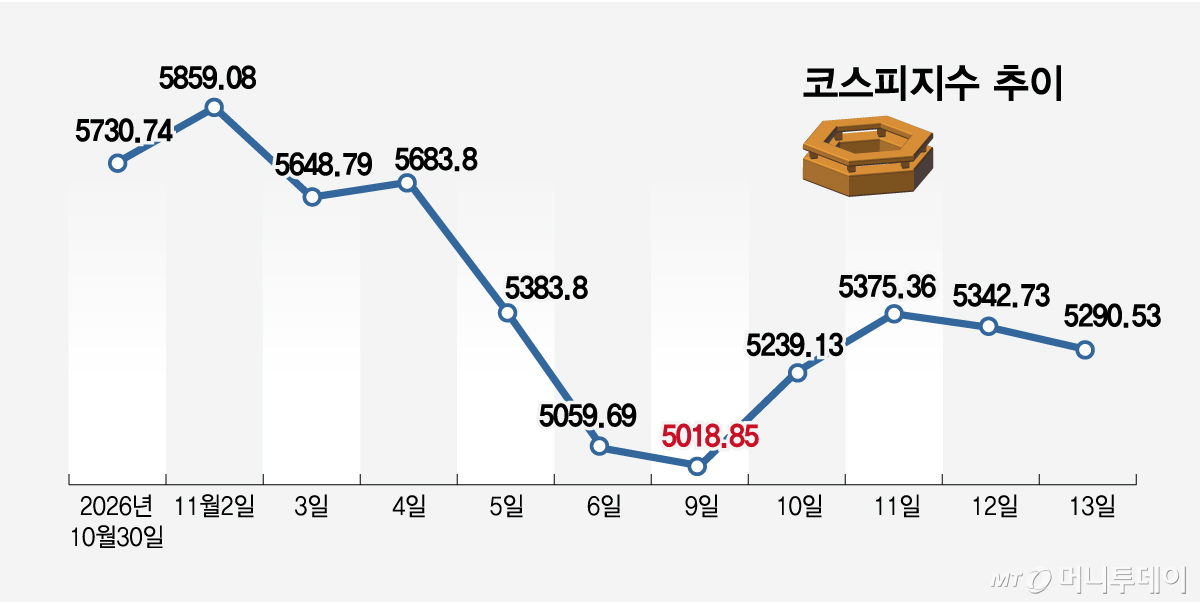
The KOSPI, which rebounded slightly after a sharp drop earlier this month, faces major events that will determine the direction of the AI (artificial intelligence) industry. The first NVIDIA earnings report since CEO (Chief Executive Officer) Jensen Huang’s departure and Anthropic’s IPO (initial public offering) are expected to serve as a test for restoring investor sentiment.
According to Korea Exchange on the 15th, the KOSPI closed at 5,290.53 last week (the 9th–13th), up 230.84 points (4.56%) from the previous weekend’s close (5,059.69). The index, which had plunged on concerns over AI data center regulations following the U.S. midterm elections, partially recovered its losses as bargain-hunting buying flowed in.
CoreWeave’s strong earnings also supported the rebound. CoreWeave, which had raised doubts about the sustainability of AI investment, announced results that exceeded market expectations. It also revised its annual revenue forecast upward. However, with Jensen Huang’s resignation increasing management uncertainty at NVIDIA, AI investor sentiment has once again become murky.
The securities industry predicted that next week (the 16th–20th), the KOSPI index will move depending on the outcomes of major AI events such as NVIDIA’s earnings announcement and Anthropic’s IPO. While analysis suggested a low probability that Jensen Huang’s resignation would lead to a slump across the entire AI industry, views diverged regarding the strength and sustainability of the stock market rebound.
NH Investment & Securities presented an expected range for the KOSPI next week of 5,200–6,000. It cited NVIDIA’s earnings and the Fed (Federal Reserve System)’s assessment of AI productivity as upside factors, while pointing to uncertainty related to Jensen Huang and hawkish remarks from Federal Reserve officials as downside factors.
Researcher Na Jung-hwan at NH Investment & Securities explained, “If the Productivity and Employment Task Force conference on the 16th (local time), attended by Kevin Warsh, Chair of the Federal Reserve System (Fed), yields an assessment that AI is leading to productivity gains, this could strengthen expectations for price stability and lead to the interpretation that the need for additional rate hikes has diminished.”
In that sense, analysis suggests that NVIDIA’s earnings report, scheduled for the 17th (local time), could be the biggest variable for the domestic market. Market attention is focused not only on the earnings figures but also on the business direction to be presented by the new management team.
Researcher Na Jung-hwan stated, “The Jensen Huang incident has accelerated discussions in the U.S. Congress about strengthening semiconductor export controls against China, such as the AI Overwatch Act, making it difficult for NVIDIA to expand sales to China for the time being,” and added, “NVIDIA’s response strategy to the U.S. government’s strengthened regulations on AI data center construction and exports to China is expected to be a key point of interest.” The AI Overwatch Act is a bill that strengthens congressional oversight authority in the process of issuing export licenses for advanced AI chips to countries of concern, such as China.
The securities industry currently sees a low probability that NVIDIA’s crisis will spread into a slump across the entire AI industry. Researcher Ko Min-sung at NH Investment & Securities explained, “Development is on track even up to the next-generation Feynman architecture (NVIDIA AI roadmap), and competitors with the capability to replace NVIDIA, such as AMD and Broadcom, remain strong,” adding, “Excessive concern about the infrastructure as a whole is unnecessary.”
Anthropic’s IPO is also a two-sided variable. If it succeeds, it could serve as an opportunity to restore confidence in the growth potential of the AI industry. On the other hand, if investors sell existing stocks to raise funds for the IPO investment, it could act as a supply-demand burden on the domestic stock market.
The securities industry viewed that while bottom signals are appearing in the domestic stock market, it is premature to expect a trend-based rebound. Senior Researcher Kim Jong-min at Samsung Securities pointed out, “While numerous significant signals indicating a market bottom, such as a decrease in credit loan balances and improved investor sentiment, have been detected, the ‘trigger’ that would drive a trend-based rebound remains ambiguous.” Researcher Kim Seong-no at BNK Investment & Securities also predicted, “Due to foreign selling, outflows from equity funds, and a decrease in customer deposits, there is insufficient momentum to resolve undervaluation on the supply-demand side, so a box-range trend will likely continue for the time being.”
The possibility of additional tightening in the U.S. also warrants attention. With the U.S. CPI (consumer price index) for October rising 0.4% month-on-month, exceeding market forecasts (0.3%), concerns grew over an expanded rate hike by the Federal Reserve next month. Researcher Kim Seong-no analyzed that a 50bp (1bp = 0.01 percentage point) hike at the December FOMC (Federal Open Market Committee) is possible based on the theoretical interest rate reflecting inflation and employment. However, he added, “Since the theoretical interest rate has reached its peak, the possibility of an aggressive hike is low.”

 in STOCK
