

With the strengthening of market capitalization-based delisting criteria for KOSPI and KOSDAQ pushed back by six months to July next year, nearly 500 listed companies facing the threat of delisting have been given a reprieve. However, as criticism continues that market capitalization does not accurately reflect a company's actual financial condition, voices are growing louder that additional supplementary measures must be prepared during the grace period.
Exchange revises listing rules on the 23rd… "Issue with abrupt revision of delisting criteria"
According to Korea Exchange (hereinafter referred to as the Exchange) on the 29th, the Exchange posted the revised contents of the "KOSPI Listing Rules" and "KOSDAQ Market Listing Rules" on the KRX Legal Portal.
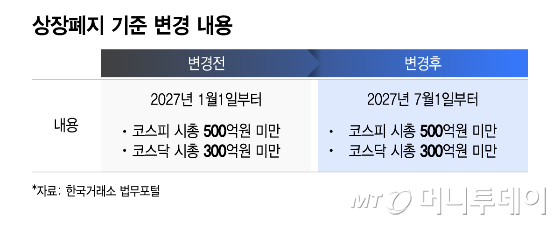
The core of the revision is to delay by six months, from January next year to July of the same year, the timing for raising the market capitalization threshold from 30 billion won to 50 billion won for KOSPI and from 20 billion won to 30 billion won for KOSDAQ.
Currently, companies with a market capitalization below 30 billion won on KOSPI or 20 billion won on KOSDAQ are subject to delisting. However, failing to meet the threshold does not immediately result in delisting. If a company fails to meet the criteria for 30 consecutive trading days, it is designated as a managed stock. Subsequently, if it fails to maintain the required market capitalization for 45 consecutive trading days within the following 90 days, it proceeds toward delisting.
With this rule revision postponing the plan to strengthen criteria in both major markets, companies that fall below or are on the borderline of the threshold market capitalization have been given a reprieve.
According to an analysis released by corporate research institute Leaders Index on the 11th of last month, out of 2,578 domestic listed companies reviewed, nearly 500 companies had an average July market capitalization below the strengthened thresholds of 50 billion won for KOSPI and 30 billion won for KOSDAQ. In particular, approximately 370 companies on KOSDAQ failed to meet the criteria, meaning one in five listed companies was affected.
Um Su-jin, a researcher at Hanwha Investment & Securities, stated, "Considering market capitalization as one of the delisting requirements is not inherently problematic, but pushing the revision too abruptly is a measure that overlooks the fact that stock prices do not always stably reflect a company's intrinsic value," emphasizing, "Market participants must keep in mind that the reasons for corporate valuation are not always rational."
More time to consider policy suitability; sufficient exit strategies needed… "More mechanisms needed to mitigate delisting shock"
Capital market practitioners point out that since there is now time to assess policy suitability, more exit strategies should be prepared to prevent unintended victims. Some also broaden the discussion by questioning whether market capitalization is an appropriate yardstick for judging corporate insolvency.
In fact, according to research by the Korea Capital Market Institute, after the market capitalization delisting thresholds were raised to 30 billion won for KOSPI and 20 billion won for KOSDAQ in July last year, 45% of companies designated as managed stocks attempted capital structure adjustments such as rights offerings (paid-in capital increases) and stock consolidations. However, the institute's analysis found that a significant number of companies that implemented stock consolidations saw their stock prices fall again after the change in listing status.
Ahn Yu-mi, a senior researcher at the Korea Capital Market Institute, said, "It has been confirmed that meeting market price criteria does not necessarily align with a company's substantive financial condition," adding, "Along with recent government supplementary measures, we need to review the results of applying current criteria and the characteristics of actually delisted companies to effectively achieve the policy goal of improving market order, and continuously monitor the impact of further raising criteria on companies and the market."
In this context, it is evaluated as a good example of a policy exit strategy that the Exchange, while revising listing rules on the 23rd last month, also opened the path for transfer listings to KONEX to help delisting-targeted companies mitigate shock. A source in the securities industry said, "There are already reports of companies submitting applications to transfer from KOSDAQ to KONEX, indicating that the related exit strategy is not bad," and added, "Multiple realistic safety nets must be established to mitigate the shock of the delisting system."

 in STOCK
