

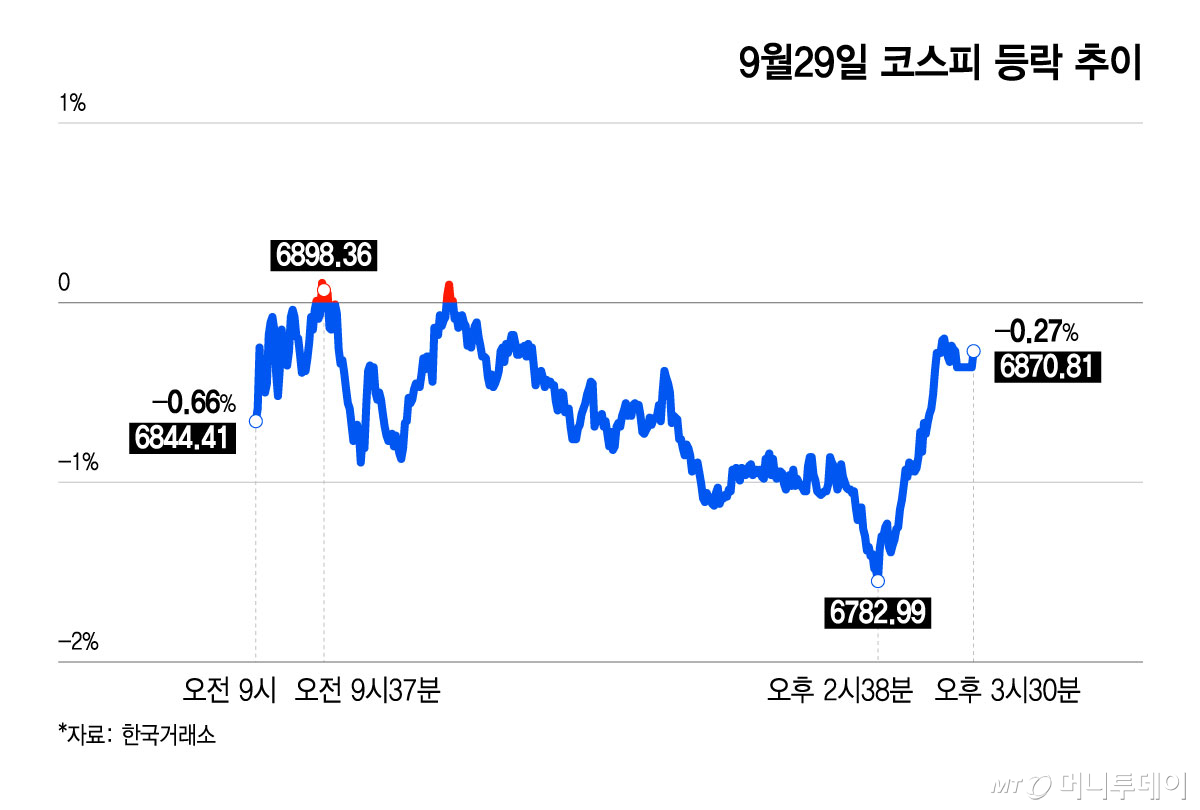
The KOSPI index closed slightly lower on the 29th, remaining in the 6,800 range. Rising U.S. market interest rates dragged down the domestic stock market for two consecutive days. As war-related uncertainties resurface, the market's focus is once again shifting toward inflation and earnings trends.
On this day, the KOSPI index closed at 6,870.81, down 18.93 points (0.27%) from the previous trading session. The intraday range was 115.37 points.
Amid tightening concerns weighing on the overall market, Samsung Electronics, which plunged sharply the previous day, closed at 272,500 won, up 2,500 won (0.93%), alleviating downward pressure on the index. In regular trading, 232 stocks rose while 624 fell.
Among top market capitalization stocks, SK Hynix closed slightly lower at 1,765,000 won, down 3,000 won (0.17%), while SK Square and Samsung Electro-Mechanics both showed strength in the 1st% range, preventing further decline in the index.
However, selling pressure intensified for non-semiconductor stocks. LG Energy Solution showed weakness in the 3rd% range, while Hyundai Motor and Samsung Biologics were down in the 1st% range. By sector, KOSPI construction fell in the 4th% range, metals, chemicals, paper and wood, and general services dropped in the 2nd% range, and transportation equipment, electric and gas, IT services, entertainment and culture, insurance, and telecommunications declined in the 1st% range.
U.S. Treasury yields acted as a negative factor even before the market opened. The U.S. 10-year Treasury yield temporarily rose to 5.241% on the 28th (local time), marking its highest level since June 2007. International oil prices rose after the U.S. Trump administration rejected Iran's "7-day ceasefire" proposal, reigniting selling pressure on Treasuries.
Lee Kyung-min, a researcher at Daishin Securities, stated, "The fact that Lisa Cook, a Federal Reserve (Fed) board member, mentioned that inflation pressure could persist for several months due to AI-related demand and rising oil prices also increased upward pressure on interest rates," adding, "OpenAI's cancellation of the GPT-6.1 Astra launch also weighed on AI investment sentiment."
Lim Jeong-eun and Tae Yoon-sun, researchers at KB Securities, said, "The key is whether expectations for earnings growth can be sustained," noting, "The market is expected to assess its stability by digesting major events, starting with the U.S. August PCE (Personal Consumption Expenditures) price index to be released on the night of the 30th (Korean time), followed by Micron Technology's earnings and employment indicators."
The KOSDAQ index closed at 849.80, up 3.22 points (0.38%) from the previous trading session. Retail investors made net purchases worth 176.6 billion won, while foreign investors and institutional investors made net sales of 143.2 billion won and 7.3 billion won, respectively.
Among top market capitalization stocks, semiconductor materials, components and equipment (so-bu-bang) stocks performed well, lifting the index toward the close. This is interpreted as being driven by expectations for benefits from news of Samsung Electro-Mechanics' production facility expansion and large-scale supply contracts. Jusung Engineering showed strength in the 6th% range, Wonik IPS and Iotech in the 5th% range, and Simmtech and Rino Industrial in the 3rd% range.
By sector, KOSDAQ non-metals and machinery equipment rose in the 3rd% range, while textiles and apparel, manufacturing, and chemicals increased in the 1st% range. Finance and construction closed down in the 2nd% range, and publishing, transportation equipment, metals, and IT services ended weak in the 1st% range.
On this day, the won/dollar exchange rate closed at 1,356.7 won for Seoul foreign exchange market daytime trading, down 8.4 won from the previous trading session.

 in STOCK
