

# As the share prices of domestic market top two companies, including Samsung Electronics and SK Hynix, surged this year, European asset management firms have been busy. This is because portfolios requiring rebalancing are emerging as they reach investment weight limits by country and stock. It is reported that some large asset managers and pension funds attempted indirect investments through related stocks, but even these hit internal regulatory hurdles such as market capitalization, prompting expressions of regret.
The pace of domestic securities firms’ expansion into Europe, long considered an untapped frontier, is also gaining momentum. Europe was one of the initial overseas destinations about 40 years ago, but did not achieve significant results. However, the local market, once viewed as a fortress, appears to be opening entry routes recently, riding the wave of the KOSPI rally.
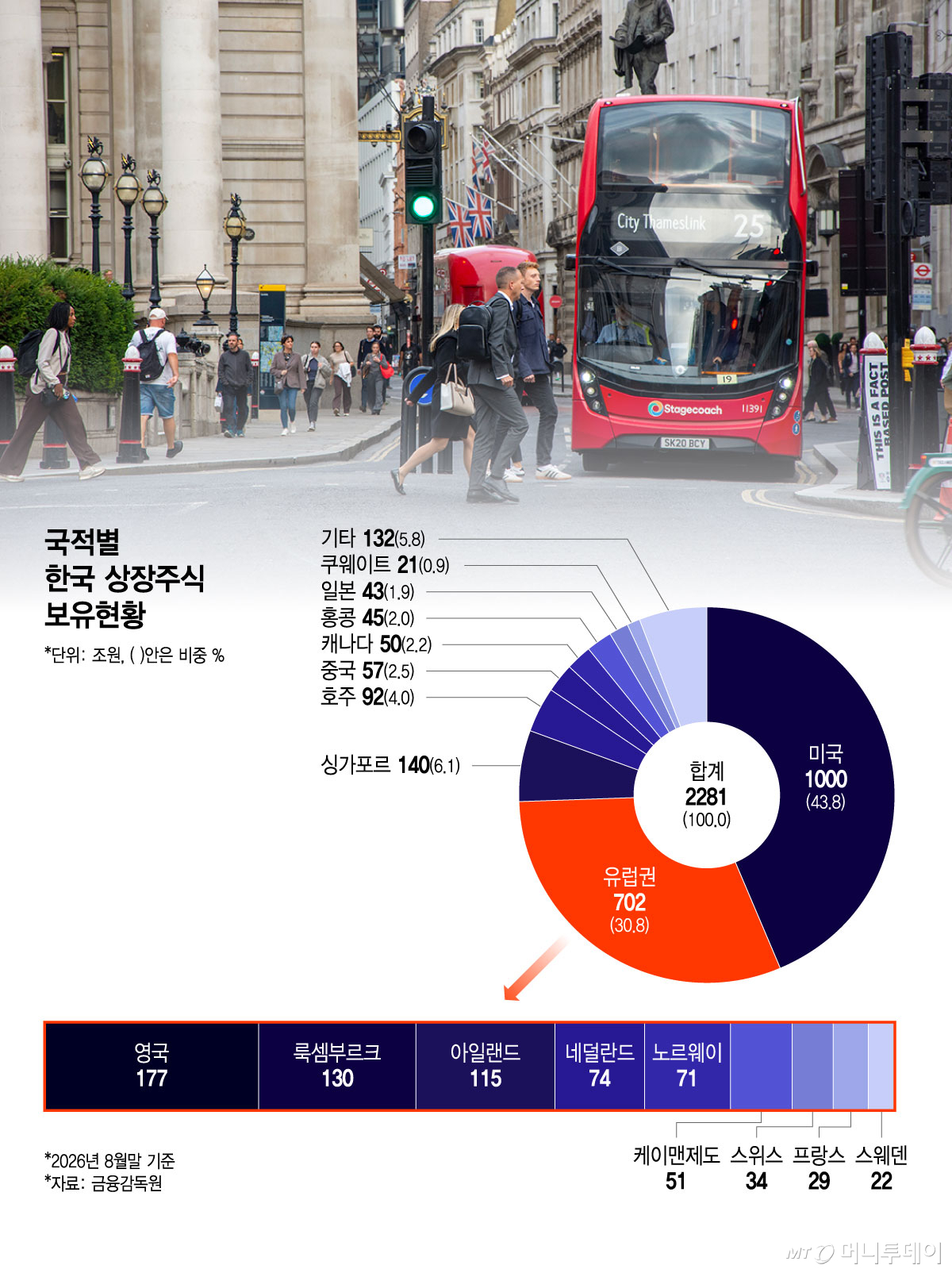
According to the Financial Supervisory Service and others on the 30th, the combined holdings of Korean listed stocks by foreign investors in nine European countries, including the UK, Luxembourg, Ireland, and the Netherlands, reached 702 trillion won as of the end of last month, a 137.2% increase from the same period last year. This exceeds the KOSPI’s rise rate (114.1%).
Industry insiders in the domestic financial investment sector who have entered Europe unanimously said they can easily feel the recent interest from European finance circles toward Korea. Han Chung-seok, head of the Korea Exchange London Office, stated, “Until last year, there was a view to ‘wait and see’ regarding Korea, but this year it seems to be regarded as a market that cannot be ignored.” He added, “The participation level in investor roadshows (IR) held with local investment banks (IBs) was very high compared to last year, and the depth of questions has also increased.”
Europe has long been considered a difficult terrain for the Korean securities industry. Initially, firms mainly engaged in intermediating Korean stocks to local institutional investors but failed to achieve significant results. Market entry is not easy due to market characteristics where investment assets are concentrated in pensions, insurance, and funds, giving institutional investors significant influence. Additionally, the track records of global financial firms that have been rooted for over 100 years act as a double hurdle. In the early 2010s, securities firms also successively withdrew their European subsidiaries.
Following recent trends in improved perception of the Korean stock market, Korean securities firms remaining in London are tightening the reins to attack the European market centered on their respective specialized survival strategies. Korea Investment & Securities and Samsung Securities target institutional investors in Europe with Korean stock brokerage, while NH Investment & Securities focuses on discovering local infrastructure and corporate finance deals. Mirae Asset Securities has expanded its base by acquiring an exchange-traded fund (ETF) market maker and establishing a new entity for proprietary investment (PI), in addition to its local subsidiary which concurrently handles brokerage, IB, and PI businesses.
Securities firms’ overseas net profit is not high, at about 8.7% of total net profit (based on last year), and the European region’s share is negligible, accounting for less than 5% of total overseas subsidiary net profits. The revenue from the European region is also not large for each securities firm individually. According to semi-annual reports, the net operating profit of the London subsidiaries of Korea Investment & Securities, Samsung Securities, and NH Investment & Securities in the first half of this year was limited to around 2 billion won each. Mirae Asset Securities, which discloses consolidated results for overseas subsidiaries, is estimated to have earned a pre-tax profit of 109.6 billion won in London in the second quarter, but its profit share by country was 18%, trailing behind the US (37%) and Hong Kong (35%).
However, it is pointed out that Europe cannot be neglected from the perspective of strategic importance, as maintaining a foothold in a well-funded advanced capital market allows for monitoring trends. This is why financial authorities and major securities firms have held local IRs multiple times. The Financial Supervisory Service held a private IR event inviting senior officials from local institutional investors, chaired by Lee Chan-jin (Director), in London earlier this month. A total of 22 companies attended, including seven global large IBs such as Goldman Sachs, Morgan Stanley, and PIMCO, and 15 asset management firms. Domestic financial institutions such as Shinhan Financial Group, Woori Financial Group, Korea Investment & Securities, and NH Investment & Securities also participated.

Korea’s efforts to enhance corporate valuation (value-up program) are also gaining resonance with European institutional investors who emphasize intrinsic value. Ki Min-seok, head of Korea Investment & Securities’ London subsidiary, said, “Europe is a place where they remain unresponsive for the initial 2-3 years, but once trading begins, it continues for 10 to 20 years.” He added, “Currently, we are working to build relationships with European family offices. There is joy in acquiring new clients.”
Amid rapidly changing policies and markets within Korea, the bridging role of our securities firms, which provide swift forecasts and response plans based on regional expertise, is also being highlighted locally across sectors such as brokerage and IB. They are aiming for new revenue sources with flexibility and customized services that differentiate them from global securities firms.
Lee Yong-seong, head of NH Investment & Securities’ London subsidiary, stated, “Although we are smaller in size compared to global securities firms, we can focus on building and maintaining local networks accordingly.” He added, “We are discovering deals as a ‘one team’ by cooperating with Seoul and other financial hubs.”

 in STOCK

