


"In Europe, ESG is considered at a level that exceeds Korean expectations."
To target Europe, a traditional advanced financial market, the domestic securities industry emphasized the importance of ESG (environmental, social and governance). As local institutional investors regard the establishment of ESG as one of their key investment criteria, it was pointed out that the domestic stock market cannot ignore this aspect in order to attract massive European capital.
Financial investment industry officials met by Money Today recently in London, UK, explained that ESG has become the final hurdle for European pension funds and asset management companies when selecting their last investment destinations. They noted that it is not uncommon for companies boasting high returns based on strong fundamentals to be held back by ESG risks.
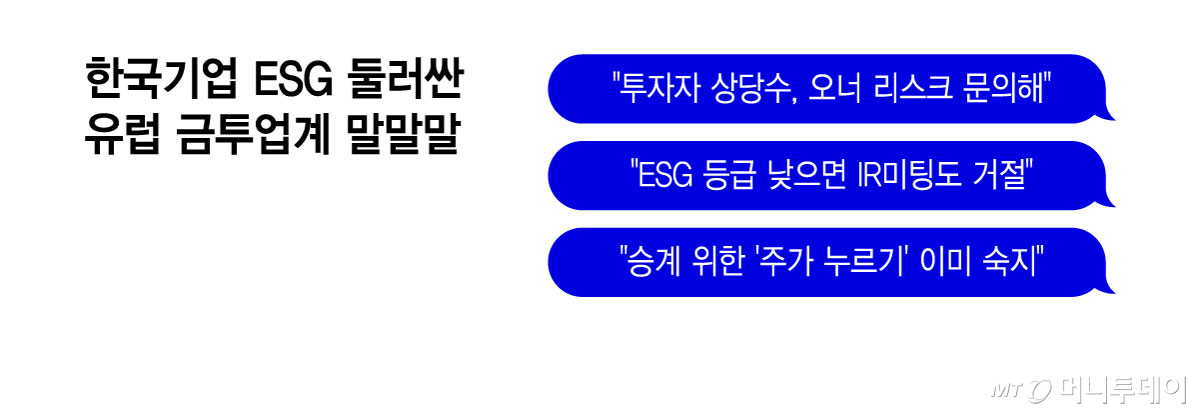
In fact, it is known that a certain institutional investor in Europe, which initially did not invest in a specific Korean stock, considered relaxing its internal regulations and initiating investment after the stock price surged sharply, raising the benchmark (performance comparison standard) return rate and threatening the relative performance of its own fund, but ultimately gave up. ESG due diligence acted as a last-minute variable. A securities industry official said, "The institutional investor relaxed its investment criteria through internal procedures that extended past the year-end, but the investment fell through due to owner risk highlighted in individual stocks," adding, "There are also places that refuse even proposals for corporate IR meetings if their MSCI (Morgan Stanley Capital International) ESG rating is inadequate."
Among the components of ESG, governance (G) is specifically identified as a weakness for Korean companies. Specifically, lack of transparency in ownership structure and decision-making that runs counter to the interests of general shareholders are cited as reasons for rejection, along with "owner risk." Because owner risk is difficult to predict in terms of occurrence probability, it is typically evaluated based on records such as shareholding structures or criminal histories. Some institutional investors also keep a close eye on violent crimes, not just economic crimes such as embezzlement and breach of trust. This is a practice that mainly appears in countries where criminal organizations have infiltrated the industrial sector, causing turmoil.
Domestic and international officials hinted that Korean small- and mid-cap stocks cannot escape inquiries from European institutional investors regarding governance risks. It is assessed that securing funds for inheritance tax or establishing succession structures has already become a prerequisite known before investment. It was reported that European institutional investors had been watching the possibility of "stock price suppression" even before low PBR (price-to-book ratio) resolution plans were discussed in the Korean financial investment industry.
Another official said, "It is no exaggeration to say that the most frequent investment inquiries received from local institutional investors are questions related to owner risk," adding, "Since accident cases continue to be reported even at large corporations, many institutional investors point out that the governance of Korean companies needs improvement."
Local officials also drew a line regarding the possibility that the "anti-ESG" trend emerging after the inauguration of the second Trump administration in the United States could spread to the European investment market. The reason is that the decline of ESG funds, which were once a hot topic, is merely a phenomenon that occurred as thematic popularity subsided, and no change in decision-making trends among institutional investors with large-scale managed assets has been detected.
While ESG has emerged as an ideological point of contention in the United States, Europe is currently in a state where numerous prestigious regulations have been introduced. It is also observed that, considering the EU's decentralized decision-making system, the possibility of the radical institutional abolition carried out by the Trump administration being replicated in the European region is slim.
One official said, "For companies of a scale that are considering attracting investment from European institutional investors and others in Korea, it is more realistic to first consider the opportunity costs arising from the failure to attract European capital rather than the sunk costs that would occur if ESG regulations were relaxed in the future."

 in STOCK

