

As virtual asset prices fell nearly 70% from their peak in the first half of this year, the domestic virtual asset market capitalization shrank to 59 trillion won. This means that 28 trillion won evaporated in just six months.
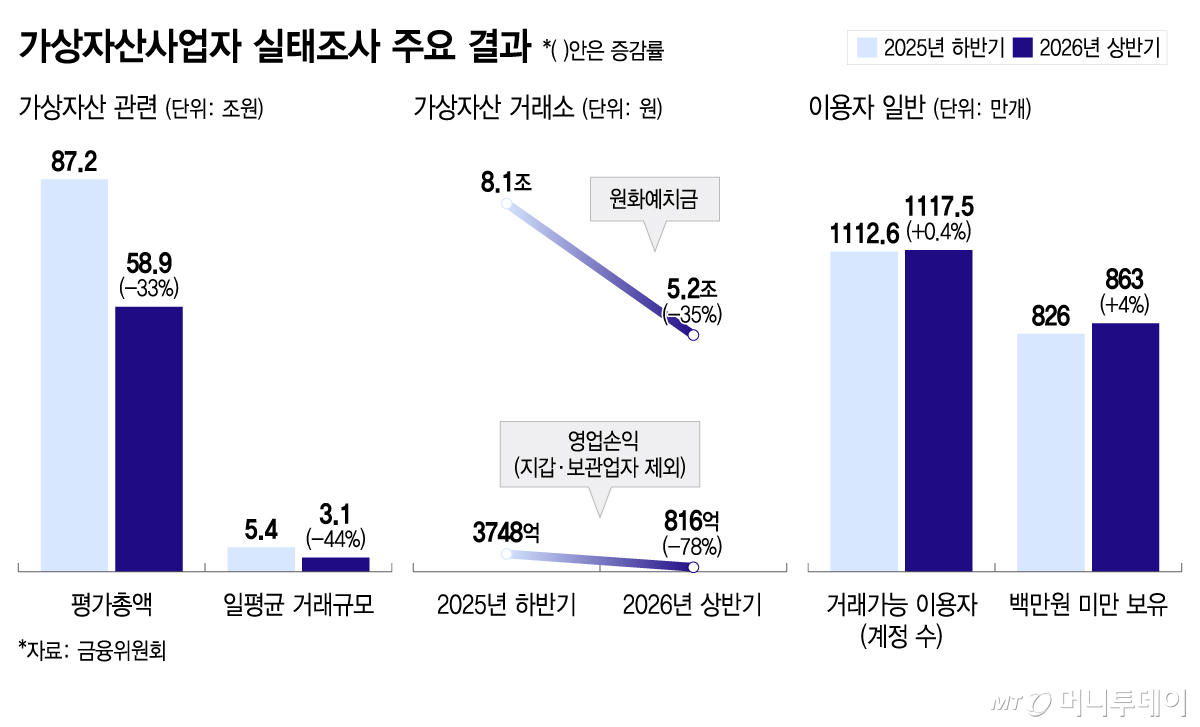
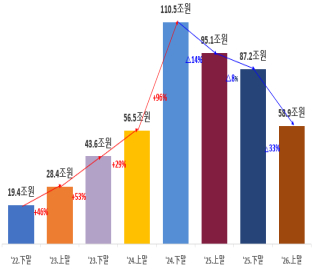
According to the 'H1 2026 Survey of Virtual Asset Business Operators' released by the Financial Services Commission's Financial Intelligence Unit (FIU) on the 1st, the total valuation (market capitalization) of domestic virtual assets as of the end of June was 58.9 trillion won, a decrease of 28.3 trillion won (33%) from the end of last year. Compared to the end of 2024, when it first surpassed 100 trillion won, the figure has been halved.
The total valuation of virtual assets had continued to decline, standing at △110.5 trillion won at the end of 2024, △95.1 trillion won at the end of June last year, and △87.2 trillion won at the end of last year.
The daily average trading volume in the first half of this year was 3.1 trillion won, a 44% decrease from the second half of last year (5.4 trillion won). The monthly daily average trading volume in the won market was △3.6 trillion won in January, △4.5 trillion won in February, △2.8 trillion won in March, △2.7 trillion won in April, △2.4 trillion won in May, and △2.4 trillion won in June, showing a steady decline after February. User won deposits, which represent idle trading funds, decreased by 35% to 5.2 trillion won.
This is due to the sharp drop in virtual asset prices. In particular, it is analyzed that the decline widened as inflation pressure increased due to war, lowering expectations for interest rate cuts and strengthening risk-averse sentiment toward risky assets. The Maximum Drawdown (MDD) of virtual assets in the first half was 69%, a larger drop than the stock market. During the same period, the MDD for KOSPI was 55% and for KOSDAQ was 31%. Bitcoin (BTC) fell by 40%, Ethereum (ETH) by 57%, and Tether (USDT) by 10%.
The total number of virtual assets circulating domestically is 673 types (excluding duplicates), a 5% decrease from the end of last year. Among these, single-listed virtual assets decreased by 21%. Single-listed virtual assets refer to those issued by Koreans or primarily traded on domestic business operators' platforms.
New listings were also sluggish. The number of new trading support (listings) was 135 cases, a 46% decrease from the second half of last year. Conversely, the number of virtual assets with trading suspended (delisted) and those designated as cautionary stocks increased by 64% and 46%, respectively.
The number of users (number of tradable accounts) at domestic virtual asset exchanges was 11.175 million, a slight increase from the previous year, but the majority of accounts held less than 0.1 billion won. The proportion of accounts holding more than 0.1 billion won was 8% (890,000 accounts), and those holding more than 1 million won was 1% (110,000 accounts), down by 2 percentage points and 0.5 percentage points, respectively, from the end of last year.
As trading volumes decreased, the performance of virtual asset business operators also deteriorated. The revenue of the 26th surveyed virtual asset business operators (17 exchanges, 9 wallet/custody providers) was 576.8 billion won, a 41% decrease from the second half of last year. Operating profit fell by 78% to 81.6 billion won. The capital adequacy ratio (equity/total assets), which indicates financial soundness, rose by 8.4 percentage points to 49.6%.
An official from the Financial Services Commission stated, "The domestic total valuation of single-listed virtual assets is 600 billion won, accounting for 1% of the whole, but 40% of these stocks are small-scale with a total valuation of less than 1 million won," adding, "It is necessary to be cautious about issues such as lack of liquidity and sharp price fluctuations."

 in STOCK

