

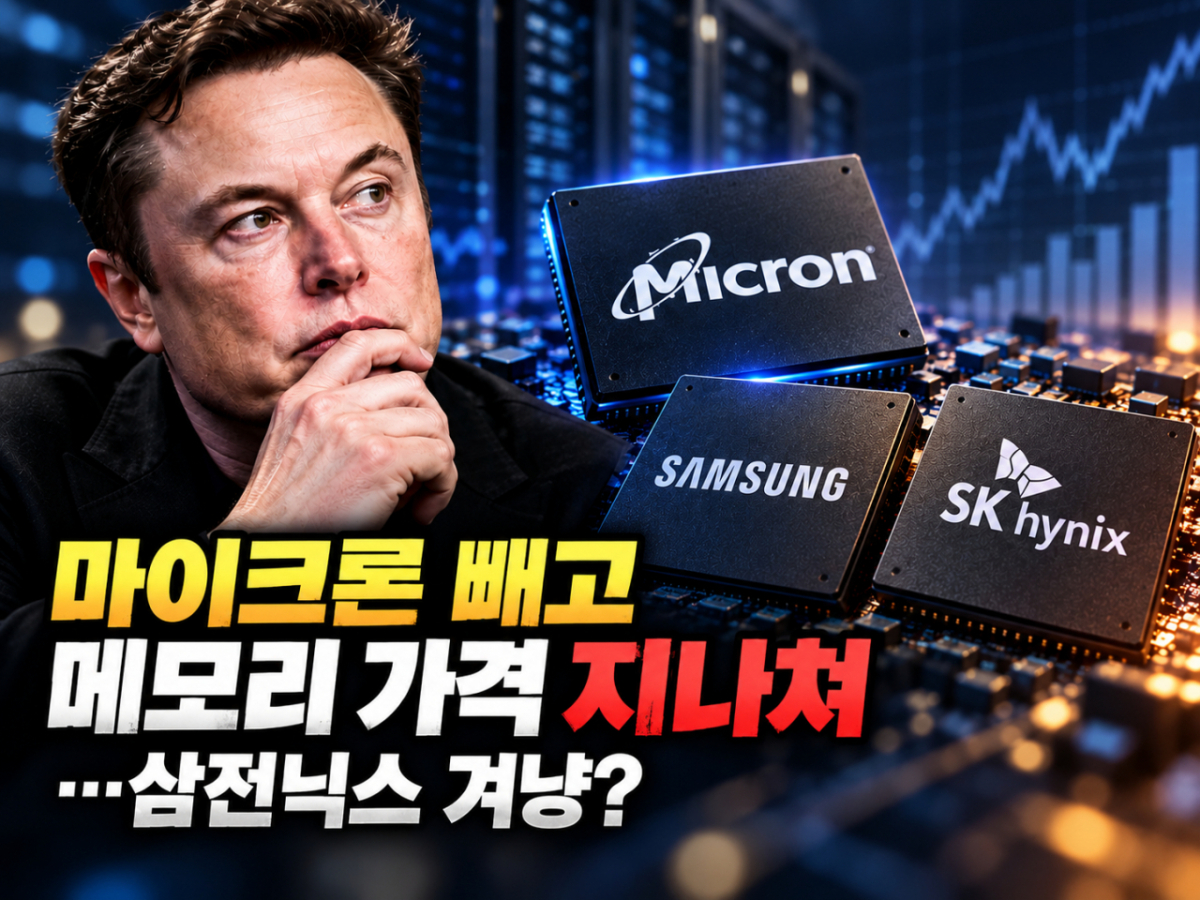
Elon Musk, CEO of Tesla and SpaceX, publicly criticized the pricing policies of memory semiconductor companies other than U.S.-based Micron. With the global memory market led by Samsung Electronics, SK hynix, and Micron, attention is focused on whether his remarks were directed at domestic firms.
On Wednesday, Musk said on X (formerly Twitter), "Micron has shown a reasonable attitude regarding future memory prices, but other companies have been demanding absurdly high prices." He added, "This is something current customers will not forget," and noted that "Micron is making a wise choice to secure long-term customer loyalty."
The remarks were made while commenting on a post introducing global investment bank JPMorgan's outlook for the memory semiconductor market. JPMorgan forecasted that the memory supply shortage rate would reach approximately 20% in 2026, 19% in 2027, and 15% even in 2028.
It also projected that the size of the HBM (High Bandwidth Memory) market, which has seen surging demand due to the expansion of the AI (Artificial Intelligence) industry, would expand from approximately $64 billion in 2026 to $280 billion in 2028.
As the memory supply shortage persists, semiconductor manufacturers' bargaining power on pricing is also increasing. JPMorgan analyzed that Micron has secured 26 long-term supply contracts and has entered into supply agreements for more than 75% of its production volume for fiscal year 2027. It noted that new contracts are being signed reflecting the current high price levels.
The global DRAM market is led by three companies: Samsung Electronics, SK hynix, and Micron. These companies are also competing in the HBM market used in AI servers. Since Musk publicly praised Micron while criticizing the pricing policies of other firms, there is a possibility that his remarks were intended for Samsung Electronics and SK hynix. However, Musk did not directly name the two companies, nor did he disclose the actual details of price negotiations.
The impact of rising memory prices is spreading to the consumer market as well. As component prices such as DRAM increase, smartphone and PC manufacturers are facing higher cost burdens, putting upward pressure on finished product prices.
Although manufacturers' bargaining power is increasing due to the memory supply shortage, Musk's remarks can be read as a warning that this advantage does not guarantee long-term customer relationships. Attention is now turning to what pricing strategies major memory companies such as Samsung Electronics and SK hynix will choose between immediate profitability and long-term customer trust.

 in TECH
