

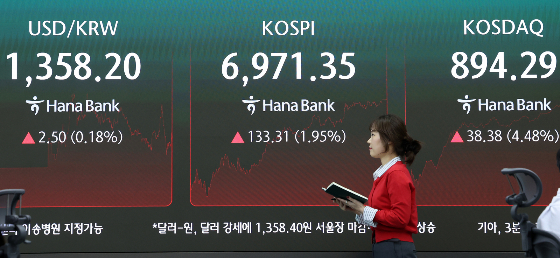
The KOSPI rose to within striking distance of the 7,000 mark, driven by a favorable semiconductor environment both domestically and abroad. This was influenced by a series of positive factors, including U.S. semiconductor company Micron reporting earnings that exceeded market expectations, and South Korea's September exports surpassing $120 billion for the first time in history. Meanwhile, attention is turning to whether the results of the U.S. Institute for Supply Management (ISM) September Manufacturing Purchasing Managers' Index (PMI), to be released on the 1st (local time), can calm the rising interest rate trend, as the yield on 10-year U.S. Treasury bonds entered the 5.3% range intraday overnight, marking its highest level since 2002.
On the 1st, the KOSPI closed at 6,971.35, up 133.31 points (1.95%) from the previous trading session. It dipped slightly in early trading but rebounded to close higher, buoyed by news of strong exports.
Micron announced after market close on the 30th (local time) that its adjusted earnings per share (EPS) for the fourth quarter of fiscal year 2026 (June–August) was $33.42. This record figure exceeded the market forecast of $31.72. Revenue also surpassed expectations, rising 379% year-on-year to $54 billion, compared to the projected $51 billion. The revenue guidance for the first quarter of fiscal year 2027 (September–November) was also set at $61.5 billion, exceeding the market forecast of $57 billion.
In a conference call, Micron emphasized that its current results are less about a rebound in memory prices and more indicative of a structural cycle where supply shortages will persist through 2027–2028. Indeed, the number of binding long-term supply agreements (SCAs) announced by Micron increased from 16 to 26. The company also expanded its capital expenditures to meet growing demand. Micron plans to invest approximately $25 billion in the first half of next year, an amount approaching this year's annual capital expenditure scale.
The KOSPI index also gained momentum as South Korea's September export results were released during trading hours. September exports rose 83.5% year-on-year to $120.9 billion, with semiconductors in particular surging 262.8% to $60.3 billion.
Lee Kyung-min, Head of FICC at Daishin Securities, stated, "Micron's strong earnings report and South Korea's robust September exports led to semiconductor buying." He added, "In particular, Micron's expansion of capital expenditures reaffirmed confidence in the memory industry outlook, as it represents investment aimed at expanding medium- to long-term production capacity."
On this day, in the KOSPI market (based on Korea Exchange data), institutional investors bought a net amount of 334.5 billion won. Retail and foreign investors sold a net amount of 1,430.5 billion won and 544.1 billion won, respectively.
Among KOSPI sectors, medical and precision instruments closed with strong gains in the 5th% range. Pharmaceuticals, electrical and electronics, securities, and manufacturing rose by more than 2%. Analysts noted that pharmaceuticals and biotechnology showed broad strength due to their undervaluation relative to earnings. Metals, textiles and apparel, machinery and equipment, and IT (information and communications) services rose in the 1st% range. Electricity and gas, general services, distribution, transportation and warehousing, real estate, and telecommunications ended with slight gains. Insurance, finance, and construction remained slightly lower. Chemicals fell by more than 1%.
Among top KOSPI market capitalization stocks, Samsung Electronics and SK Hynix rose in the 2nd% and 3% ranges, respectively. Samsung Electro-Mechanics and Samsung Biologics gained in the 3rd% and 2% ranges, respectively. SK Square, Samsung C&T, and Hyundai Motor rose by more than 1%. Samsung Life Insurance and LG Energy Solution closed with slight gains. Among stocks ranked in the top 10 by market capitalization, only KB Financial Group fell in the 1st% range.
The KOSDAQ closed at 894.29, up 38.38 points (4.48%) from the previous trading session.
In the KOSDAQ market, foreign and institutional investors made net purchases of 230.7 billion won and 568.1 billion won, respectively. Retail investors made net sales of 776.1 billion won.
Among KOSDAQ sectors, machinery and equipment surged in the 6th% range. Manufacturing, electrical and electronics, pharmaceuticals, medical and precision instruments, chemicals, and finance rose by more than 4%. Distribution, transportation equipment and parts gained in the 2nd% range, while IT (information and communications) services, construction, and others rose in the 1st% range. Food and tobacco closed with slight gains, while entertainment and culture ended with slight losses.
Among top KOSDAQ market capitalization stocks, Rino Industrial surged in the 10th% range, and Wonik IPS jumped in the 9th% range. Iotech and HPSP also rose by more than 8%. Simmtech and Jusung Engineering showed strength, rising by more than 5% and 4%, respectively. It is interpreted that the strength of materials, components, and equipment (so-bu-bang) was prominent, as these stocks have relatively greater room for price appreciation compared to large-cap KOSPI semiconductor stocks.
EcoPro, EcoPro BM, and RAINBOW Robotics closed with strong gains in the 5th% range. Alteogen rose by more than 4%.
A variable that could impact the stock market the following day is the ISM (Institute for Supply Management) September Manufacturing Purchasing Managers' Index (PMI), to be released in the U.S. overnight. Analysts point out the need to pay attention to the direction of the price index within the PMI, given the high sensitivity to inflation ahead of the Federal Reserve System (Fed)'s October Federal Open Market Committee (FOMC) meeting. This is because a robust economy can stimulate price increases, which in turn could lead to interest rate hikes.
Han Ji-young, a researcher at Kiwoom Securities, said, "The views of executives in key sectors such as electronics and electrical equipment on AI demand are also crucial." She added, "If bottlenecks in AI-related products are mentioned again, following August, it will confirm the link connecting 'increased AI capital expenditure' to 'actual improvement in capital expenditure demand.'"
On this day, in the Seoul foreign exchange market, the won-dollar exchange rate closed weekly trading at 1,358.4 won, up 5.6 won from the previous trading session.

 in STOCK
