

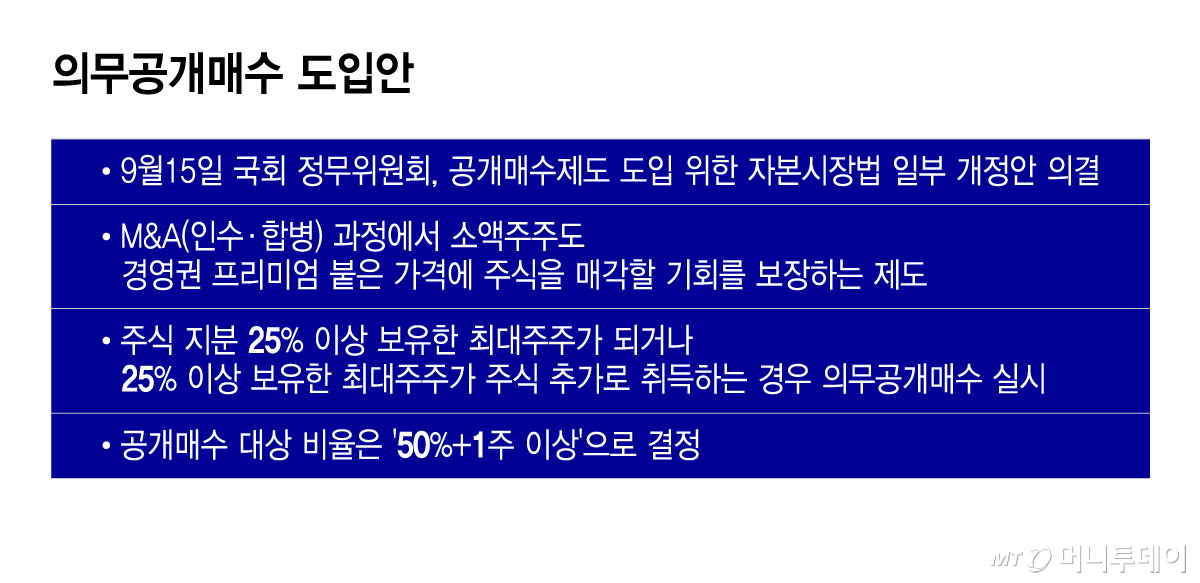
The mandatory tender offer system, which guarantees minority shareholders the opportunity to sell their shares at a price reflecting the control premium during corporate M&A (mergers and acquisitions), is expected to be implemented this year. It is one of the representative measures to protect minority shareholders. The core ratio for the mandatory tender offer was agreed upon as "50%+1 share or more," taking into account market burdens, among other factors.
According to the National Assembly's political circle on the 25th, the Legislation and Judiciary Committee's First Subcommittee of the Political Affairs Committee recently approved a partial revision of the Capital Market Act to introduce the tender offer system. Since the revision has gone through cross-party agreement, it is highly likely to be implemented this year after passing the Legislation and Judiciary Committee and plenary session votes. This system was introduced in 1997 but was abolished just one year later on the grounds that it made M&A difficult during the foreign exchange crisis. It is now being revived for the first time in 28 years since its abolition.
The mandatory tender offer is a system that requires a mandatory public tender offer for a certain percentage of shares when acquiring enough shares to secure control of a listed company. The core principle is that general shareholders have the right to sell their shares at the same price as controlling shareholders. During corporate M&As, major shareholders repeatedly sold their stakes at high prices reflecting the control premium, while general shareholders did not receive fair value. As cases of harm to minority shareholders were pointed out, arguments for reintroducing the system gained momentum, and discussions began in political circles two years ago.
According to the revision, a mandatory tender offer must be implemented when an acquirer purchases shares of the target company to become the largest shareholder with 25% or more of the stake, or when the largest shareholder holding 25% or more acquires additional shares. This also includes cases where convertible bond (CB) rights are exercised.
The key issue of the tender offer ratio was decided as "50%+1 share or more." "50%+1 share or more" means that if a controlling stakeholder secures 25% of shares to become the largest shareholder, they must mandatorily make a public tender offer for the remaining 25% or more.
Opinions had previously diverged over the tender offer ratio, with proposals such as "50%+1 share or more" and "all remaining shares," but it is interpreted that a compromise was reached considering market burdens. In the investment banking (IB) industry, there were concerns that the M&A market could shrink because acquirers would need to prepare more acquisition funds than before. The business community also held the view that it could hinder the sustainability of companies in financial distress by making M&As and restructuring more difficult.
However, opposition remains strong. The Economic Reform Alliance, which had argued that acquirers must purchase all remaining shares (100%) of the target company, stated in a statement on the 16th: "The partial tender offer system does not align at all with the purpose of the mandatory tender offer system promised by President Lee Jae-myung." It further argued, "To achieve the positive effect of the principle of equal treatment of shareholders, a mandatory tender offer system for all remaining shares must be introduced."
The revision stipulates that failure to comply with the mandatory tender offer will result in imprisonment of up to five years or a fine of up to 200 million won. This increases the penalty compared to existing violations of general public tender offers (imprisonment of up to three years or a fine of up to 100 million won), imposing heavier punishment.
Exceptions for application include cases where an acquirer already holds more than 50% of shares and is making additional purchases, or when purchasing shares of companies showing signs of insolvency or undergoing reorganization proceedings. The Ministry of Economy and Finance may add further exceptions by ordinance, comprehensively considering the possibility of infringement on minority shareholder rights, among other factors.

 in STOCK
