

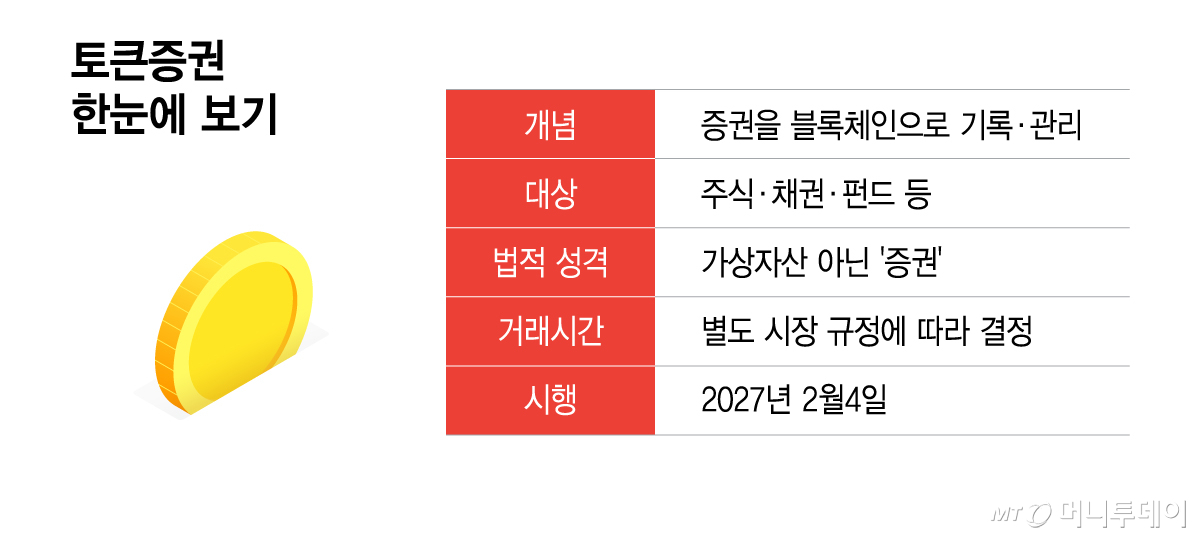
With the implementation of the tokenized securities system just four months away, digital capital market activation policies, including those for fractional investments, are set to be scrutinized during the National Assembly's state audit that began on the 6th. Financial authorities recently put subordinate regulations out for public comment, but the securities industry is still exploring what specific products can be offered and what business models can generate revenue. As political circles also heighten their interest in nurturing the digital asset market, the financial authorities' policy directions—including the licensing of fractional investment OTC exchanges and the activation of new types of securities markets—are expected to be examined together during the audit.
Four months from system launch, but actual business models still 'in exploration'
According to the financial investment industry and political circles, the Financial Services Commission put out for public comment on the 2nd revised subordinate regulations, including the Enforcement Decree of the Capital Markets Act and the Financial Investment Business Regulations, to implement the tokenized securities system. The revised Capital Markets Act and Electronic Securities Act will take effect on February 4 next year. This marks a turning point where a market that had been operated in a limited manner, primarily through regulatory sandboxes, is expanding into an institutional digital capital market.
Tokenized securities are issued and managed using blockchain-based distributed ledgers, covering existing securities such as stocks and bonds, as well as investment contract securities used for fractional investments. Fractional investment is a business model in which multiple investors share investments in assets or rights such as real estate, artworks, and music tracks, making it one of the key application areas of the tokenized securities market.
Securities firms are also preparing new digital businesses by investing in tokenized securities infrastructure and fractional investment platforms. However, responses indicate that it is still unclear what revenue models can be created during the issuance and distribution processes. A source at a securities firm said, "We do not know how the details of the system will change going forward, but we cannot afford to fall behind the trend of the digital capital market, so we have no choice but to begin preparing for business."
Pointers also emerge that the market foundation is insufficient. Korea Exchange (KRX) had originally planned to operate a mock new securities market for six weeks starting from this day before opening the official market on the 16th of next month, but postponed the schedule. KRX explained that it "considered market conditions." Market analysis followed, suggesting that the situation where the supply of tradable fractional investment products was insufficient also had an impact. This is the backdrop for voices calling for financial authorities to move beyond establishing a legal foundation and concretize activation policies to secure actual products, investors, and transactions.
Audit focus on activation policies for issuance and distribution markets
Political circles are also expected to examine the financial authorities' policies related to nurturing the digital capital market. The National Assembly's Committee on Political Affairs selected Heo Se-young, CEO of Lucent Block, as a witness for the Financial Services Commission audit on the 8th. Lucent Block had operated a real estate fractional investment service through a financial regulatory sandbox but failed to obtain preliminary licensing for a fractional investment OTC exchange in February this year.
Last year, the Financial Services Commission limited new operators of fractional investment OTC exchanges to a maximum of two. This decision was based on the judgment that liquidity could be dispersed if there were too many operators, given that the annual purchase transaction volume of four sandbox distribution platforms in 2024 amounted to only about 14.5 billion won. Subsequently, NXT Consortium and KDX received preliminary licenses.
At the time, concentrating liquidity in a small initial market was the policy priority, but it is also raised as a policy issue when competition among operators should be expanded once the market grows after the implementation of the tokenized securities system next year. The Financial Services Commission also stated at the time of preliminary licensing that it would consider additional licenses for competition and innovation while observing trends in increasing demand for fractional investments.
In this audit, in addition to OTC exchange licensing, plans to actually activate the digital capital market are expected to be reviewed together. According to the National Assembly's Committee on Political Affairs, key issues include the issuance foundation to increase product supply, the distribution market to secure transaction liquidity, the division of roles between existing securities firms, fractional investment operators, and KRX, and investor protection mechanisms.
If additional OTC exchange licenses are considered, what criteria—such as transaction volume, number of products, or number of investors—will be applied is also a point of interest. The industry is watching how the financial authorities will supplement policies tailored to protecting the initial market to fit the stage of market expansion, using the audit as an opportunity.

 in STOCK
