

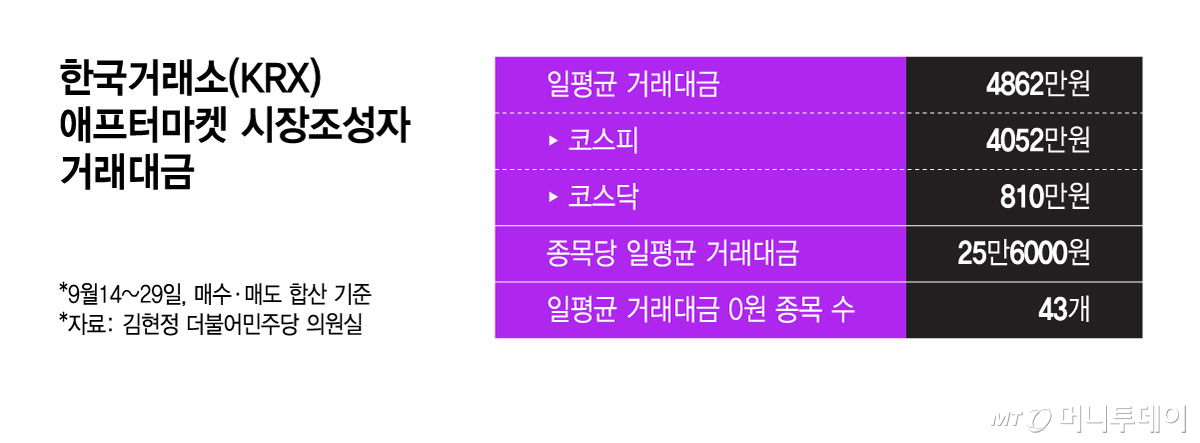
Last month, on the first day of the Korea Exchange (KRX) aftermarket opening, price volatility surged and the Volatility Inducement (VI) system was triggered en masse. Meanwhile, market makers’ trading volume was recorded at an average of 48 million won per day, or just over 250,000 won per stock. Critics point out that although stock trading hours were extended to 8 p.m., the lack of liquidity measures has only increased market volatility.
According to data submitted by Korea Exchange and obtained on the 7th by Kim Hyeon-jeong, a Democratic Party of Korea lawmaker on the National Assembly’s Political Affairs Committee, market maker trading volume for 190 stocks from the aftermarket opening on the 14th of last month through the 29th amounted to an average of 48.62 million won per day (combined buy and sell orders). This included 40.52 million won for KOSPI-listed stocks and 8.10 million won for KOSDAQ-listed stocks.
On a per-stock basis, the average daily trading volume was only 256,000 won. Forty-three stocks had an average daily trading volume of “0 won,” meaning no market-making trades occurred during this period. This included 26 KOSPI stocks and 17 KOSDAQ stocks. Notably, 36% of the stocks under market-making contracts on KOSDAQ had a trading volume of “0 won.” These stocks include Seoul Semiconductor, Com2uS, Nexon Games, and Ecopro H&N.
Including those with zero volume, 73 stocks had an average daily trading volume of less than 10,000 won. This means that even over the course of 10 trading days, their total trading volume did not reach 100,000 won. Expanding the range to include stocks with an average daily volume of less than 100,000 won brings the number to 100 stocks, accounting for more than half of the total. Only 10 stocks exceeded an average daily trading volume of 1 million won, and the stock with the highest trading volume (Kimho Construction) had an average daily volume of approximately 3.34 million won.
Compared to the aftermarket’s overall average daily trading volume of 1.1476 trillion won during its first week of operation (the 14th–18), market makers’ share of the average daily trading volume was just 0.004%. Although the aftermarket is inevitably less liquid than the regular session, making the role of market makers crucial, their contribution is assessed to be virtually negligible.
The aftermarket is a market where all KOSPI and KOSDAQ stocks can be traded from 4 p.m. to 8 p.m., following the close of the regular session. Financial authorities and the exchange have been pushing for its introduction with the goal of establishing a 24-hour trading system.
Market makers are securities firms that supply liquidity by continuously providing two-way buy and sell quotes during trading hours, facilitating smooth transactions for stocks with low trading volumes. They enter into market-making contracts with the exchange to provide liquidity for pre-designated stocks.
Analysts suggest that insufficient liquidity supply from market makers has also contributed to increased market volatility. In fact, on the first day of the aftermarket opening, the VI system, designed to mitigate sharp stock price fluctuations, was triggered 1,637 times (including duplicates). This is four times the number of triggers in the regular session on the same day (400 instances). Seventy-nine percent of these VI triggers occurred with KOSDAQ-listed stocks.
Consequently, there are criticisms that the aftermarket was opened prematurely without adequate liquidity measures. Since retail investors account for 90% of aftermarket trading volume (based on the first day of operation), the structure is such that greater market volatility can lead to greater losses for retail investors.
Kim (Rep.) stated, “The exchange opened the aftermarket without proper preparation, only increasing market volatility,” adding, “Retail investors are bearing this risk entirely.”
A Korea Exchange official said, “While operating a market maker system in an aftermarket is rare among major countries, it was introduced to supplement liquidity in the aftermarket.” The official added, “The stock market’s market maker system is limited to low-liquidity stocks with sluggish trading, and fewer securities firms participated compared to the regular market due to labor burdens and other factors.”
The official further explained, “It is judged that trading was sluggish because the period through the end of September was operated as a pilot phase for testing by participating securities firms.”

 in STOCK
