

As securities firms and asset managers share performance fees from the operation of discretionary investment products, a situation has arisen where the roles are reversed—securities firms are pressuring advisory firms (asset managers or investment advisors) regarding the composition of their product portfolios. With the sharing of performance fees between securities firms and advisory firms now permitted, securities firms have begun intervening in the operations of asset managers responsible for advising on discretionary investment products. This has been criticized as increasing the risk of losses for investors by driving a short-term pursuit of high returns.
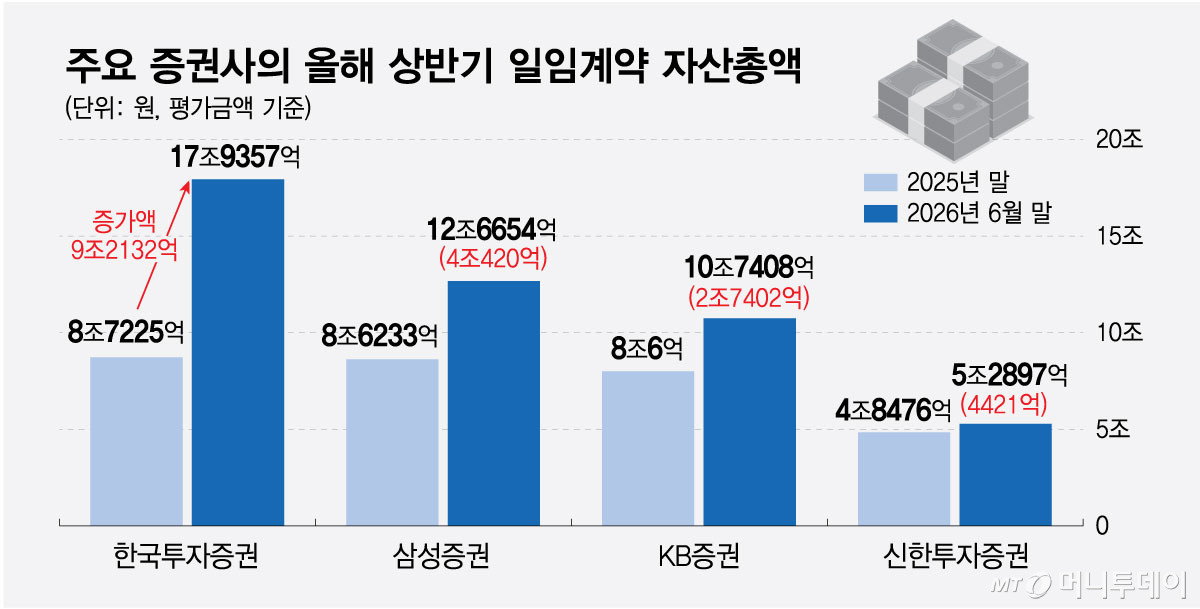
According to electronic disclosures from the Financial Supervisory Service on the 8th, Korea Investment & Securities had 283,659 discretionary investment contracts, an increase of 31,752 contracts compared to last year. Consequently, total assets under discretionary contracts (based on valuation) surged from 8.7225 trillion won last year to 17.9357 trillion won this year.
This trend is similar at other securities firms. Samsung Securities’ total assets under discretionary contracts increased from 8.6233 trillion won last year to 12.6654 trillion won this year, KB Securities from 8.06 trillion won to 10.7408 trillion won, and Shinhan Investment Corp from 4.8476 trillion won to 5.2897 trillion won.
A discretionary investment contract is an agreement in which a customer opens a custody account with a securities firm and delegates the management of that account. Typically, the securities firm first collects a base fee (base commission) of approximately 1% of the managed assets from the customer, and subsequently charges a performance fee (performance commission; hereinafter referred to as “fee”) of 20% on excess returns. Returns of 7% to 8% or higher are calculated as excess returns.
Securities firms share fee revenue with advisory firms by distributing compensation. Performance fees, which serve as compensation for advice, vary significantly in proportion across different firms. The method involves calculating ratios such as 4:6 or 5:5 to divide excess returns between the securities firm and the advisory firm.
The issue is that pressure from securities firms on asset managers has intensified during this process. According to the financial investment industry, some securities firms are indirectly exerting pressure on asset managers through their branches regarding portfolio composition. As a result, it is reported that portfolios for equity discretionary investment products are being rapidly replaced, causing advisory firms’ capabilities to focus on short-term high-return pursuits.
In particular, in cases of products that concentrated operations on specific stocks such as Samsung Electronics and SK Hynix, risks arising from excessive investment have been transferred to customers. Investors in target return conversion-type advisory wrap discretionary investment products, which were aggressively sold by the securities industry in the first half of this year, incurred valuation losses in their accounts. This product is characterized by converting into cash assets upon achieving a target return rate of around 6% after deducting fees and various costs. However, after the KOSPI recorded 9385.59 on June 1 last month, it declined and has been fluctuating around the 7000th mark, failing to meet the target for conversion and resulting in principal losses in accounts. Based on the closing price on that day, the KOSPI decline rate reached 25.4% compared to the high recorded in June.
The sharing of performance fees between securities firms and advisory firms was prohibited under guidelines from financial authorities in 2011. This was to curb side effects caused by massive funds concentrating on a small number of advisory firms. Wrap products allow concentrated investment in a few stocks, and trading details can be disclosed. Consequently, there was potential for secondary damage, such as investor groups driving up stock prices of included securities. Some advisory firms earned short-term high returns, and as discretionary investment products were managed in the form of funds, the product’s intent to align with individual customers’ positions faded. Ultimately, in May 2013, the Capital Markets Act was amended to designate performance fee transactions between investment advisors and discretionary investment managers as unfair business practices.
The situation changed starting in 2019. That year, the Financial Services Commission relaxed regulations through its “On-site Innovation-type Asset Management Industry Regulatory Improvement Plan,” allowing “performance fee sharing based on contracts” and thereby permitting the sharing of performance fees between securities firms and advisory firms.
In the financial investment industry, it is assessed that the system has been reverted to its previous state because securities firms lack the capability to independently judge portfolios for discretionary investment products compared to advisory firms. In fact, it is rare to find a securities firm that directly operates products by composing equity portfolios solely with its own capabilities. It is pointed out that as such securities firms indirectly intervene in product operations, discretionary investment products are being distorted into high-risk short-term investment products that can be greatly shaken by volatility, rather than pursuing stability for investors.
A source in the securities industry said, “It appears the system was improved on the grounds that the sales strategy for selecting advisory firms is more important, and given that securities firms lack the inherent capability to manage stocks, the role of advisory firms remains crucial.” The source added, “If the focus during the process of replacing advisory products is on performance fees rather than advisory capabilities, it is worth examining whether such fees remain merely as compensation.”

 in STOCK
