

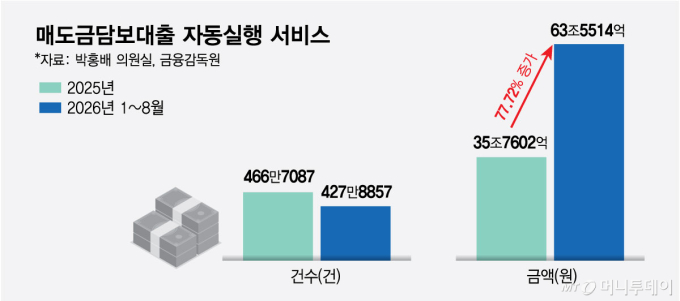
The amount of ultra-short-term loans received from securities firms to cover unpaid stock purchases (margin calls) exceeded 63 trillion won through August this year. This represents an increase of approximately 28 trillion won (77.7%) compared to the annual total for last year. Securities firms are using this service not only to boost trading volume but also to secure loan interest income, prompting calls for integrated management of "margin investing (investing with debt)" from an investor protection standpoint.
According to documents submitted on the 7th by the Financial Supervisory Service to the office of Democratic Party of Korea lawmaker Park Hong-bae, a member of the National Assembly's Political Affairs Committee, the execution amount for the "Automatic Margin Call Collateral Loan Service" totaled approximately 63.5514 trillion won from January to August this year. This is an increase of about 27.7912 trillion won compared to last year's annual execution amount of 35.7602 trillion won, and the total through December is expected to significantly exceed twice last year's figure.
The issue is that the automatic margin call collateral loan service is being used as a de facto ultra-short-term "margin investing (investing with debt)" tool for covering unpaid stock purchases by selling other stocks. This service automatically executes loans when investors engage in margin trading, preventing their accounts from being set as frozen margin accounts due to unpaid balances. If an account is designated as a frozen margin account, the investor must pay 100% of the entrusted collateral in cash within 30 days, and the frozen account information is shared across all securities firms.
Among the top 10 securities firms, Mirae Asset Securities, Kiwoom Securities, and KB Securities have introduced the automatic margin call collateral loan (Maedamdae) service. In particular, at Kiwoom Securities, dubbed the "No. 1 retail broker," the amount of automatically executed Maedamdae loans reached 58.9755 trillion won from January to August this year. This is an increase of approximately 80% compared to last year's annual execution amount (32.7705 trillion won). Since the loan service is only triggered when a margin call occurs, this indicates that the volume of margin trading at securities firms has risen accordingly.
The amount of Maedamdae loans automatically executed due to margin calls also increased at Mirae Asset Securities and KB Securities. At Mirae Asset Securities, the figure rose from 2.6451 trillion won for last year's full year to 4.1493 trillion won over the eight months this year, an increase of approximately 57%. At KB Securities, it increased by about 24%, from 3.4 billion won to 4.2 billion won over the same period.
Another concern is that if investors continue to use the automatic Maedamdae service for so-called "margin investing (investing with debt) rollovers," they will find it difficult to escape the vicious cycle of ultra-short-term trading and high-interest rates. On online stock communities, inquiries and shared information regarding how to use margin calls after exhausting credit loan limits, and how to sell stocks to prevent account freezing when unable to pay off margin call balances, are appearing frequently.
The activation of the automatic service is a boon for securities firms. Before securities firms voluntarily lowered interest rates, Maedamdae rates were at levels of 8% to 10%. It was confirmed that one major comprehensive financial investment business (CFIB) earned approximately 670 million won in interest income from Maedamdae loans alone in the first half of this year.
Critics point out that while securities firms are strengthening their own management of credit loans, they are struggling to prevent the vicious cycle of ultra-short-term "margin investing (investing with debt)" linked by "credit loans – margin calls – Maedamdae." The Korea Financial Investment Association decided on the 1st of this month to reduce the credit extension limit of major securities firms to within 90% of their own capital (statutory limit is 100%), and from the 19th, to voluntarily manage the proportion of credit loans for specific stocks to within 15%. However, it was pointed out that a "blind spot in margin investing (investing with debt) management" remains, as this does not include margin trading or leveraged products.
Harsh criticism also emerged from the National Assembly regarding the need for stronger management by the industry and authorities. Park (Rep.) stated, "As margin call collateral loans linked to margin trading are surging, we must grasp the current state of usage and risk factors," adding, "Financial regulators should review all loans related to margin trading and establish an integrated management plan to prevent excessive margin investing (investing with debt)."


 in STOCK

