

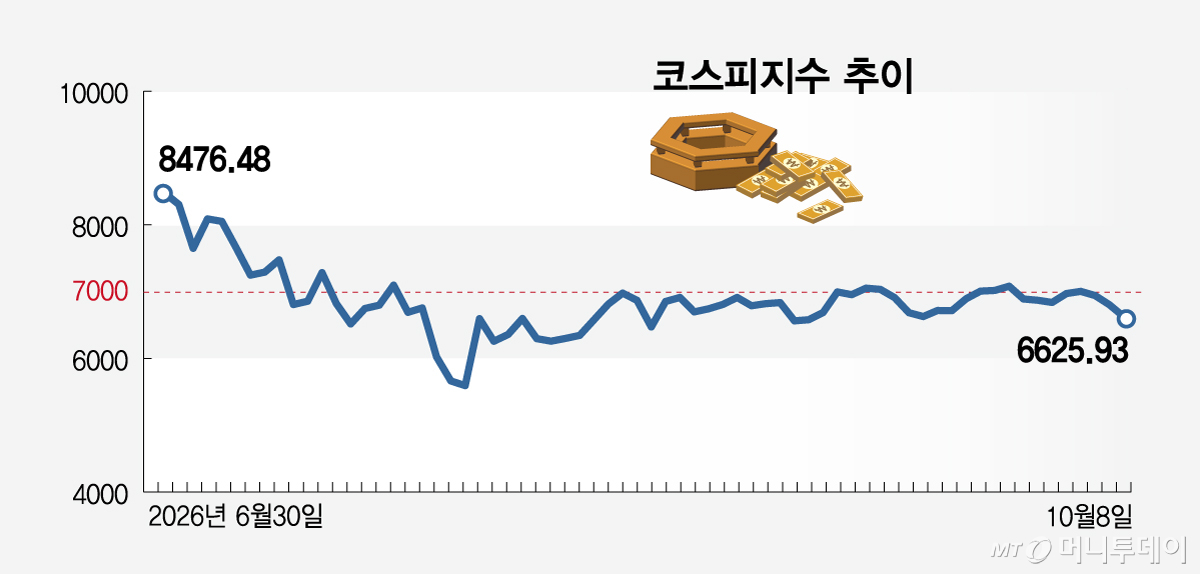
The KOSPI entered mid-October after relinquishing the 6,700 mark. As interest rate and geopolitical variables once again pulled the index down from the threshold of 7,000, the market is in a box range. With the third-quarter earnings season emerging as a key market focus, experts advised investors to pay attention to overseas indicators and corporate trends that can gauge the mood in advance.
According to Korea Exchange on the 11th, the KOSPI closed at 6,625.93 on the 8th. Amid a cumulative weekly decline of 377.81 points (5.39%), retail investors made net purchases worth 6.3591 trillion won and other corporate entities bought a net 2.4823 trillion won, while foreign investors sold a net 6.4692 trillion won and institutional investors sold a net 2.3887 trillion won. The KOSPI 200 Volatility Index (VKOSPI) fell by 4.15 points (10.13%) from the previous week to 36.81, maintaining levels seen before the outbreak of the US-Iran war.
The average daily trading value increased by 12.16% from the previous week to 21.6769 trillion won, but the index fell for three consecutive trading days. On the 8th, ahead of the Hangul Day holiday, it also experienced a sharp drop of over 2%. The same day, factors cited as the backdrop for the weakness included sell-high activity following Samsung Electronics’ third-quarter preliminary earnings release, the expiration of KOSPI 200 options, rebalancing of exchange-traded funds (ETFs), and wait-and-see sentiment before the market closure.
Concerns also persisted that downward support was weakening as Samsung Electronics and SK Hynix’s on-exchange share buybacks were nearing their end. Samsung Electronics has acquired 106.7% of its announced quantity, effectively completing its purchase operations, while SK Hynix has acquired 83.3% and is expected to place its final buy order around the latter half of this month.
Kim Seok-hwan, a researcher at Mirae Asset Securities, stated, “It is burdensome that large-scale buyers who are not sensitive to price have disappeared, but a significant portion of the sell volume released into the market during the purchase period has also been absorbed.” He added, “Market attention is shifting to ‘whether earnings can support stock prices even without share buybacks.’”
This week’s turning points are cited as the release of US inflation indicators and earnings from major overseas stocks. Based on Korean time, the US September Consumer Price Index (CPI) will be released on the 14th, while the US September Producer Price Index (PPI) and TSMC’s earnings in Taiwan will be disclosed on the 15th.
Experts forecast that if inflation pressure remains within the expected range and anxieties surrounding artificial intelligence (AI) demand and funding subside, the domestic stock market could enter the major corporate earnings announcement phase with rebound momentum intact.
Lee Kyung-min, a researcher at Daishin Securities, explained, “The US August Personal Consumption Expenditures (PCE), which showed inflation slowdown at the end of last month, had limited market impact as it reflected changes in the calculation method by the Bureau of Economic Analysis (BEA). However, if the inflation slowdown is confirmed again in the September CPI, we expect that wariness regarding inflation will ease while contributing to a downward stabilization in bond yields.”
He further noted, “The KOSPI market’s 12-month forward price-to-earnings ratio (PER) has fallen further from historical lows to 5.26 times.” He added, “There is sufficient room for upward adjustment due to valuation normalization, and even assuming a forward PER of only 6 times, the index can reclaim the 7,700 mark.”
Regarding investment strategy, opinions favoring a gradual approach were dominant. In particular, with controversies over capital raising by big tech companies following one another, it is assessed that a strategy of responding after confirming earnings and indicators is effective for semiconductors, whose sensitivity to the macroeconomy has increased. The compounded uncertainty arising from the intersection of Middle East armed conflicts and US midterm elections supports this outlook.
Hwang San-hae, a researcher at LS Securities, stated, “We are paying attention to sectors where interest rates and geopolitical risks act as revaluation factors.” He added, “The expansion of European defense budgets and energy restructuring will support orders for defense and shipbuilding stocks, high oil prices will support margins for energy stocks, and power bottlenecks in data centers will support the pricing power of power equipment stocks. Financial stocks also have room for revaluation if it is confirmed from earnings by companies such as JPMorgan Chase that high interest rates are being converted into profits.”
Kim Jong-min, a researcher at Samsung Securities, said, “While the time for large-cap stocks is approaching, this is premised on the resolution of macroeconomic pressures. At the current point, an alpha play (pursuit of excess returns) centered on flexible small- and mid-cap stocks is in a valid range.” He added, “It is rational to set the investment timing for the two major semiconductor stocks after the expected resolution of macroeconomic concerns around the US midterm elections and after confirming a trend-based breakout of the index.”
Some also advised paying attention to trends in small- and mid-cap semiconductor stocks and secondary battery stocks. Lee Jae-won, a researcher at Yuanta Securities, stated, “It is difficult to expect a supply-demand reversal with good earnings alone in the current environment.” He added, “If semiconductors take a break, supply-demand shifts may continue toward KOSDAQ semiconductor materials, components and equipment (SME) stocks, where retail investor weightings are relatively high. Energy storage systems (ESS) are a theme of bipartisan China containment unrelated to US midterm elections, AI infrastructure, and turning profitable.”

 in STOCK
