

Major traditional pharmaceutical companies in South Korea are expected to maintain their top-line growth momentum in the third quarter of this year. This is driven by increased sales of prescription drugs, royalties from new drugs (regular technology fees), technology transfer revenues, and exports. However, operating profit is expected to show varying degrees of performance depending on key earnings drivers.
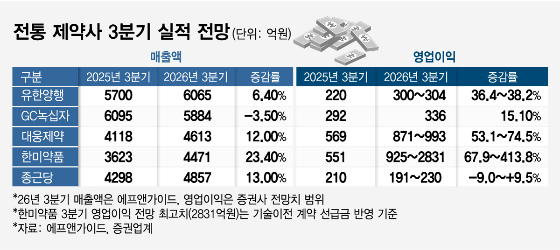
According to financial information provider FnGuide and the securities industry on the 11th, among five major traditional pharmaceutical companies—Yuhan, GC Green Cross, Daewoong Pharmaceutical, Hanmi Pharmaceutical, and Chong Kun Dang—the third-quarter revenue of four companies, excluding GC Green Cross, is projected to increase year-on-year.
Hanmi Pharmaceutical appears to have the highest revenue growth rate. The company's third-quarter revenue forecast is 447.1 billion won, a 23.4% increase from the same period last year. Chong Kun Dang is expected at 485.7 billion won, up 13%; Daewoong Pharmaceutical at 461.3 billion won, up 12%; and Yuhan at 606.5 billion won, up 6.4%. GC Green Cross is projected to decline by 3.5% to 588.4 billion won.
Hanmi Pharmaceutical is expected to record the largest increase in operating profit, but there is also a wide variance in forecasts among securities firms. The company's third-quarter operating profit forecast ranges from 92.5 billion to 283.1 billion won, representing an increase of 67.9% to 413.8% compared to 55.1 billion won in the same period last year.
The difference in forecasts stems from whether the upfront payment for the obesity drug candidate 'HM17321,' which was transferred to Genentech in August, is reflected in the results. Samsung Securities forecast 92.5 billion won, while iM Securities estimated 283.1 billion won. The HM17321 technology transfer contract totals $2.3 billion, with an upfront payment of $190 million (approximately 260 billion won). Hanmi Pharmaceutical has not disclosed the timing for recognizing the upfront payment in its earnings.
Daewoong Pharmaceutical is expected to be driven by expanded exports of its botulinum toxin 'Nuvoton.' The estimated third-quarter operating profit is 87.1 billion to 99.3 billion won, projected to increase by 53.1% to 74.5% year-on-year. Nuvoton recorded combined domestic and overseas revenue of 103.4 billion won in the second quarter, surpassing the 100 billion won quarterly mark for the first time. The effect of expanded sales in the U.S. market is expected to be added in the third quarter.
Yuhan is expected to see growth in its core business, such as prescription drugs, supplemented by royalty revenue from its lung cancer drug 'Lecraza' (generic name: lazertinib). The third-quarter operating profit is projected at 30 billion to 30.4 billion won, an increase of 36.4% to 38.2% year-on-year. Lee Ji-soo, a researcher at Daol Investment Securities, analyzed that "growth in the pharmaceutical and lifestyle distribution businesses, along with increased Lecraza royalties, will enable earnings growth compared to the same period last year."
GC Green Cross is the only one among the five companies expected to see a revenue decline. This appears to be influenced by the fact that GC Green Cross Wellbeing, which recorded revenue in the 40 billion won range in the third quarter of last year, has been excluded from consolidated results since the second quarter of this year. The third-quarter operating profit is projected at 33.6 billion won, an increase of 15.1% year-on-year. With sales of its immunoglobulin blood product 'Aliglo' expanding in the U.S., the deferral of flu vaccine revenue to the third quarter is also expected to positively impact profitability improvements.
Chong Kun Dang shows diverging profitability forecasts despite top-line growth. The third-quarter operating profit forecast ranges from 19.1 billion to 23 billion won, varying from a 9% decrease to a 9.5% increase year-on-year. This is because while sales of imported products such as Wegovy, Ailiya, and Ivenity are driving top-line growth, the expanding share of low-margin products and the burden of selling, general, and administrative expenses are cited as variables affecting profitability.

 in THEBIO
