

The information technology (IT) sector, including semiconductors that led the KOSPI in September, has stalled since entering October. While rotation trading (sequential movement of buying pressure) drove the market in August and semiconductors took the lead in September, it has been difficult to identify a leading sector since October began. Experts analyze that rather than positive factors disappearing, pressure from interest rates and oil prices is having a negative impact on the domestic market.
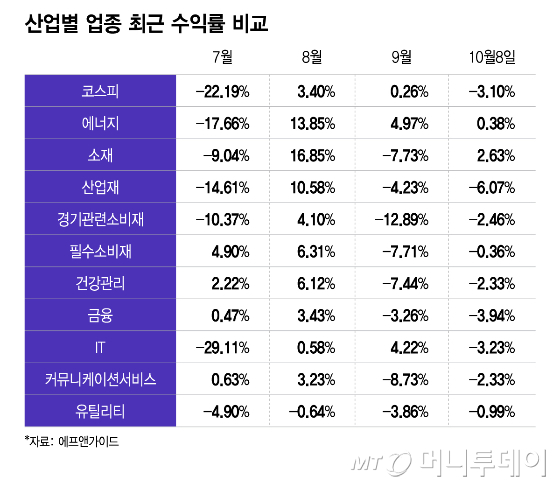
According to financial information platform FnGuide and the financial investment industry on the 12th, the return for the IT sector, which includes major KOSPI semiconductor stocks, was -3.23% as of the 8th, turning negative for the first time in about two months.
Not only the IT sector, but also materials -6.07%, financials -3.94%, consumer discretionary -2.46%, and healthcare and communication services each at -2.33%, most sectors have recorded negative returns this month. The overall KOSPI return is also in a negative trend. This is the first time in about two months since July, when the index fell by as much as -22.19% due to extreme concentration in single-stock leverage ETFs (Exchange-Traded Funds).
Last month, energy (4.97%) and the IT sector (4.22%) held up, allowing the KOSPI to rise by 0.26%, albeit within a box range. Only these two sectors posted positive returns, supporting the downside.
Energy is linked to artificial intelligence (AI) and data center power issues and is recently classified as a semiconductor-related sector. In contrast, all sectors except semiconductors and energy showed negative returns in September, including consumer discretionary -12.89%, communication services -8.73%, materials -7.73%, consumer staples -7.71%, and healthcare -7.44%. It is assessed that the KOSPI was able to maintain its box range essentially because semiconductors and semiconductor-related sectors held up.
This contrasts with August, when materials (16.85%), energy (13.85%), and industrials (10.59%) posted double-digit returns, driving the index through rotation trading. Domestic capital market experts opine that rotation trading supported the downside in August, while semiconductors did so in September.
The problem is that semiconductor stocks, which had been a pillar of the market since October, are also wavering. Despite Samsung Electronics reporting quarterly operating profit exceeding 107 trillion won, its highest ever, in its preliminary third-quarter earnings released on the 8th, the stock prices of Samsung Electronics and SK Hynix fell by more than 2% that day, and the downward trend continued on this day as well.
As semiconductor stock prices fall despite good performance, market concerns inevitably grow. Capital market experts note that in a situation where expectations for industry improvement have already been largely reflected in stock prices, improved foreign supply and demand must accompany strong earnings for further gains. However, one pillar is tilting as foreign funds are flowing out in large numbers.
In fact, foreigners have been net selling approximately 8 trillion won worth of KOSPI stocks since the start of this month. Among these, they have net sold more than 5 trillion won in Samsung Electronics and SK Hynix alone.
Regarding this, Han Ji-young, a researcher at Kiwoom Securities, stated, "It cannot be denied that market concerns surrounding the semiconductor supercycle narrative as the leading stock remain unresolved," adding, "We have reconfirmed that the market's standards for AI are becoming stricter, and we must prepare for increased sensitivity to the quality of earnings (profitability, revenue recognition speed, etc.) during the third-quarter earnings season."
Lee Kyung-min, a researcher at Daishin Securities, stated, "It is not that positive factors have disappeared, but rather that they are obscured by pressure from interest rates and oil prices," adding, "If the pressure eases, we expect strongly suppressed positive momentum to flow in."

 in STOCK
