

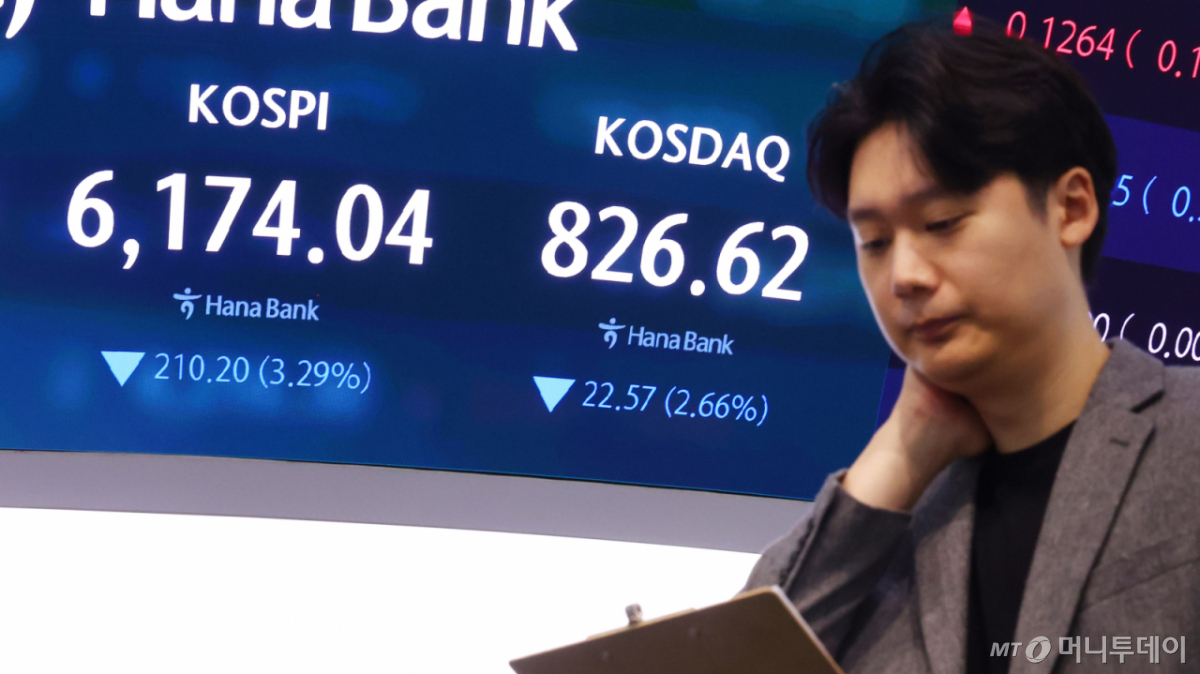
KOSPI is plunging amid concerns over memory supply from China. The sell-side sidecar (futures market circuit breaker) was triggered for the first time in 35 trading days. The index fell below the 6,000 mark during trading hours. Financial investment industry experts advised that while a trend reversal may take time, conditions have formed from a valuation perspective, and investors should observe the situation rather than hastily buying or selling.
As of 10:57 a.m. on the 13th, KOSPI stood at 5,954.79, down 429.45 points (6.73%) from the previous trading day. After opening with a drop in the 3rd% range, KOSPI widened its decline and slid toward the 5,900 level. This marks the first time since July 31 that KOSPI has fallen below the 6,000 mark during trading hours, a span of 74 days.
The sell-side sidecar (futures market circuit breaker) was also activated. It has been 35 trading days since the last sell-side sidecar (futures market circuit breaker) was triggered in the KOSPI market.
What dragged down the KOSPI index on this day was news that Chinese memory semiconductor company ChangXin Memory Technologies (CXMT) plans to release server semiconductors within the year. As concerns over memory supply from China grew, the Philadelphia Semiconductor Index fell 2.67% in the U.S. stock market on the 12th (local time), and as a result, the share prices of Samsung Electronics and SK Hynix also declined. Currently, Samsung Electronics is down 7.88%, and SK Hynix is down 9.22%.
The external environment is also negative for the stock market. International oil prices are rising. As caution grows ahead of the U.S. September CPI (consumer price index) release on the 14th (local time), foreign investors' risk appetite is weakening.
Accordingly, foreigners are net selling 2.4452 trillion won in KOSPI today. Retail investors and institutional investors are net buying 1.6090 trillion won and 741.6 billion won, respectively. As the share buybacks by Samsung Electronics and SK Hynix, which had played a role in cushioning supply and demand, enter their final stages, market liquidity resilience is also weakening.
Yang Hyun-kyung, a researcher at iM Securities, analyzed that "concerns over funding and profitability for AI (artificial intelligence) infrastructure investment, China's CXMT technological pursuit, and supply-demand burden from foreign selling have converged."
Experts judged that conditions for a rebound have formed from a valuation perspective, as KOSPI has broken below the 200th-day moving average line (6,376 points). This is because the 200th-day line has served as a benchmark for judging medium- to long-term trends since the crash in July.
However, forecasts suggest that it will take time before a trend reversal occurs. This is because negative external environments and doubts regarding AI and semiconductors cannot be dispelled in the short term.
Han Ji-young, a researcher at Kiwoom Securities, said, "Re-entering the recovery trajectory of the domestic stock market depends on whether macro burdens are alleviated, such as the risk of further U.S. interest rate hikes, and whether earnings visibility improves through upward revisions to KOSPI's earnings estimates for next year and 2028."
This means waiting until the end of this month, when earnings and guidance releases from semiconductor companies and big tech firms are expected to intensify. The increasing likelihood that the U.S. Federal Open Market Committee (FOMC) will hold benchmark interest rates steady in October is also a positive factor. Next month's U.S. midterm elections could also influence the direction of the stock market.
Therefore, advice is emerging that investment decisions should not be made hastily in the current situation. Lee Sang-yeon, a researcher at ShinYoung Securities, said, "Rather than reacting to daily fluctuations, one should observe the situation until the end of this month," adding, "Given the possibility of benchmark interest rate holds at the October FOMC, I believe a wait-and-see strategy is more appropriate than formulating strategies based on current market prices."

 in STOCK
