

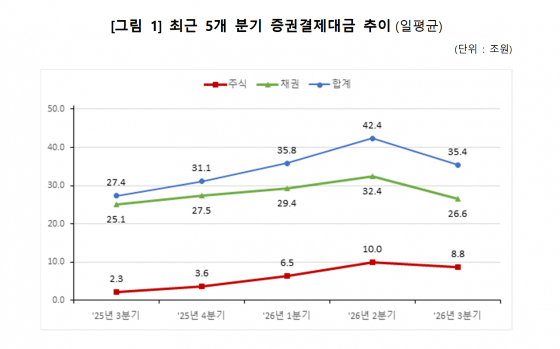
Domestic securities settlement amounts in the third quarter of this year fell by more than 16% compared to the second quarter. This marks a reversal of the upward trend that had continued since the third quarter of last year. The decline is interpreted as being influenced by the KOSPI, which surged past 9,000 in June before falling to the 6,000 range in July and subsequently remaining within a trading range.
The Korea Securities Depository announced on the 12th that the daily average securities settlement amount for stocks and bonds combined in the third quarter was 35.4 trillion won. This represents a 16.5% decrease from the previous quarter, but a 29.4% increase compared to the same period last year. The daily average stock settlement amount was approximately 8.8 trillion won, down 12.4% from the previous quarter, but up 288.9% year-on-year.
Notably, on-exchange stock trading decreased significantly. The daily average trading volume in the on-exchange stock market in the third quarter was 77.28 trillion won, a 34.1% decrease from the second quarter. During the same period, the daily average settlement amount in the on-exchange stock market also fell by 6.6% to 4.097 trillion won.
The impact of reduced trading by institutional investors was significant. The daily average trading volume for institutional investors in the third quarter was 45.366 trillion won, down 26.4% from the previous quarter, while the daily average settlement amount decreased by 16.9% to 4.683 trillion won.
Kim Jae-seung, a researcher at Hyundai Motor Securities, explained, "The KOSPI has fallen more than 20% from its previous high. This is not due to fundamental factors, but because many retail investors have been positioned in loss-making zones since the bear market began in June, damaging investment sentiment, and foreign investors have continued net selling."
Bond trading also declined in the third quarter. The daily average bond settlement amount in the third quarter was 26.6 trillion won, a 17.7% decrease from the previous quarter. The daily average trading volume in the on-exchange bond market was 8.177 trillion won, down 9.1%, and the settlement amount was 2.741 trillion won, down 6.2%. Both figures also decreased by 44.1% and 21.9%, respectively, compared to the same period last year.
The daily average bond settlement amount for institutional investors in the third quarter was 23.9 trillion won, a decrease of 18.9%. The daily average bond trading volume for institutional investors was 32.795 trillion won, down 16.9% from the previous quarter. In particular, trading in short-term commercial paper by institutional investors dropped sharply; the third-quarter trading volume for short-term commercial paper was 7.194 trillion won, a 36.6% decrease from the previous quarter. The settlement amount also fell by 37.8% to 6.544 trillion won.
By bond type, the daily average settlement amount for government bonds was 6.394 trillion won, accounting for 51% of the total, followed by financial bonds at 3.573 trillion won (28.5%), special bonds at 911 billion won (7.3%), treasury bills at 864 billion won (6.9%), corporate bonds at 422 billion won (3.4%), local government bonds at 31 billion won (0.3%), and others at 335 billion won (2.7%).
The securities industry advises that the U.S. midterm elections mark a good timing to re-enter securities investment. Kim Jong-min, a researcher at Samsung Securities, stated, "If the third quarter immediately following an extremely hot second quarter was a period where the desire for profit-taking was strongly stimulated even by minor negative news, then the fourth quarter after the third quarter is a situation where a psychological cooling-off period has led to increased wait-and-see sentiment." He added, "After a breather in October, the index is expected to establish a clear direction with the U.S. midterm elections in November as a turning point."
Researcher Kim emphasized, "With global stock market earnings momentum centered on AI (artificial intelligence) remaining favorable, the regularization of shareholder return policies can resolve the structural discount of the Korean stock market. Once macro uncertainty is resolved after the end of the U.S. midterm elections, the practical benefits from upside potential are judged to be far greater than downside risks." He added, "In October, it is effective to prepare for a gradual increase in allocation to large-cap stocks tactically, while simultaneously pursuing an aggressive strategy of increasing allocation to small- and mid-cap stocks."

 in STOCK
