

Only one "K-bank" has entered the KOSPI... Let's bundle duplicate listings to stop the "extinction of big fish," and IPOs are frozen solid
34 new listings this year, down 37% from the same period last year
The complex calculations surrounding corporate initial public offerings (IPOs) have been complicated by the duplicate listing guidelines, which were introduced with the aim of protecting shareholder rights. As market cooling accelerates, private equity funds (PEFs) that had invested on the condition of a listing are finding it nearly impossible to recover their capital. Although these funds are exploring various options, including share sales and mergers and acquisitions (M&A), the market slump continues as they remain unable to make new investments due to their tied-up capital, creating a vicious cycle.
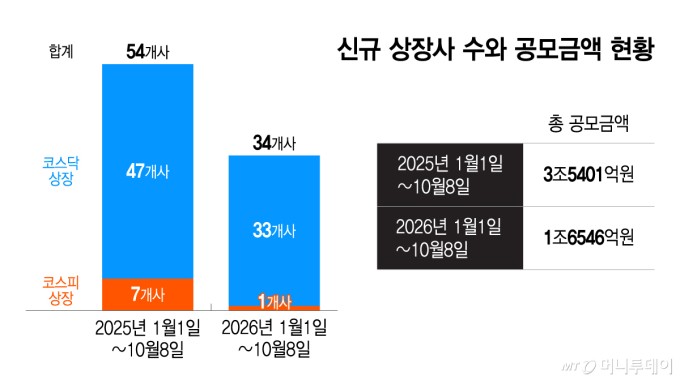
According to the financial investment industry on the 8th, the number of newly listed companies from the beginning of this year through that day totaled 34 (excluding SPACs and SPAC mergers). While 33 companies entered the KOSDAQ market, only one company was listed on the KOSPI. This represents a decrease of 20 companies (37.0%) compared to the same period last year, when there were 54 new listings (7 on the KOSPI and 47 on the KOSDAQ).
The total amount raised through public offerings also declined. From January 1 to October 8 this year, the total offering amount by companies listed on the KOSPI and KOSDAQ was 1.6546 trillion won, less than half of the same period last year (3.5401 trillion won).
Last year, companies that had been touted as major IPO candidates, including Myungin Pharmaceutical, Daehan Shipbuilding, Daishin Value REIT, Dalba Global, and LG CNS, all went public simultaneously. In contrast, the only major listing on the KOSPI this year has been K Bank. This marks a significant contraction in the market compared to last year, when companies from a wide range of industries were listed.
In the securities market, the government's regulations on duplicate listings are cited as a key factor. The listing of major corporate affiliates, which had accounted for a significant portion of large-scale deals in the past, has been blocked by exchanges' policy against duplicate listings. Companies have also successively withdrawn or indefinitely postponed their listing plans.
A subsidiary created through a stock split must obtain the approval of the parent company's shareholders via a special resolution in order to list on an exchange. Even with shareholder approval, it must still clear the exchange's stringent preliminary review hurdles.
Accordingly, HD Hyundai Robotics, established through the spin-off of HD Hyundai's robotics division, had previously postponed its initial public offering (IPO) plans once. However, it was recently reported that HD Hyundai Robotics is reconsidering its IPO push after listing possibilities opened up, following cases such as Deoksan Nepcore entering KOSDAQ as an exception to the dual-listing rule.
LS Group, which has been mired in ongoing controversy over duplicate listings, is completely reevaluating its IPO strategy for affiliated companies. The IPO plan for Essex Solutions, a great-granddaughter company of LS, was officially withdrawn last January. As a result, the funding plan that LS had prepared for capital investment has also been disrupted.
The position of financial investors (FIs) who invested on the premise of an initial public offering (IPO) is even more precarious. A prime example is SK Ecoland. The company raised 1 trillion won through a pre-IPO round in 2022. Under the option agreements signed with FIs at the time, the IPO was supposed to be completed by last July, but as this proved unfeasible, the company repaid the investment funds to the FIs. While it may be possible to seek an exception to the duplicate listing rule through rebalancing, advancing the IPO remains difficult under current circumstances.
Trapped funds lead to a broader market slump. The returns of hedge fund products that adopted a strategy of investing in non-listed companies and profiting from gains after an initial public offering (IPO) have fallen to as low as -60% this year. Most IPO-focused hedge funds have seen returns limited to just 1%. Analysts note that a vicious cycle is repeating, in which the growing unrealized losses on funds tied up in these investments prevent reinvestment.
Experts point out that, alongside regulation, pathways for investors to recover their capital must be broadened. Lee Young-kyung, a senior researcher at the Korea Institute of Financial Research, stated, "In our country, investors' routes for recovering funds are not diversified beyond initial public offerings, such as through mergers and acquisitions or secondary share sales. As a result, regulations on duplicate listings can make it difficult for companies to raise capital and may lead to reduced corporate growth." She added, "(Regarding duplicate listing regulations) we need to consider together ways that allow companies to raise funds through various channels."
An industry insider in the investment banking sector stated, "In the past, holding companies were established with subsidiaries placed beneath them to prevent circular shareholdings. However, if duplicate listings are regulated under this label, there is concern that domestic listed companies may relocate overseas." The insider added, "Because the timing of stock transactions is not uniform, it is not easy to exploit exceptions for duplicate listings either. Efforts should focus on establishing clear criteria."
Duplicate Listings: Separating the Wheat from the Chaff… Focus on "Value Transfer," Not Just Form
"Refinement of criteria centered on whether shareholder value has been impaired is needed"
As the duplicate listing restriction system, which has been in effect for more than two months, continues to draw attention from the market, voices are emerging that argue "what is being restricted" is more important than "how much is being blocked." This is because the economic nature of duplicate listings varies significantly, ranging from relisting core businesses following a spin-off, to subsidiaries acquired through mergers and acquisitions (M&A), to initial public offerings (IPOs) of newly developed business ventures. Calls are also growing for the review criteria to be refined so that, while upholding the policy intent of protecting shareholders, transactions that actually erode the value of general shareholders can be accurately identified.
According to the financial investment industry on the 11th, the core of the Financial Services Commission's plan to improve the dual-listing system is to strictly restrict "asymmetric dual listings," which do not consider the rights and interests of general shareholders of the parent company. In particular, shareholder consent has been made mandatory when listing a subsidiary created through a physical spin-off. For other dual listings, shareholder consent is recommended, but the board of directors of the parent company is required to review the impact on general shareholders and establish measures to protect shareholders.
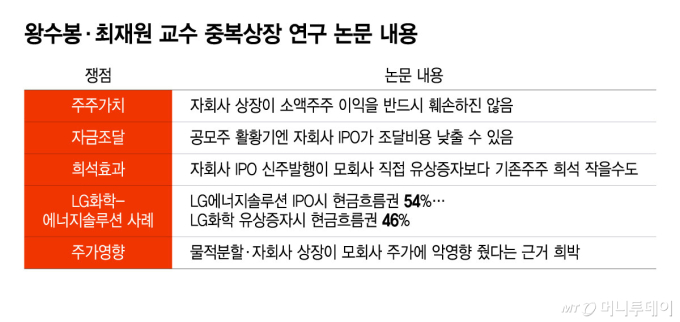
Academic research has also challenged the equation that a subsidiary's initial public offering (IPO) inevitably results in losses for the parent company's shareholders. In their paper, "Does Physical Division Truly Harm Shareholder Interests?", Professor Wang Su-bong of Ajou University and Professor Choi Jae-won of the University of Illinois and Yonsei University analyzed that it is difficult to conclude that a subsidiary's IPO necessarily impairs the cash flow rights of minority shareholders of the parent company.
During the boom in the IPO market, issuing new shares through a subsidiary's IPO was seen as a way to lower financing costs and reduce equity dilution for existing shareholders compared to a rights offering (paid-in capital increase) conducted directly by the parent company. In the case of LG Chem and LG Energy Solution, after LG Energy Solution's IPO, the cash flow rights (shareholders' economic rights to corporate profits) of existing minority shareholders in LG Chem stood at 54%. In contrast, if the same amount of funds had been raised through a direct rights offering by LG Chem, this figure would have dropped to 46%.
The point is that even in cases of duplicate listings, the impact on existing shareholders can vary depending on which business has been spun off, the revenue mix between new and old shares, the corporate valuation at which the company is listed, and how the raised funds are deployed. It is also difficult to definitively assert that the economic nature is identical whether a business acquired externally is relisted to secure growth capital or a core business nurtured within the parent company is physically split off and listed.
The Financial Services Commission also differentiated its regulatory approach during the design of the system, taking into account the types of dual listings and their impact on shareholders. Lee Eui-woon, Chairman of the Financial Services Commission, stated at a public seminar on improving the dual listing system in April that he would strictly distinguish between asymmetric dual listings, where the benefits are concentrated among a small number of parties, and dual listings that are fair to all shareholders and create new value, when conducting reviews.
The Financial Services Commission applied different shareholder approval standards to subsidiaries formed through spin-offs and other types of dual listings in its final guideline LINE as well. However, there is not yet a sufficient body of precedent regarding how thoroughly specific requirements must be met for a dual listing to be recognized as one that is fair to all shareholders and creates new value during the actual listing review process.
Market participants argue that as more cases of listing reviews accumulate, the criteria for determining whether the economic value of ordinary shareholders is actually impaired should be made clearer than simply focusing on the form of a duplicate listing. A financial investment industry official said, "While maintaining the principle of strengthening shareholder protection, it is necessary to consider the substance of the transaction together, including the listing price, the scale of new share issuance, the use of raised funds, and the value of the remaining shares held by the parent company."
Ultimately, the success or failure of duplicate listing regulations is assessed not by how many listings are reduced, but by how accurately they identify transactions in which the value of ordinary shareholders unfairly transfers to specific shareholders or stakeholders.
Advanced markets that do not block dual listings regulate through disclosure obligations and conflict-of-interest management
Korea demands proof of reasons for maintaining listing status, while the U.S. and U.K. regulate through disclosure and governance... Korea also needs to refine its review process centered on damage to shareholder value
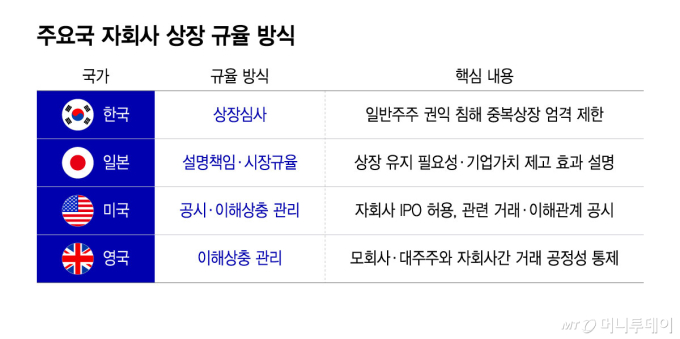
While South Korea generally restricts the duplicate listing of subsidiaries, major markets such as the United States, Japan, and the United Kingdom place greater emphasis on managing conflicts of interest, protecting minority shareholders, and corporate disclosure obligations, rather than imposing a blanket ban on subsidiary listings themselves. In particular, although cross-listings—structures in which both the parent company and its subsidiary are listed—have been rapidly declining in Japan, exchanges do not impose a uniform prohibition; instead, they require companies to explain the economic rationale for maintaining such structures.
This kind of overseas regulatory practice also offers implications for domestic dual-listing policies. Experts point out that the system needs to be refined not merely by deciding how strictly to restrict listings themselves, but by identifying which transactions actually undermine the value for ordinary shareholders, and by simultaneously addressing corporate disclosure obligations and conflict-of-interest management.
According to Nomura Capital Market Research Institute on the 11th, the number of Japanese companies with cross-listings in Japan at the end of fiscal year 2025 was 160, a decrease of 20 from the previous year. This marks the sixth consecutive year of double-digit net declines. Compared to the peak in fiscal year 2006, the number has decreased by more than 60%.
However, Japan's approach differs from outright banning dual-listing structures. Based on feedback from institutional investors both within and outside Japan last year, the Tokyo Stock Exchange (TSE) has required companies maintaining such structures to review whether their current setup is optimal in terms of group-wide corporate valuation and capital efficiency, and to explain this to investors.
Investors' criteria are also specific. In a document titled "Investor Perspectives on TSE and Related Matters," which compiles views from domestic and foreign institutional investors, the Tokyo Stock Exchange (TSE) stated that it is necessary to review whether subsidiaries generate returns exceeding their cost of capital using quantitative indicators such as return on equity (ROE), return on invested capital (ROIC), price-to-earnings ratio (PER), and price-to-book ratio (PBR). The document also introduced investor opinions suggesting that the parent company should consider whether it is the "best owner" capable of maximizing the corporate valuation of the subsidiary in question, and noted that if it is not, a sale to a third party could be an option.
Recent research points in the same direction. The Japan Securities Economic Research Institute published "Japan's Cross-Listings: Mechanisms of Maintenance and Resolution" by Shin'ya Kawamoto, a professor at Ryukoku University, last month. The study empirically analyzes factors such as the motivations for maintaining cross-listings and corporate performance, drivers of resolution through full subsidiary status or share sales, and the roles of minority shareholder protection and activist investors, rather than evaluating cross-listings in a uniform manner.
Japan's recent approach is closer to permitting listings that have a legitimate reason for being maintained, while addressing those that pose significant concerns over the erosion of shareholder value through market mechanisms and corporate governance regulations. This distinction between "good dual listings" that enhance corporate valuation and "bad dual listings" that undermine the value for ordinary shareholders offers implications for domestic regulatory frameworks as well.
The United States recognizes the "equity carve-out," in which a parent company lists a portion of its shares in a subsidiary or business division through an initial public offering (IPO), as a corporate finance tool. Rather than imposing a blanket restriction on such transactions solely because both the parent and the subsidiary would be publicly listed, it relies on disclosure requirements, conflict-of-interest management, and corporate governance standards to allow investors to assess the fairness of the transaction.
The U.S. Securities and Exchange Commission (SEC) separately regulates potential conflicts of interest that may arise after a company goes public, including requiring disclosure when transactions between the company and related parties, such as major shareholders, involve significant conflicts of interest.
The United Kingdom also places greater emphasis on regulating transactions in which actual conflicts of interest arise between listed companies and their controlling shareholders or parent companies, rather than preemptively blocking the listing structure itself.
The systems in the United States, Japan, and the United Kingdom differ from one another, but they share a common feature: they do not block transactions solely on the basis of the form of a subsidiary’s listing. These regimes require companies to explain why a separate listing is necessary, manage conflicts of interest with minority shareholders, and verify the impact on shareholder value through disclosure and market discipline. It has been pointed out that while Korea should maintain the principle of protecting general shareholders, its review system needs to be refined to distinguish between cases that impair shareholder value and those that do not, rather than blocking duplicate listings that enhance corporate valuation based solely on whether a listing occurs.
[MT Report] Between Duplicate Listings and Duplicate Growth (Part 1)
“Even SK Hynix?” Share price is like this, yet a spin-off listing? … The real calculations behind Solidigm’s IPO

 in STOCK


