

Following a sharp drop in the KOSPI index on the 15th, market capitalization evaporated by 286.8 trillion won compared to its annual high (June 22). Of this amount, the combined market cap of semiconductor giants Samsung Electronics and SK Hynix ("Samjeon-Nix") reached 199.7 trillion won, leading analysts to point out that the structural vulnerability of the KOSPI, which relies heavily on the semiconductor sector, has once again been exposed. With rising U.S. Treasury yields and expectations for a tight monetary policy accelerating foreign investor outflows, it is projected that recovery in the short term will not be easy.
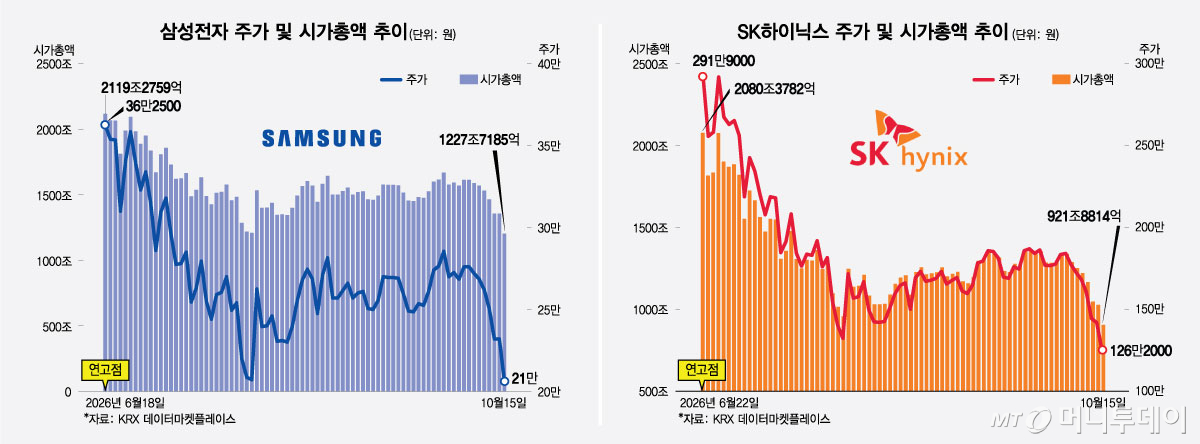
According to the Korea Exchange, KOSPI market capitalization on this day stood at 458.11786 trillion won, down by 286.84141 trillion won from its annual high of 744.95927 trillion won on June 22. This means that 38.5% of the market cap has vanished in less than four months. Analysts note that the October crash revealed the structural vulnerability of a market heavily reliant on the two "Samjeon-Nix" stocks. Samsung Electronics' market cap, which was approximately 206.7 trillion won on June 22, fell to 122.8 trillion won on this day, while SK Hynix's market cap dropped from 208.0 trillion won to 92.2 trillion won. The evaporation of 199.7 trillion won from just these two stocks accounted for 70% of the total KOSPI market cap decline, a proportion higher than their combined weight in the KOSPI (approximately 47%).
As foreign investors have been net sellers centered on large-cap semiconductor stocks, it is projected that KOSPI recovery will not be easy for the time being.
Park Yeon-ju, head of the research center at Mirae Asset Securities, stated, "Concerns over whether massive AI investments can translate into sufficient returns had the greatest impact on the sharp drop in the KOSPI," and diagnosed that "amid high volatility in the Korean stock market, foreign investors have moved to take profits, while there is no clear buying force."
Yoon Seok-mo, head of the research center at Samsung Securities, pointed out, "Because semiconductor companies such as Samsung Electronics and SK Hynix account for a very large share of both market capitalization and exports, they have more directly absorbed the shock from the plunge in the Philadelphia Semiconductor Index and global doubts about the sustainability of AI investments." He added, "With U.S. 10-year Treasury yields soaring to 5.3%, safe-haven U.S. Treasuries are offering high yields, significantly reducing the relative investment appeal of the Korean stock market as an emerging market equity."
In fact, foreign investor outflows from "Samjeon-Nix" have been intense over the past month. According to the Korea Exchange, foreign investors sold off 16.8841 trillion won worth of SK Hynix and 6.9766 trillion won worth of Samsung Electronics over the last month. SK Hynix and Samsung Electronics are the only stocks that saw net selling in the trillions-of-won range over a one-month period.

 in STOCK
