

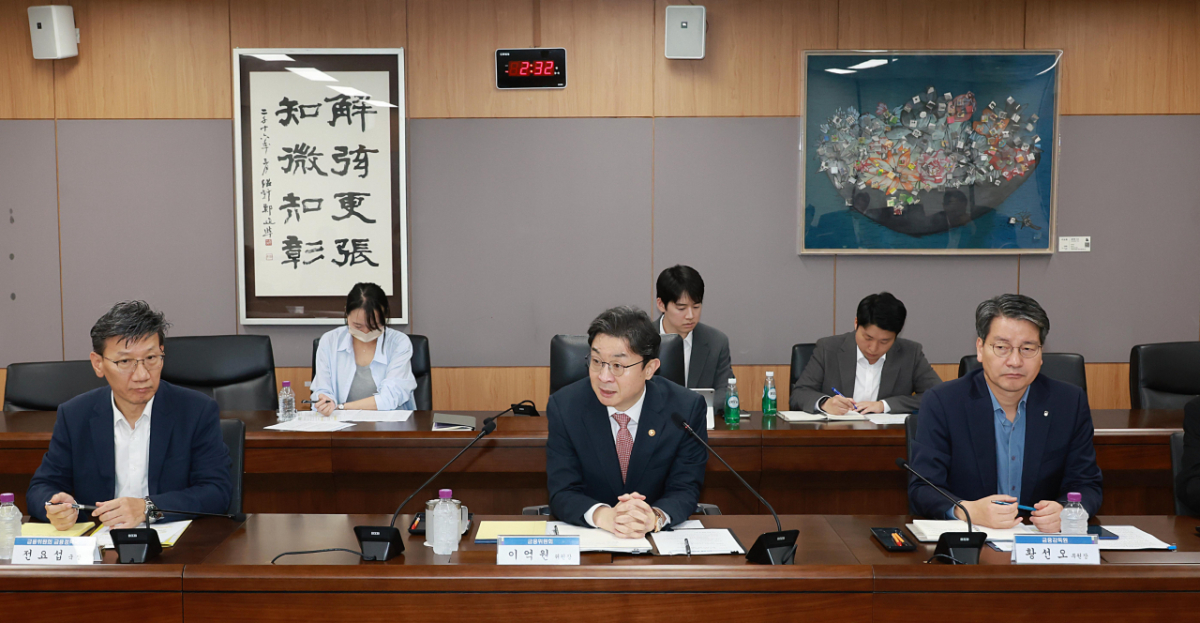
As volatility in the domestic stock market expanded due to factors such as expectations of U.S. interest rate hikes and uncertainty in the artificial intelligence (AI) semiconductor industry, financial authorities convened an emergency review meeting to respond to market stabilization. Financial authorities and market experts assessed that recent stock market declines have been excessive in terms of speed and supply-demand dynamics. The authorities called for a strict response to market disruption activities while urging financial institutions to refrain from indiscriminate credit extension and strengthen risk management.
The Financial Services Commission announced on the 15th that it held an "Emergency Stock Market Situation Review Meeting" chaired by Lee Eok-won (Chairman), with attendance from relevant institutional investors such as the Financial Supervisory Service and Korea Exchange, as well as market experts. At the meeting, participants reviewed recent domestic stock market trends amid expanding external uncertainty and the supply-demand situation of foreign and institutional investors, and discussed future response directions.
Attendees included the Deputy Commissioner of the Financial Supervisory Service, the Vice Chairman of Korea Exchange, Tak Gyeol-je-won (President) of the Korea Deposit Insurance Corporation, the Vice President of Korea Securities Finance, the Deputy Director of the International Finance Center, the Deputy Director of the Capital Markets Institute, the Head of the Securities and Futures Division of the Korea Financial Investment Association, and heads of research centers at KB Securities and Shinyoung Securities.
Participants diagnosed that stock market volatility had expanded due to domestic and international macroeconomic conditions, including recent global interest rate rise expectations, uncertainty regarding investment and profit outlooks in the AI semiconductor sector, and rising international oil prices. However, they assessed that recent market movements have been excessive in terms of decline speed and supply-demand dynamics.
They also agreed that the fundamental strength of the domestic economy and corporations remains solid. It was judged that major domestic industries such as semiconductors, defense, and shipbuilding are delivering good performance based on global competitiveness, while foreign exchange reserves, current account balance, and the soundness of financial institutions are also maintaining solid levels.
Accordingly, they emphasized the need to maintain vigilance against expanding market volatility while guarding against the spread of excessive anxiety and sharp concentration phenomena. They also agreed that investors need to make rational investment decisions by considering factors such as the intrinsic value of companies and medium- to long-term growth potential.
Financial authorities and relevant institutional investors decided to respond strictly under a zero-tolerance principle to market disruption activities, including spreading false rumors, market manipulation, and illegal short selling that exploit market instability, while closely monitoring domestic and international market trends and supply-demand situations. They also plan to thoroughly prepare in advance to swiftly implement contingency plans if necessary.
Lee (Chairman) urged, "Maintain vigilance even against small volatility and actively respond to financial market stability and investor protection." In particular, warning of the risks of credit-utilized investment, he emphasized risk management by financial institutions. Lee (Chairman) stated, "Investment relying on excessive debt and credit is risky, and risk management is especially important at times like these." He further strongly urged that "financial institutions should refrain from indiscriminate credit extension and ensure full protection of customers and risk management."

 in STOCK
