


As financial authorities move to curb 'margin investing (investing with debt)' (investing with borrowed funds), the risk of forced selling on existing margin loans has emerged as a new source of market instability amid increased volatility, including recent sharp drops in the stock market. This is because while measures to prevent excessive concentration of margin loans in specific stocks take effect on the 19th, the risks already accumulated through margin investing (investing with debt) do not disappear.
Concerns are rising in the market that if stock prices fall further, forced selling from existing loans could occur, fueling the decline in the stock market. It is pointed out that there is a growing need to manage the risks of existing margin loans separately from efforts by financial authorities and securities firms to suppress new borrowing.
Blocking new margin investing, but existing risks remain… The dilemma of regulation
According to the financial investment industry on the 18th, the Financial Services Commission held an emergency review meeting on the 15th in response to the stock market plunge and urged financial companies, including securities firms, to refrain from indiscriminate credit extension. Financial Services Commissioner Lee Eui-woon emphasized the risks of investing that relies excessively on debt and credit, urging them to take every possible measure for customer protection and risk management.
This directive from financial authorities coincides with the margin loan concentration management measures taking effect on the 19th. The Korea Financial Investment Association and 10 comprehensive financial investment businesses formulated a plan last month to strengthen voluntary management of margin loans. The core of the plan is to more strictly manage new margin loans for specific stocks if margin loans for that stock exceed 15% of the total margin loans of the respective comprehensive financial investment business.
Each comprehensive financial investment business can utilize methods such as lowering the loan limit per investor for the relevant stock or raising the collateral ratio, which is the proportion investors must bear with their own funds when purchasing stocks. The specific management methods are determined autonomously by the securities firms.
A notable point is that the new measures apply to new investments rather than existing margin loans. The Korea Financial Investment Association explained this was to minimize the impact on the market. Investors who previously borrowed money to buy stocks are not required to immediately repay their loans solely because of the implementation of the new standards. Existing loans are managed according to the previous management system, including maturity dates and collateral maintenance ratios as per the agreement.
There is also a dilemma regarding margin loan regulations related to market stability. If margin investing is deemed risky and pressure is applied to reduce existing loans all at once, investors may have to sell their held stocks to repay their debts. While the market might be able to absorb such selling volume during stable periods, it is highly likely to act as additional selling pressure in a situation where stock prices are plunging.
Forced selling risks remain for existing margin investing (investing with debt)… Concerns over chain selling
Even if new regulations do not apply to existing loans, the risk of forced selling remains. Margin loans are transactions where investors provide stocks purchased with borrowed funds as collateral. If stock prices fall and the collateral value drops below a certain level, securities firms demand that investors cover the shortfall in collateral. If investors fail to deposit cash or additional collateral by the specified deadline, securities firms initiate forced selling, forcibly selling the collateral stocks to recover the loan amount.
In particular, during a plunging market, the collateral value of multiple investors can drop simultaneously. As the number of investors unable to secure additional collateral increases, the possibility of forced selling volume flooding the market all at once also grows. A vicious cycle can occur where forced selling drives stock prices down further, leading to collateral shortfalls for other investors and additional forced selling.
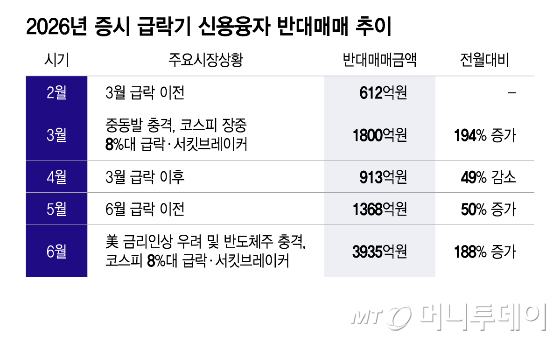
Forced selling of margin loans surged even during this year's stock market plunge. According to the office of People Power Party lawmaker Kim Sang-hoon, the executed amount of margin loan forced selling at 10 major securities firms in March last month, when the stock market was significantly shaken by Middle East-related shocks, was approximately 180 billion won, nearly triple that of the previous month (61.2 billion won). In June as well, the forced selling amount increased by 188% to 393.5 billion won from the previous month (136.8 billion won).
There have been cases in past market crashes where large-scale margin loan forced selling occurred. According to data from the Financial Supervisory Service, the margin loan forced selling amount at 10 major securities firms in August 2024 was 260.2 billion won, recording the largest monthly scale for that year. At the time, the KOSPI plunged by 8.8% and the KOSDAQ by 11.3% on August 5.
As such, the risk of forced selling that can materialize in a plunging market is difficult to resolve solely through the concentration management of margin loans by individual stock taking effect on the 19th. Since the measure aims to prevent risks from becoming more concentrated by restricting new margin loans supplied to specific stocks, collateral shortfalls or forced selling risks associated with previously accumulated margin loans must be managed separately.
It is also difficult to suppress forced selling itself. This is because if securities firms fail to recover loans even when the collateral value has dropped, their credit risk could increase. Conversely, it is analyzed that there are difficulties in risk management because if forced selling by multiple securities firms concentrates on specific stocks or at specific times, it can amplify market downward pressure.
Accordingly, it is pointed out that in situations where stock market volatility expands, not only the increasing trend of new margin loans but also the risks of collateral shortfalls and the possibility of forced selling for existing loans must be closely examined.
A financial investment industry official said, "It is necessary to check how much additional collateral demands are increasing due to plunging stock prices and whether there is a possibility that forced selling will concentrate at specific times or on specific stocks." The official added, "Investors also need to recognize that the new regulations do not protect existing loans and verify the collateral maintenance ratios, additional collateral deposit deadlines, and forced selling conditions applicable to them."

 in STOCK

